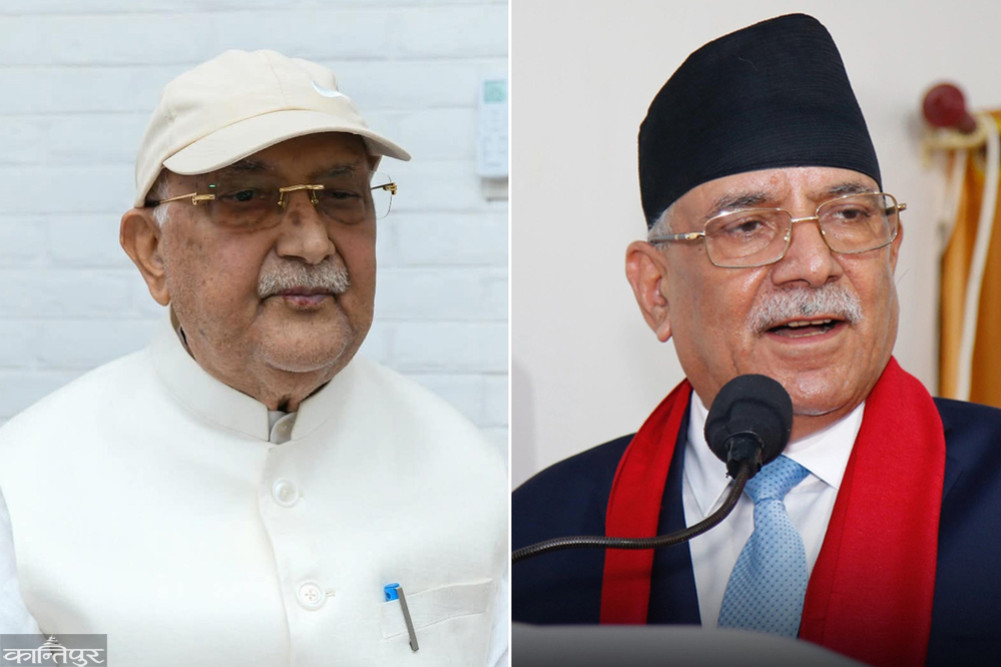
Former CPN-UML Senior Vice Chairman Ishwar Pokharel says: In the past, agreements reached without a serious review of unity and division do not appear to have a strong foundation. This is a collaboration centered on the interests of two leaders.
We use Google Cloud Translation Services. Google requires we provide the following disclaimer relating to use of this service:
This service may contain translations powered by Google. Google disclaims all warranties related to the translations, expressed or implied, including any warranties of accuracy, reliability, and any implied warranties of merchantability, fitness for a particular purpose, and noninfringement.
Voices of dissatisfaction have arisen within the party over the agreement between UML Chairman KP Sharma Oli and Nepal Communist Party (NCP) Coordinator Pushpa Kamal Dahal to cooperate in the provincial government. After Oli and Dahal reached an agreement on Saturday to cooperate in the provincial government without an informal decision in the party, expressions of discontent have begun to be heard within party ranks.
Although Oli had informal discussions with Vice Chairman Bishnu Poudel and General Secretary Shankar Pokharel about cooperating with the NCP, he had not made a formal decision in the committee. Oli and Dahal had held several rounds of talks for functional cooperation. On 14 Asar, at the 75th birth anniversary of Madan Bhandari, Oli, Dahal, Madhav Kumar Nepal, and Jhala Nath Khanal spoke from the same stage about the need for leftist cooperation.
Oli and Dahal agreed to resolve unhealthy competition, promote political stability, good governance, prosperity, and accelerate the pace of provincial development.
“Recently, the misunderstandings seen in the provincial assembly during budget formulation, the situation of lacking a budget, and problems such as unhealthy political competition will be resolved, and in accordance with the people's wishes, we, the two political parties—the Communist Party of Nepal (UML) and the Nepal Communist Party—have reached the following agreement to accelerate political stability, good governance, prosperity, and the pace of provincial development,” states the cooperation agreement signed by Oli and Dahal.
Even though there is an agreement on cooperation among the top leaders, there has been no formal discussion in the party, says UML Vice Chairman Gokarna Bista. “We only found out after the agreement with NCP Coordinator Pushpa Kamal Dahal. There has not been any discussion about this in the party,” he said.
UML leaders say the rationale for cooperating with the NCP must be justified. UML former senior vice chairman Ishwar Pokharel says that although there was a power-sharing partnership with the Maoists in 2074, 2079, and 2080, it broke down due to Oli and Dahal themselves, and that there is no strong basis for the current cooperation either. “In the past, agreements made without a serious review of unity and division do not appear to have a strong foundation,” he said. “This is a cooperation centered on the interests of two leaders.”
There is no political reason behind the latest cooperation between UML and NCP. The crisis faced by UML and NCP after the Gen-Z movement compelled Oli and Dahal to reach an agreement. “This agreement is not based on political debate and analysis,” said Pokharel. “How far will this go? How significant is its political objective? It is not clear.”
UML Secretary Bhanu Bhakta Dhakal said that Chairman Oli consulted senior leaders as needed and reached an agreement to cooperate with the NCP. “This agreement happened out of necessity,” he said. “Some decisions can also be made on the basis of informal discussions. That is what has happened now.”
UML Deputy General Secretary Yogesh Bhattarai described the agreement between Oli and Dahal as a “guerrilla” style. “Uproar in each party. The same guerrilla style. No participation. No transparency,” he wrote on social network X. “Questions upon questions about intent and process. The same mistake repeated again and again. Where is the accountability?”
The NCP Central Office Bearers’ meeting has also not made a decision on cooperating with UML. Dahal had assigned leaders Barshaman Pun and Pramesh Hamal to do the groundwork for cooperation with UML.
Dahal held informal discussions with Co-coordinator Madhav Kumar Nepal and other senior leaders and informed them about the agreement to form an alliance with UML in the provinces. Dahal said that cooperation with UML was necessary, citing that the leftist movement in Nepal was facing a crisis, the government was taking a path of retaliation, and the federal democratic system was being undermined.
Co-coordinator Nepal suggested that much consideration was needed before cooperating with Oli. One leader said that Nepal suspected Oli could break the cooperation at any time, even if he agreed now.
NCP leader Beduram Bhusal said that after discussions at the highest level of the party, a decision was made to cooperate with UML. “Cooperation with UML has started again. This is also a test for leftist cooperation,” he said.
Another senior NCP leader said that an agreement made without a serious review of the NCP split and without determining the future political path would not be sustainable. “An agreement made without a serious review of past splits and divisions is linked to power interests,” the leader said. “The current agreement between KP and Prachanda is also the same.”
Leaders have said that the cooperation between UML and NCP has begun with a focus on next year’s local and provincial assembly elections. However, in the general elections of 2074, there was an electoral alliance between UML and the then Maoists, and in Jestha 2075, the parties unified. Due to the leadership struggle between Oli and Dahal, the then NCP split in Falgun 2077. At that time, due to the lack of clear debate and procedures regarding politics, ideology, and leadership, chairmen Oli and Dahal ignored the nearly two-thirds public mandate.