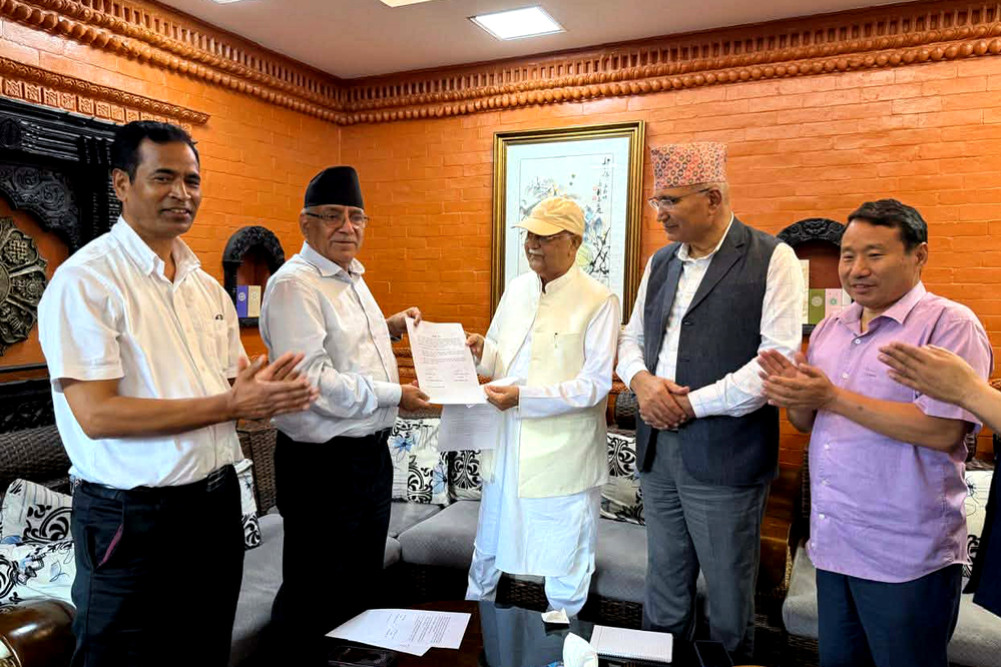
It has been agreed that the UML will lead the Koshi, Bagmati, and Lumbini provincial governments, while the CPN will lead Karnali and Sudurpaschim. It has been stated that the structure for Madhesh and Gandaki will be determined in consultation with other parties.
We use Google Cloud Translation Services. Google requires we provide the following disclaimer relating to use of this service:
This service may contain translations powered by Google. Google disclaims all warranties related to the translations, expressed or implied, including any warranties of accuracy, reliability, and any implied warranties of merchantability, fitness for a particular purpose, and noninfringement.
UML and the CPN have agreed to cooperate in the provincial assemblies and form a joint government. On Saturday, the two parties reached an agreement for the UML to lead the governments in Koshi, Bagmati, and Lumbini provinces, and for the CPN to lead in Karnali and Sudurpaschim provinces.
The agreement, signed by UML Chair KP Sharma Oli and CPN Coordinator Pushpa Kamal Dahal, states that the leadership and composition of the government in Madhesh and Gandaki provinces will be determined only after consulting with other political parties. In those provinces, the Congress currently leads the government. There, a government cannot be formed by UML and CPN alone.
Both parties have described their cooperation in the provincial governments as a means to maintain political stability. The agreement states that, in light of recent disagreements during budget formulation in the provincial assemblies, the situation of lacking a budget, and the problems caused by unhealthy political competition, both parties have decided to cooperate to resolve these issues and accelerate good governance, prosperity, and provincial development.
Recently, mistrust had grown between the Congress and UML over the budget brought by the Sudurpaschim provincial government. The Congress, which led the government, monopolized the budget process, and when coalition partner UML did not support it, the budget for the current fiscal year could not be passed. After that, Chief Minister Kamal Bahadur Shah dismissed the UML ministers.
With Saturday’s agreement, working unity among leftist forces in the provincial governments has moved forward, said CPN leader Narayan Kaji Shrestha. He said his party chose cooperation to prevent the dissolution of provincial governments. “We had proposed that the Congress and UML leaderships continue the government together. But they could not agree to work together. There was also talk of the three major parties joining, but the Congress was not ready,” Shrestha said. “That’s why the leftist parties had to come together.”
Shrestha said the Congress-led Madhesh provincial government could continue. Since Mangsir 2082, the Congress has led the Madhesh provincial government, with the CPN and other parties also participating. Asked whether the intention is to continue the current government in Madhesh, CPN leader Shrestha said, “There are indications that the Congress also wants to join in Madhesh. Therefore, the Congress-led government may continue. For that, we will hold further discussions with the Congress and other parties.”
Congress Vice President Bishwo Prakash Sharma said that while there was a proposal for UML, Congress, and CPN to form governments in all seven provinces, the Congress did not agree. He said that forming governments of the three major parties in all provinces, effectively making the provincial assemblies opposition-free, would be a one hundred percent mistake from the perspective of democratic practice.
He said that a meeting held at the party’s central office on Friday, attended by the Congress president, vice president, general secretary, four chief ministers, and provincial assembly speakers, had reached a clear and unanimous position on the matter. Sharma also said that the Congress had no negative comments regarding the agreement between UML and CPN. He remarked that the tendency of “power at any cost” is taking root in Nepali politics, and claimed that the Congress has sent a different political message against this trend.
Congress General Secretary Pradip Paudel also said that they do not want a three-party alliance. “Mr. Oli made the provincial government an issue to find a basis for joining with the CPN. He had been saying from the beginning that the CPN should also be brought into the provincial government,” he said. “But we did not agree, because if we go for a three-party alliance, the provinces will be left without an opposition, which is not good for democracy.”
General Secretary Paudel said that the Congress will now move forward according to its own plans. He said the party will not leave the Madhesh and Gandaki provincial governments as long as it has the numbers. “We will not go seeking support, and as long as we have the numbers, we will not leave the government,” he said. The Congress currently leads the governments in Bagmati and Sudurpaschim as well as in Madhesh and Gandaki.
UML leader Surya Thapa said the agreement in the provincial governments is not party unification but only working unity and electoral coordination for the upcoming elections. “This agreement does not mean party unification. It is only about working unity and electoral coordination,” he said.
Although UML and CPN have divided the leadership of five provinces, only in Koshi, Karnali, and Sudurpaschim do the two parties have a comfortable majority. In other provinces, they do not have the numbers to form a government without the support of other parties.
The most favorable situation for UML and CPN is in Koshi Province. Of the 93-member Koshi Provincial Assembly, there are currently 92 members. Forty-seven votes are needed to form a government. UML has 40 and CPN has 17 members, so they easily have a majority. Similarly, in the 53-member Sudurpaschim Provincial Assembly, there are currently 52 members. Twenty-seven members are needed to form a government. There, CPN has 22 and UML has 11 members, so the two parties are in a comfortable position to form a government.
In Karnali, UML and CPN can easily form a government together, but the latest equation there is a bit different. While there is an informal agreement between UML and CPN at the center, in Karnali, the Congress and CPN are cooperating. Members of both parties jointly filed a no-confidence motion against UML Chief Minister Yam Lal Kandel. Kandel resigned from his post on Saturday. In the 40-member Karnali Provincial Assembly, UML has 10 and CPN has 14 members.
The most difficult situation for the two parties is in Gandaki. With one seat vacant, there are currently 59 seats. UML has 22 and CPN has 7 seats (including the Speaker). Since the Speaker does not normally vote, their effective number for government formation is only 28. Thirty are needed to form a government. The Congress alone has 27 seats. There are two Rastriya Prajatantra Party (RPP) members in the Gandaki Provincial Assembly. That number is decisive for government formation. Another member was elected from the Nepal Socialist Party led by Baburam Bhattarai. Fanindra Devkota, elected from that party, had already joined the Congress government against party instructions. He is considered close to Chief Minister Surendra Pandey.
Because he went against party policy, he once lost his seat as a member of the assembly. The Supreme Court later reinstated his seat. In Gandaki, whichever side can win over the two-seat RPP will be able to form the government. If UML and CPN can secure RPP support, the alliance will be comfortable not only in Gandaki but also in Bagmati and Lumbini. Therefore, leaders of both parties are working to persuade the RPP.
RPP spokesperson Mohan Shrestha says the party has not made a policy to join the government. “It is not new for leaders to call and talk. But the party has not made a policy to join the government,” he said. A strong group within the RPP is firmly against joining the government under any circumstances. Since the party has been raising the issue of abolishing the provinces, they argue that joining the government would weaken their own agenda. “If we raise the issue of abolishing the provinces and then join the provincial government, it will weaken the issue we have been raising,” said one RPP leader.
Of the total 107-member Madhesh Provincial Assembly, there are currently 103 members (including the Speaker). Fifty-two seats are needed to form a government, but the combined number of UML and CPN is only 39. The largest party in the province, JSP Nepal, has 28 members. Since the Speaker is also from JSP Nepal, UML and CPN want to bring JSP Nepal on board. The Congress, which leads the government, has 22 seats in Madhesh.
In the 110-member Bagmati Province, there are currently only 104 members. Fifty-three members are needed to form a government. However, the combined number of UML and CPN is only 51. In Bagmati, RPP has 12 members. With RPP support, the combined number would reach 63. Bhuwan Kumar Pathak, who was Speaker from RPP, resigned citing the Jain–Ji movement. Since then, no new Speaker has been elected in Bagmati.
In the 87-member Lumbini Province, there are currently 83 members. Forty-two seats are needed to form a government. UML has 29 and CPN has 13 seats (including the Speaker) in Lumbini. With the Speaker included, they have just enough for a majority. However, since the Speaker’s vote is not counted in government formation, UML and CPN need one more seat. For that, they will need to win over one of RPP, JSP, Nepal, or Janamat Party.
000
Status of Parties in the Provinces
Koshi Province
Total seats 93, current 92
UML 40
Congress 29
CPN 17
RPP 5
JSP Nepal 1
Bagmati Province
Total seats 110, current 103
Congress 36
UML 25
CPN 26
RPP 12
NEMKIPA 3
Hamro Nepali 2
Madhesh Provincial Assembly
Total seats 107, current 103
JSP 28
UML 24
CPN 15
Congress 22
Janamat 12
Federal Socialist 1
RPP 1
Gandaki Provincial Assembly
Total seats 60, current 59
Congress 27
UML 22
CPN 7
RPP 2
Nespa 1
Lumbini Province
Total seats 87, current 83
UML 29
Congress 27
CPN 13
JSP Nepal 5
RPP 4
Janamat 3
Janamorcha 1
Independent 1
Karnali Province
Provincial Assembly total/current 40
Congress 15
UML 10
CPN 14
RPP 1
Sudurpaschim Provincial Assembly
Total seats 53, current 52
Congress 18
UML 11
CPN 22
RPP 1