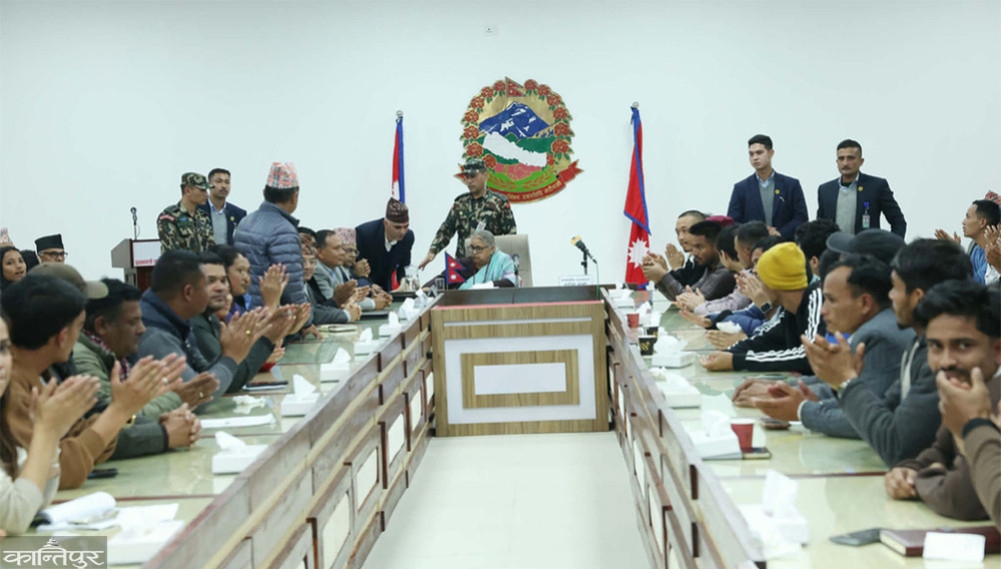
Leaders of the movement have expressed dissatisfaction, saying that the new government appears to be trying to implement the agreement, but is displaying a tendency to evade responsibility by not taking concrete and effective steps.
We use Google Cloud Translation Services. Google requires we provide the following disclaimer relating to use of this service:
This service may contain translations powered by Google. Google disclaims all warranties related to the translations, expressed or implied, including any warranties of accuracy, reliability, and any implied warranties of merchantability, fitness for a particular purpose, and noninfringement.
After the Gen-Z movement on Bhadra 23 and 24, the then interim government led by Sushila Karki signed a historic 10-point agreement with the protesters on Mangsir 24, 2082. It has been almost seven months since the agreement, and in the meantime, Balen Shah has already assumed the leadership of the government. However, the leaders of the Gen-Z movement have begun to express dissatisfaction, saying that the agreement has not been implemented even after the new government took office. They have also commented that the new government appears to be trying to implement the agreement but is displaying a 'tendency to evade responsibility' by not taking concrete and effective steps.
The agreement letter between the then government and the protestors stated that those who lost their lives during the movement would be declared martyrs with high honors, all medical treatment for the injured would be provided free of charge, relief would be provided to the victim's families, and education and employment would be guaranteed for their dependents. Additionally, the agreement included a commitment to conduct impartial judicial investigations into incidents of state repression and human rights violations during the movement and to take strict legal action against those found guilty.
The agreement prioritized ending policy-level corruption, ending politicization in public institutions, and investigating the assets of high-ranking officials. Similarly, the government committed to forming an independent recommendation commission to amend the constitution in order to improve the system of governance and further strengthen inclusivity. The agreement also included ensuring meaningful representation of the Gen-Z generation and marginalized and disadvantaged communities in every state mechanism. The government also guaranteed to make the decision-making process and state expenditures fully transparent and to publicly disclose them at the citizen level.
Not only that, but the government also agreed to arrange voting rights for Nepalis living abroad to make the electoral system clean and fair, and to implement a 'No Vote' provision in elections. Furthermore, the agreement emphasized practicing primary elections within political parties to strengthen internal democracy. Both sides agreed to ensure citizens' freedom of expression and digital rights, and to completely end government control and surveillance over the internet and digital communications.
Upon the arrival of the government led by Balen Shah, the implementation status of the 10-point agreement appears disappointing. According to a recent study report by Democracy Research Centre Nepal (DRCN) titled "Interim Government Decisions and Actions in Relation to the Gen Z–Government Agreement," while there has been progress in some superficial administrative tasks that were possible, long-term issues of policy, structural, and legal changes remain unresolved. The report points out that although the government has been active in immediate relief distribution and administrative decisions, it has failed to fulfill its commitments to political and systemic reforms.
According to the report, under partial implementation of the agreement, the government has declared 45 people who lost their lives during the movement as martyrs and provided compensation of 1.5 million rupees per family to 53 families. Separate 'Gen-Z Clinics' have been established in 16 major hospitals across the country for the free and easy treatment of the injured. While this is considered a positive step by the government, the essence of the movement was not limited to this alone.
The leaders of the Gen-Z movement have accused the government of deliberately procrastinating on the implementation of the agreement. Movement leader Monika Niroula said the government was displaying 'superficiality' in the name of implementing the agreement. "It appears that some agreements are being implemented, but it is difficult to distinguish whether the government is taking this work seriously or just trying to evade responsibility. The actions are not effective at all," Niroula told Kantipur.
Questioning the government's intentions, she added, "We had envisioned the role of the Gen-Z Council as a strong mechanism to advise and monitor on issues of good governance and youth. But now the government responds with an arrogant attitude, saying, 'We have all the experts, there is no need to consult anyone.'" Niroula also expressed dissatisfaction with the current parliamentary structure and the process of constitutional amendment. "More than 80 percent of this parliament is represented only by Khas-Arya, and regional and marginalized parties are excluded. In such a situation, raising the issue of constitutional amendment without a transparent process and without the ownership and participation of all groups seems inappropriate and dangerous," she said.
Highlighting the miserable condition of the injured from the movement, Niroula drew the government's attention. "Those with access to power and authority are reaping personal benefits. But injured friends without access are suffering so much mentally that they ask, 'Will the government only listen to us if we self-immolate?' There has been no work centered on the victims for the long-term management of their education, health, and employment," she vented her frustration. "We wrote in the agreement about making constitutional commissions independent, but the government is moving in the opposite direction. The government does not seem to have paid much attention to many points of the agreement, and the whole process is extremely suspicious and non-transparent. Our experience is that the new draft amendment of the Youth Council is also reducing citizen participation. The process of collecting suggestions also appears to be merely 'consent manufacture' (making it look like an agreement has been reached)."
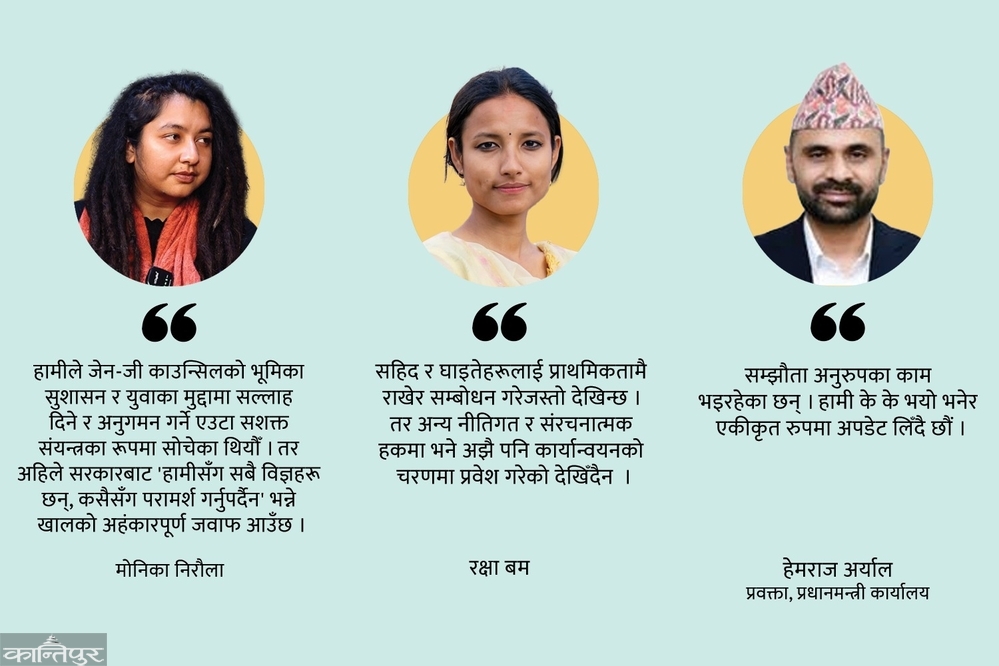
Another movement leader and signatory to the agreement, Raksha Bam, shares a similar understanding as Niroula. She says that although some points of the agreement appear to have been implemented, a closer look reveals that the government is merely trying to evade responsibility. "It appears that martyrs and the injured have been addressed as a priority. But in terms of other policy and structural rights, implementation has not yet begun," Bam said.
She accused the government of trying to advance the agenda of constitutional amendment in the wrong way. "Our agreement was that the constitution should be amended, but the current process is not in line with the agreement. Our main condition was that the basic values of democracy should not be tampered with and that all sectors, communities, and classes should be consulted. But the government did not follow that. On the contrary, it seems intent on attacking the very basic values," she said.
Bam said that instead of strictly adhering to the agreement, the government is only pretending to have done so. She objected that the arrest of youths continues simply because they participated in the movement. "Other things outside the agreement are also happening. It appears as if implementation is taking place, but it looks like an attempt to evade responsibility. How can youths be arrested just for participating in a peaceful movement? This is a blatant violation of the agreement," Bam questioned.
Agreement signatory Rijan Ranamagar also said the government appears reluctant regarding the aspect of truth and reconciliation. "The government has shown no will to adopt truth and reconciliation for those facing charges simply because they participated in the movement," he told Kantipur. "There is still a situation where some injured are considered heroes, while others are treated as criminals. Movement leaders are in power, but the warriors who fought without regard for their lives are forced to sit in the dock."
Magar argued that the government seems confused about how to implement the agreements. "The government has 'owned' the issues of the agreement, but there is a problem with how to execute them. That is why the implementation status is only about five out of ten," he said. "The right foot has already moved forward, but the government is confused about where to move the left foot next."
Meanwhile, the Prime Minister's Office has stated that work is being carried out as per the agreement. According to Hemraj Aryal, spokesperson for the Prime Minister's Office, work is ongoing in line with the agreement. "Work is underway. We are taking integrated updates on what has been done," Aryal said.