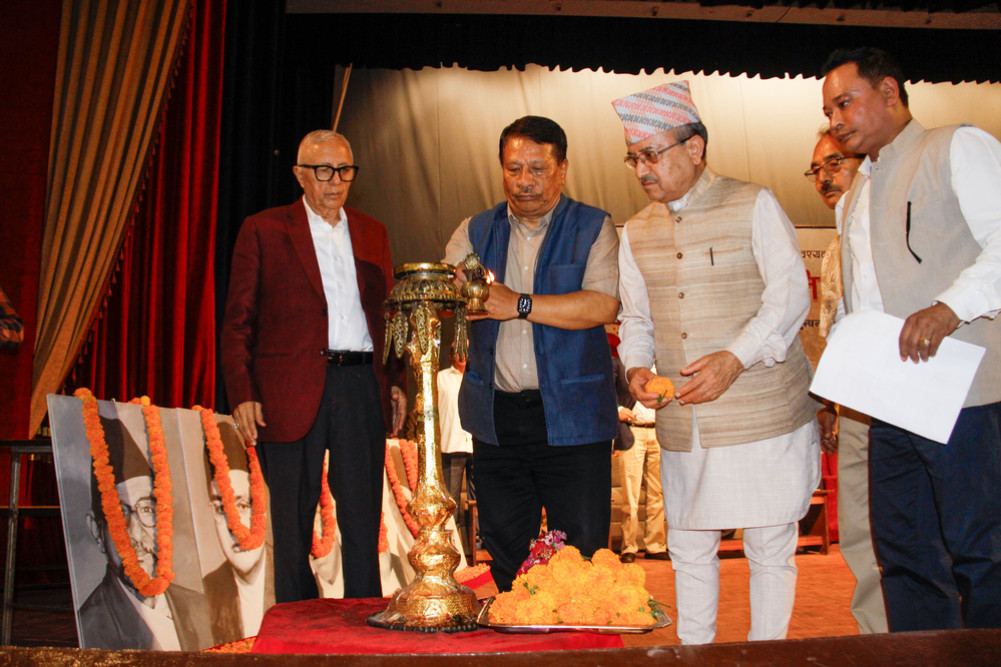
While the dissatisfied faction held a program at the Nepal Academy in Kamaladi on Wednesday, the establishment faction organized a 'Green Run' to raise public awareness about climate change.
We use Google Cloud Translation Services. Google requires we provide the following disclaimer relating to use of this service:
This service may contain translations powered by Google. Google disclaims all warranties related to the translations, expressed or implied, including any warranties of accuracy, reliability, and any implied warranties of merchantability, fitness for a particular purpose, and noninfringement.
On 2 Falgun 2003 BS, the Nepali National Congress was established with Tanka Prasad Acharya as Honorary President and BP Koirala as Executive President. On 17 Poush 2005 BS, with the active involvement of Subarna Shamsher, the Prajatantra Congress was formed under the chairmanship of Mahendra Bikram Shah. These two parties merged on 27 Poush 2006 BS to become the Nepali Congress. BP was one of the leaders who brought the two parties together.
6 Saun is BP Memorial Day. On Wednesday, the 44th Memorial Day, however, the Congress establishment and the dissatisfied faction held separate programs for the memorial day, sending a message of division rather than unity. At the event organized by the dissatisfied faction at the Nepal Academy in Kamaladi, leaders even declared that if unity was not achieved soon, they would form a separate party. They also announced that a national gathering would be called in Kathmandu on 29 Saun from the Academy itself to determine the way forward.
Meanwhile, the establishment faction led by President Gagan Thapa has scheduled a two-day program for BP Memorial Day. On Wednesday, the establishment faction organized a ‘Green Run’ to raise public awareness about climate change, and on Thursday, it will hold a special program focused on BP Koirala’s ideas, democratic socialism, and contemporary political challenges. The internal power struggle that began after the special general convention has not been resolved even after six months. As the dispute intensifies, leaders from the groups of former president Sher Bahadur Deuba and former acting president Purna Bahadur Khadka are moving forward with preparations to form a separate party.
Previously, Shekhar Koirala had not participated in Deuba faction programs, but he was present at Wednesday’s event. Congress leaders have viewed this as significant. Except for former Koshi Province Chief Minister Kedar Karki, no other close associates of Koirala were present. The event was also attended by former acting president Purna Bahadur Khadka, former office bearers Prakash Man Singh, Krishna Prasad Sitaula, Bimalendra Nidhi, Shashank Koirala, Vijay Kumar Gachhadar, Prakash Sharan Mahat, and other leaders.
According to leader Badri Pandey, Shekhar Koirala had informed group leaders that he would attend the program. “Shekhar dai said he would go. Once he said he would go, we had no reason to stop him. But we did not go,” he said. “We have been saying that unity should be maintained so that those who attended and those who did not attend the special general convention can meet at the 15th general convention. The key question for leaders seeking a role is whether to lead the party to division or unity.”

At Wednesday’s event, Koirala commented on party president Thapa’s working style. He mentioned that the party had started to operate in an authoritarian manner and recalled that the Congress was born to end autocracy. “Autocracy is emerging within the Congress itself, and we are having to end it,” he said. Leaders from the dissatisfied faction said that if there is no agreement on party unity before the national gathering, they will decide their future political course, which could include forming a new party. “We have already held gatherings in all seven provinces; after the national gathering, we will take our own path,” said leader Prakash Man Singh, who chaired the program.
The central working committee formed after the special general convention does not include the groups of Deuba, Khadka, or leader Shekhar Koirala. Some leaders who were previously in the Deuba and Koirala groups have been nominated to the central working committee. Koirala himself, however, had maintained that he would not join the central working committee or attend gatherings of the Deuba-Khadka faction until full party unity was achieved.
The main issue at the center of the current dispute is whether to collectively integrate the office bearers and members elected from the 14th general convention into the central working committee led by Gagan Thapa. The establishment faction is not in favor of collective integration, arguing that integrating the office bearers and members of the old working committee all at once could lead to the creation of separate power centers in the future based on the same numbers, institutionalize factional politics, and even create legal pressure for party division.
Deputy General Secretary Prakash Rasaili Sneh said that collective integration would not happen under any circumstances. “A separate party has not been formed yet. The party president, vice president, and other office bearers have made many efforts for unity within the rules and statutes. But the issue of integrating the 14th general convention is what has prevented agreement,” he said. “Integration is a regressive step.”
Leader Khadka, who leads the Deuba faction, said that he is talking about integration not for himself but only for honorable unity. “None of us will remain inactive; we are ready to put forward the youth and be their shield,” he said. “We want nothing. Do not be mistaken about this. We fought even in the Panchayat for honor. We are ready to die, but we cannot compromise on honor.”
The establishment faction has also linked the current debate to the experience of party unity between the Congress and Nepali Congress (Democratic) in 2064 BS. They conclude that the 60–40 power-sharing model adopted at that time institutionalized a culture of division within the Congress. They argue that if unity is again achieved in the same manner, group-based division will not end and the new political practices proposed by the special general convention will be weakened.
President Thapa also concludes that if the old structure and political legacy are carried over unchanged into the new working committee, the party will not be able to send a new message. Some office bearers who came from the special general convention are also concerned that if all office bearers and members from the 14th general convention are integrated, their own political future will be at risk in the upcoming general convention.
Meanwhile, the Deuba-Khadka faction believes that collective integration would preserve their political relevance. They conclude that if integration is done individually, the group will become weaker and their political standing within the party will shrink. Leader Prakash Sharan Mahat said that if the establishment faction is not ready for either collective integration of the 14th and special general conventions or for creating an empowered mechanism to make the general convention impartial and independent, the upcoming national gathering will chart its own course.
Former president Deuba is currently abroad. On Wednesday, he issued a statement saying he would return to Nepal soon. According to a Deuba faction leader, preparations are being made to bring Deuba back to the country on the occasion of the national gathering on 29 Saun. Leaders close to Deuba say that the current political activities are also taking place in consultation with him.
If agreement is not reached before 29 Saun, the question of under whose leadership the new political campaign will move forward remains unresolved.
Many leaders within the Deuba group believe that if they move forward under the leadership of Shekhar Koirala, it will be easier to build a new political force. However, Koirala and Khadka have been telling their close leaders that they are not in favor of splitting the party.
Pandey, a leader close to Koirala, said they have no information about taking the leadership of a new party. “Yesterday, we did not attend the special general convention because we feared the party might split. Just as we did not go yesterday, even though Shekhar dai went to Wednesday’s program, we did not go. We were concerned that we might also become companions in a split,” he said. “People like us, on a sacred day like BP Memorial Day, belonged neither here nor there. Sanepa (the establishment) could not create an environment for us to go, and we could not go to the Deuba side either.”
If Koirala is not ready, the name of former general secretary Shashank Koirala is also being discussed as an alternative leader. Some leaders believe that since he is the son of BP Koirala, his leadership could influence the Congress’s traditional voters. Similarly, Bimalendra Nidhi, Prakash Man Singh, and Krishna Prasad Sitaula have also shown interest in leadership.
Amidst this dispute, party president Thapa has been accused of not wanting to unite the party. Especially leaders from the Deuba faction have accused president Thapa of not moving discussions forward seriously.
Congress analyst Puranjan Acharya says the establishment faction should take the main initiative for party unity. He says that if the establishment does not take the initiative, the party could split. “On BP Memorial Day, instead of sending a message of party unity, holding separate programs and sending a message of division is unfortunate for both the party and the country,” he said.
Acharya says that those who bear responsibility should take the initiative for unity. “The establishment faction has a great responsibility to protect the existing Congress and also to produce a new Congress,” he said. “The party was built by BP with great hardship. If there is this awareness, Congress cannot be led toward division. If there is no awareness, it will rejoice at the prospect of division.” Acharya commented that the leadership missed the opportunity to transform the ongoing dispute into unity on BP Memorial Day itself.
Another analyst, Geja Sharma Wagle, says that although BP emphasized party unity, democratic values, and the politics of ideas throughout his life, the Congress’s inability to stand on a single platform even on his memorial day has sent a message of division both politically and psychologically. “Now is the time for self-reflection, self-examination, and self-criticism. But one group does not seem to have internalized this reality,” he said. “What is needed now is to broadly reorganize, transform, and purify to build a new Congress. The new Congress cannot be built with classical thinking and classical tendencies.” He argues that the issues of factional division and leader management, as sought by the dissatisfied faction, will not create a new party.