The deadline for applications was set for June 20. More than 4,400 applications were received during that period.
We use Google Cloud Translation Services. Google requires we provide the following disclaimer relating to use of this service:
This service may contain translations powered by Google. Google disclaims all warranties related to the translations, expressed or implied, including any warranties of accuracy, reliability, and any implied warranties of merchantability, fitness for a particular purpose, and noninfringement.
The process of appointing new ambassadors has reached its final stage. As part of the selection process that began about a month and a half ago, Foreign Minister Shishir Khanal is preparing to recommend some names by next week.
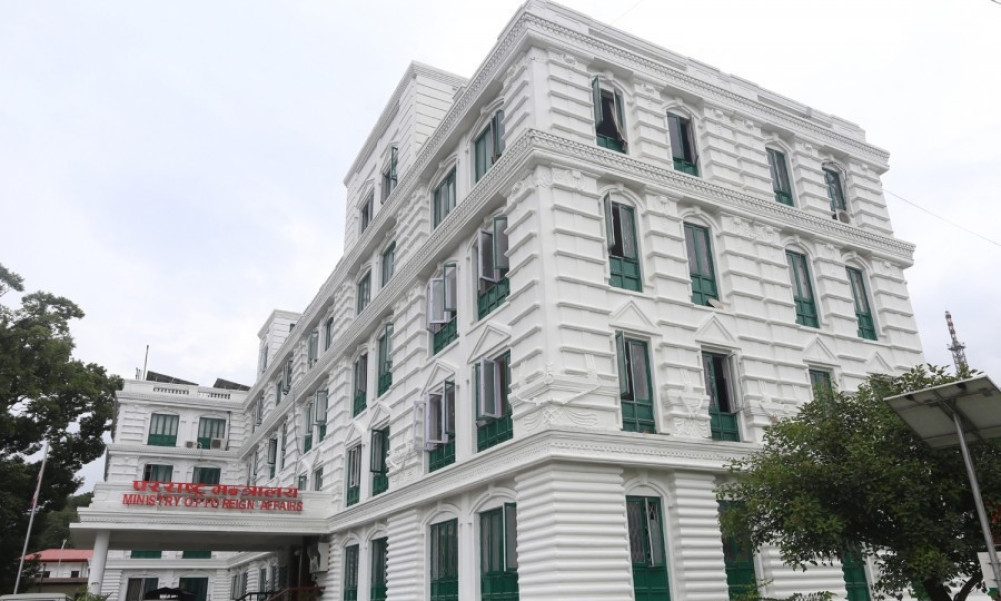
The Ministry of Foreign Affairs had called for open applications on June 28 for the vacant ambassadorial posts of 13 countries, including India, China, the US, the UK and Australia. The deadline for applications was set for June 20. More than 4,400 applications were received during that period.
After removing duplicate and incomplete applications, about 2,700 applications were selected. After that, a few hundred applications were put on the final list and sent to the Secretariat of the Foreign Minister.
'The selection process was very challenging. A single person had submitted up to 94 applications through email and post,' said an official involved in the selection process. According to him, Foreign Minister Khanal is studying the CVs of potential candidates and is expected to recommend some ambassadorial appointments by next week.
The final decision on the appointment of the ambassador is said to be made after discussions between Prime Minister Balendra Shah, Rastriya Swatantra Party President Ravi Lamichhane, Finance Minister Swarnim Wagle, Foreign Minister Shishir Khanal and other top leaders of the ruling party.
'But our party is clear that the responsibility for appointing the ambassador lies with the government and the Foreign Minister,' said a Rastriya Swatantra Party leader.
While the government is moving forward with the selection process, potential candidates have started intensive lobbying in the ruling party and various power centers. But an RSVP official has claimed that such lobbying will not have any impact on the appointment.
'A qualified person should get an opportunity based on qualifications and capabilities,' he said.
Some Nepali diplomatic missions have been without ambassadors since Asoj last year. On Asoj 30, the Sushila Karki-led government recalled the ambassadors of China, Germany, Israel, Malaysia, Qatar, Russia, Saudi Arabia, Spain, the US, the UK and Japan.
The current government then recalled Shankar Prasad Sharma of India, Chitralekha Yadav of Australia, Purna Bahadur Nepali of Sri Lanka, Shivamaya Tumbahangphe of South Korea, Sumnima Tuladhar of Denmark and Kapil Shrestha of South Africa on April 20.
'Despite the government having a strong political mandate, there has not been the expected interest in appointing ambassadors,' said a Nepali diplomat.
Currently, most Nepali missions are being run by charge d'affaires.
According to Naresh Bikram Dhakal, former Nepali ambassador to Saudi Arabia and Qatar, in the absence of a permanent ambassador, the embassy cannot play an effective diplomatic role other than regular administrative work.
'If the government wants to strengthen political dialogue and bilateral relations, the appointment of ambassadors should not be delayed further,' he said.
If the appointment process is prolonged further, officials say that more missions will be without ambassadors, as the terms of seven additional ambassadors will also expire by mid-July.
According to a joint secretary at the Ministry of Foreign Affairs, the process has been delayed due to the high number of applications and the government's confusion over which embassies to close.
'It was not clear which missions would be closed until the budget was made public. Now that confusion has been cleared,' he said.
Through the budget for the current fiscal year, Finance Minister Swarnim Wagle had announced the closure of Nepali embassies in Denmark, Brazil and South Africa and the closure of the Consulate General of the United States in San Francisco, the Consulate General in Chengdu, China, and the Embassy branch in Visakhapatnam, India.
Due to this, the Ministry of Foreign Affairs had to rearrange the appointment plan, which also caused the delay, officials say.
Nepal has long had the practice of distributing ambassadorial appointments among political appointments and career diplomats in the Foreign Service.
This time, the ministry had invited applications through open competition for countries and international organizations including India, China, the United States, the United Kingdom, Australia, Israel, South Korea, Austria, Bahrain, Bangladesh, Malaysia, Oman, and Saudi Arabia.
According to an official at the Ministry of Foreign Affairs, discussions are also underway to continue some ambassadors whose terms expire after the upcoming Bhadra. Similarly, the issue of whether or not to recommend immediately for the other seven missions that will be vacant after that has not yet been finalized.
Ministry of Foreign Affairs Spokesperson Lok Bahadur Poudel Chhetri said that the selection process is ongoing and that the recommendation will be made public once the process is completed.