Gagan's seven proposals for constitutional amendment
We use Google Cloud Translation Services. Google requires we provide the following disclaimer relating to use of this service:
This service may contain translations powered by Google. Google disclaims all warranties related to the translations, expressed or implied, including any warranties of accuracy, reliability, and any implied warranties of merchantability, fitness for a particular purpose, and noninfringement.
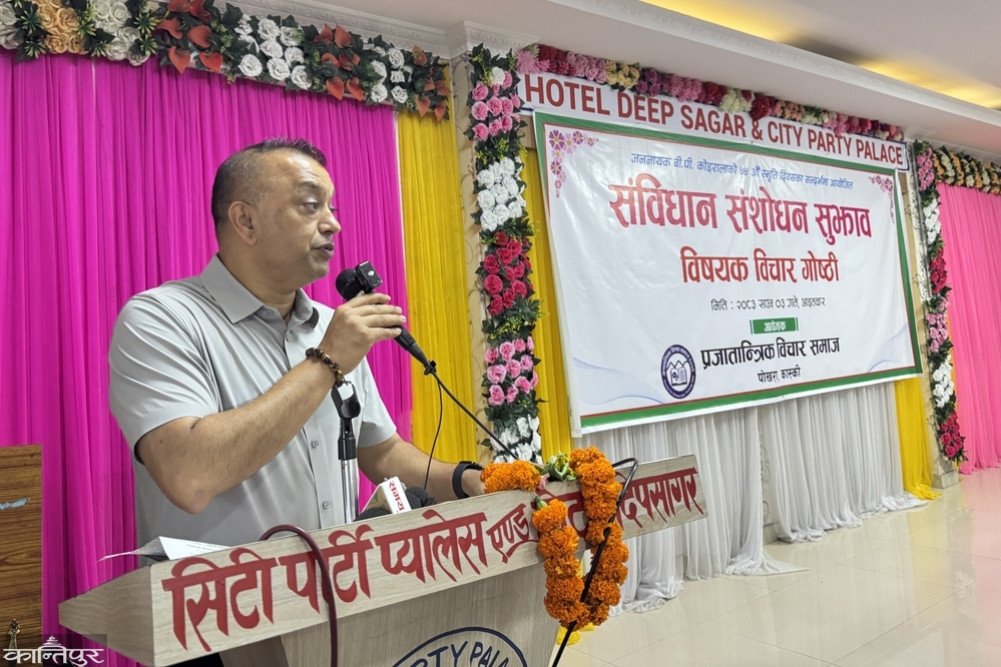
Nepal Congress President Gagan Thapa has said that the current government has not paid attention to the accidents that can occur when the constitution is amended without understanding the difference between the Constituent Assembly and the Parliament. Speaking at a seminar on ‘Context and Challenges of Constitutional Amendment, Suggestions for Constitutional Amendment’ organized by the Democratic Thought Society Kaski in Pokhara on Sunday, he said that it is necessary to understand the difference between constitutional power and legislative power.
‘The Constituent Assembly and the Parliament are not the same, even now this Parliament can amend the Constitution. But the Constituent Assembly has constitutional power, it has the ability to write the Constitution. Since the Constituent Assembly has constitutional power, it had the freedom to keep which features of the Constitution, which the current Parliament does not have,’ he said, ‘The power that the current Parliament has is legislative power. That is the limit of legislative power. I have two-thirds, so the approach of thinking that I will do this and that in this Constitution causes accidents.’
He said that the current number of votes received by the Rashtriya Swayamsevak Sangh (RSS) is two-thirds to form a government, and the current government has not paid attention to the possibility of an accident because it does not understand the difference between legislative power and constitutional power.
He said that the constitutional amendment should not be seen as a matter of power consolidation but as an opportunity to strengthen democracy in the long term. He proposed that reforms in seven major areas are needed for the constitutional amendment, and that the direct electoral system, restructuring of federalism, independent authority for good governance, effective implementation of fundamental rights, ending the division of power in constitutional appointments, making the provincial government economical, and protecting the democratic system should be the primary agenda of the amendment.
He said that the constitution should be understood as a living process that is amended according to the needs of the time rather than a static document. ‘The constitution is not only a living document, but also a living process. It should be amended in a timely manner so that the trust of the citizens increases,’ he said.
He claimed that the current mixed electoral system has become a major cause of political instability. He said that although the objective of proportional representation is positive, its implementation has prioritized the choices of the top leaders of the party. He proposed that inclusiveness can be ensured through constituency reservation while making the House of Representatives fully directly elected. ‘We need representation in parliament, but it should not come from the pockets of the leaders, but from the people’s votes,’ he said. ‘We can only make the constituency reserved and have competition between Dalits and women.’
His other proposal was to reduce the size of the provincial government to make the federal structure effective. Stating that having too many ministries in the provinces has increased expenses and created discontent among the citizens towards federalism, he said that 16-17 ministries at the center and a maximum of eight ministries in the provinces would be sufficient. Since the essence of federalism is decentralization of power, the union should transfer power to the provinces and the provinces to the local level.
Thapa said that the Commission for the Investigation of Abuse of Authority should be made completely independent from political influence for good governance. He said that the practice of party-based participation in appointments through the Constitutional Council should be ended and responsibility should be given to independent and impartial persons. ‘The authority should be so powerful that it can investigate even the Prime Minister,’ he said. ‘When a person who follows the party’s orders reaches the authority, the corruption file is not opened, it is closed.’
He also said that a more clear constitutional provision is needed for the implementation of fundamental rights such as the right to housing and land rights of Dalits mentioned in the constitution. He said that the state should not back down from its constitutional obligation to provide land to squatters and poor Dalits once and for all.
He clarified that the objective of the Congress in standing in favor of the constitution amendment is not to weaken federalism but to make it more effective and citizen-oriented. Recalling that the Congress had committed to strengthening federalism and reforming the governance system in its election manifesto, he said that the amendment was necessary to implement it.
Warning that any kind of interference in the democratic system would not be acceptable, Thapa said that the Congress was ready to fight both in the House and on the streets to protect the constitution. ‘The Nepali Congress does not accept that democracy will be turned upside down,’ he said. ‘Wherever it has to be fought, be it in the House or on the streets, the Congress has that capacity. We will not let the constitution fall into an accident.’
Stating that his party’s approach towards the government is free from prejudice, he made it clear that although the party running the government has the right to act according to the mandate, it will not allow any play on democratic values, rule of law and constitutional system.
He urged all parties to focus on building political stability, effective federalism and accountable governance system, stating that the constitutional amendment should be seen as an opportunity to rise above party interests and restore the trust of the citizens.