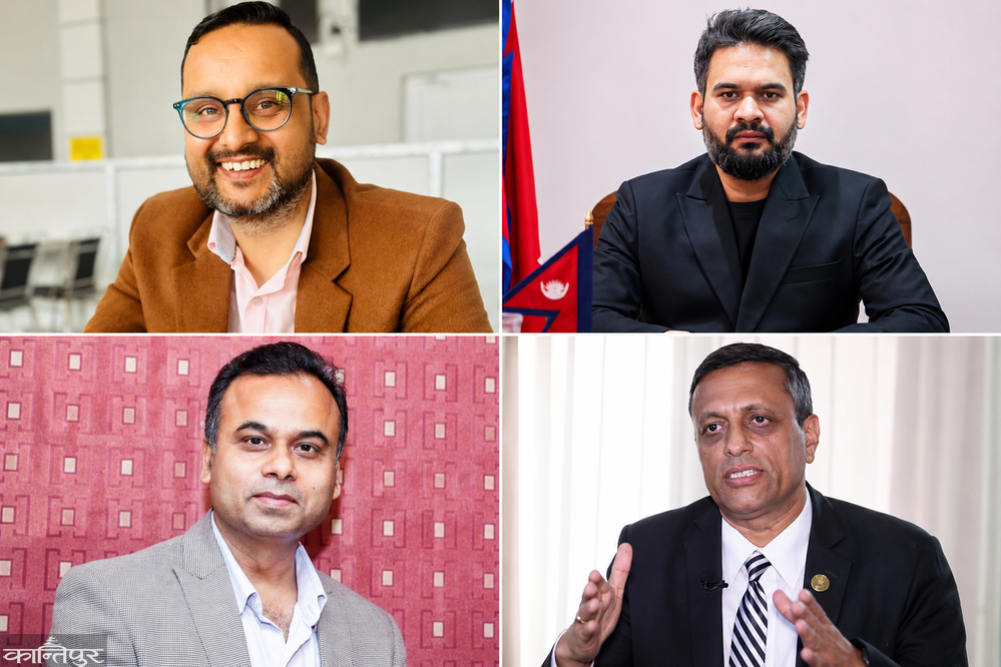
Constitutional scholars have commented that the task force that prepared the discussion paper missed a unique opportunity to make the constitutional amendment a common document.
We use Google Cloud Translation Services. Google requires we provide the following disclaimer relating to use of this service:
This service may contain translations powered by Google. Google disclaims all warranties related to the translations, expressed or implied, including any warranties of accuracy, reliability, and any implied warranties of merchantability, fitness for a particular purpose, and noninfringement.
The ‘Constitutional Amendment Drafting Task Force’ has submitted a report to the government with suggestions for amendments to 245 articles. The report suggests amendments to about 80 percent of the 308 articles of the constitution. Constitutional law experts have commented that the government-formed task force has proposed so many amendments to the articles, and that the constitution itself is being rewritten.
The task force, formed under the leadership of Prime Minister Balendra Shah’s political advisor Asim Shah, has said that the report was prepared by incorporating the suggestions received in discussions with stakeholders and experts. The task force’s report states that amendments have been made to all articles except for Article 274(1) of the Constitution, which provides for the sovereignty, territorial integrity, independence and sovereignty vested in the people of Nepal. The task force submitted its report on Thursday.
Constitutional experts and political party leaders have commented that even though the task force submitted its report, it has missed an unprecedented opportunity to make the constitution amendment a common document. The Council of Ministers had formed a task force on 16 Chaitra with representation from all the parties in parliament. However, the Congress did not send a representative to the task force, and the representatives designated by the UML did not attend the meeting.
On 22 Ashad, representatives from the NCP, LOSPA, JSP Nepal and Rastriya Janamorcha left the task force. Constitutional law experts say that there is uncertainty about how the constitution amendment process will proceed now that the task force, which only included representatives from the ruling Rashtriya Swayamsevak Sangh (RSS), Shram Sanskriti Party (SSP) and RPP, has finalized the report.
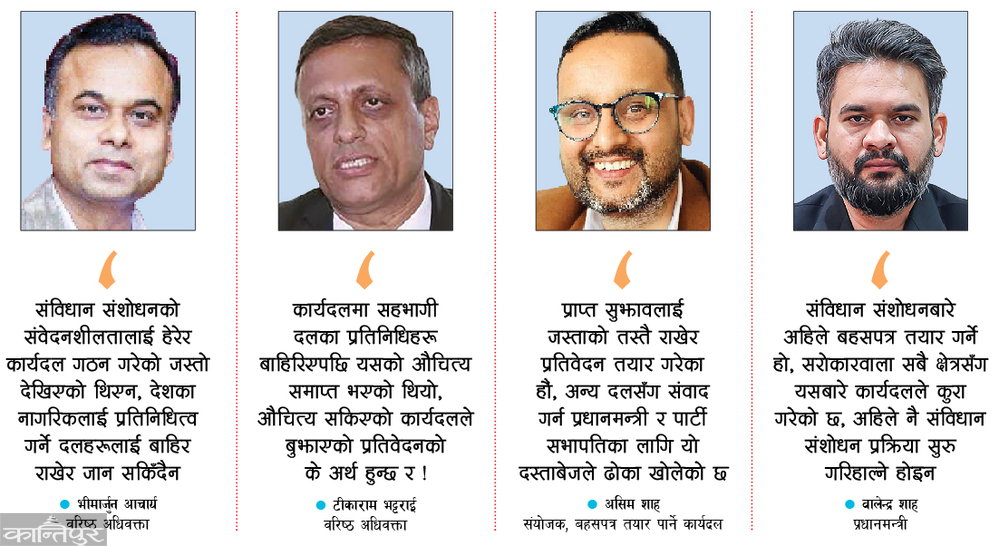
‘First of all, it was controversial from the beginning. After the representatives of the parties participating in the task force left, its justification ended,’ said senior advocate Tikaram Bhattarai. ‘What is the meaning of the report submitted by the task force when its justification has already ended!’ He commented that the task force had missed the opportunity to make the constitutional amendment a matter of national consensus.
Provisions for constitutional amendment are made in Article 274 of the Constitution. According to Article 274(2) of the Constitution, a bill to amend or repeal any article of the Constitution may be registered in the House of Representatives or the National Assembly of the Federal Parliament. The bill must be published publicly for public information within 30 days of registration.
Constitutional scholars comment that the task force preparing the discussion paper has missed an unprecedented opportunity to make the constitutional amendment a common document If the amendment relates to the boundaries, name or rights of a province, it must be sent to the relevant provincial assembly for opinion. The constitutional amendment bill must be passed by a majority of at least two-thirds of the total number of members then in both houses of the Federal Parliament. The ruling Rashtriya Swayamsevak Sangh (RSS) has about two-thirds of the seats in the House of Representatives but no representation in the National Assembly. Amendment of the Constitution is not possible unless political parties stand together.
The report of the task force preparing the discussion paper mentions that there have been suggestions for amendments to the articles related to fundamental rights and duties, provisions related to citizenship, directive principles of the state, policies and responsibilities, form of governance, provisions related to the president, vice president, federal executive (Prime Minister, Council of Ministers), federal legislature (House of Representatives and National Assembly). Similarly, suggestions have also been made to the articles related to the judiciary (Supreme, High and District Courts), Judicial Council, Judicial Service Commission, provisions related to constitutional bodies, local levels, constitutional bodies and the Constitutional Council.
The task force has sought written suggestions from more than 150 bodies, including constitutional bodies, and has prepared the report based on 44,613 suggestions received from the general public via email and WhatsApp. According to the task force, suggestions received via telephone and electronic means have also been included. According to coordinator Shah, the five-hundred-page report also suggests reducing the number of local and provincial-level public representatives. He informed that there should be a directly elected executive president and the abolition of federalism. “Some suggestions are for amending the constitution, while others are sufficient even if the laws are amended,” Shah said. “When classifying those suggestions, it is seen that 20 groups will be formed.”
The report also includes the views of political parties and the views of the members of the task force. Task force coordinator Shah said that the task force has not decided on any views and only the suggestions received have been included in the report. “We have not decided on any views. We are not going to form views,” he said. “We have kept the suggestions given by the leaders of political parties, legal experts, former judges and those with whom we had discussions as they were.”
Coordinator Shah informed that they have also suggested that the government should do more work based on this report. He said that the Prime Minister should make the report public soon and start the process of amending the constitution as per the constitution.
He expressed confidence that the government would preserve the report in its archives and create an environment for taking further suggestions from the citizens. ‘We have suggested in the report that the government can proceed with the constitution amendment process by forming another constitution amendment commission or committee after reaching an agreement among all the political parties represented in the parliament,’ Shah said. ‘As per the advice of the Council of Ministers, we have only completed the work of preparing the discussion paper.’
Shah said that no one should be suspicious about the report. He said that the suspicion that it would attack the constitution was baseless. Stating that this report would serve as a reference material after the constitution amendment commission was formed, he opined that Prime Minister Shah and Rashtriya Swayamsevak Sangh President Ravi Lamichhane should now consult with political parties. ‘This document has opened the door for the Prime Minister and the party president to hold talks with other political parties on the constitution amendment,’ said task force coordinator Shah.
The task force included Mohanlal Acharya from Rashtriya Swayamsevak Sangh, Bhishma Raj Adhikari from UML, Dev Prasad Gurung from NCP, Dhruvraj Rai from Shram Sanskriti Party and Gyan Bahadur Shahi from RPP. Similarly, Laxman Lal Karna from LSP, Surendra Jha from JSP and Manoj Bhatta from Janamorcha were members of the task force. Law Secretary Pushkar Sapkota from the Office of the Prime Minister and Council of Ministers and Secretary of the Law Commission Indira Dahal were also members of the task force. UML officials did not participate in any meeting/discussion. Karna, Jha and Bhatta left the task force at the last minute, expressing disagreement on 6 points.
The task force had decided on 54 issues as the basis for discussion in the first phase after consulting various parties. Then, the task force prepared the report after discussing with former judges, legal experts, former attorney generals, former presidents and other stakeholders. The task force suggested to the government to include all political parties in the discussion paper by taking the task force's report as a general reference material
When leaders including RPP Chairman Rajendra Lingden met Prime Minister Shah on Thursday, they said that issues such as the abolition of monarchy, Hindu nation, federalism and others should also be included in the constitution amendment debate paper. During that time, Prime Minister Shah did not immediately start the constitutional amendment process, but responded that the task force worked only to prepare the basis for debate, said RPP Chairman Lingden.
Constitutional law experts have commented that the report prepared by the Shah-led task force appears to be more oriented towards rewriting than amendment. Stating that constitutional amendment itself is a challenging task, they have said that its acceptability has decreased after parties withdrew from the task force at the last moment. However, they say that this report can become the basis for constitutional amendment in the coming days and the government can move forward accordingly.
Senior Advocate Bhattarai argued that the task force has pushed the issue of constitutional amendment further into confusion. ‘Constitutional amendment should have been a matter of national consensus. The task force missed that opportunity,’ he said. ‘It depends on how the government moves forward in the coming days.’
Senior Advocate Bhimarjun Acharya said that there should be as much common ownership as possible in constitutional amendment. ‘If there is no common ownership, majority ownership is needed,’ he said, ‘the task force had the opportunity to create this. The way the task force was formed did not seem to be done considering the sensitivity of the constitutional amendment.’
He said that the government should take the constitutional amendment seriously and take steps to include all parties and stakeholders. ‘All parties represented in the federal parliament are its main stakeholders. The constitutional amendment process cannot move forward by keeping them out,’ he said, ‘The way the parties left the task force has lost an unprecedented opportunity. The task force report can be taken as a general reference material and moved forward by including all parties. Otherwise, there is a danger that tomorrow this constitution will not exist and there will be no other in hand.’
The Congress and the UML have been holding similar views on most issues of constitutional amendment. They are unanimous on the basic issues of the constitution, a federal democratic republic, a prime minister elected by parliament and a mixed electoral system. The NCP, JSP Nepal and the Janamat Party are in favor of a directly elected head of state and a fully proportional electoral system.
All the old parties are in agreement on the issues of a federal democratic republic, secularism, inclusiveness and social justice. The parties involved in the drafting of the 2072 constitution are in favor of amending it while maintaining the basic principles of the constitution, including the federal democratic republic.
The Congress, UML and other parties have been objecting, saying that the government task force has gone beyond its jurisdiction and is oriented towards rewriting the constitution rather than amending it, and that it is trying to interfere with the basic political consensus of the constitution.
The Congress decided not to participate in the government task force and formed a Constitution Amendment Study and Suggestions Committee under the leadership of Vice President Pushpa Bhusal in Chaitra. Based on the initial conclusions prepared by the committee after discussions with lawyers, civil society, stakeholders and experts, party President Gagan Thapa had made public the Congress's formal view on the constitution amendment. He had said that the basic principles of a pluralistic federal democratic republic, secularism, proportional inclusive representation, fundamental rights and others cannot be changed.
The Congress has put forward the view that necessary reforms can be made while maintaining the mixed electoral system. The Congress has concluded that the proportional representation in the House of Representatives will be maintained but the proportional list selection process will be made more democratic. The Congress has made public the view that necessary amendments can be made to the schedule of the constitution to make the distribution of powers clearer while keeping the structure including the seven provinces intact. Vice President and Committee Coordinator Bhusal informed that the Congress is conducting homework to form a common opinion on the amendment of the constitution by communicating with other political parties and civil society on the basis of this document.
UML leader Mahesh Bartoula commented that the report submitted by the government task force is meaningless as the constitution cannot be amended by the government alone. ‘We went to the discussion of the government task force. But we left when it was not clear why the constitution should be amended, what the action plan was,’ he said. ‘Although it was said that the constitution should be amended, the basic law of the country, the government did not have a clear plan. Now that report also does not make sense.’
Bartoula accused the government of moving in the direction of destroying the constitution rather than amending the constitution. ‘The proof that the government does not like federalism is seen in the fact that it is trying to make the local level partyless,’ he said, ‘There is an attempt to rewrite the new constitution, which is unacceptable.’
NCP leader Dev Gurung said that they had left the task force because the government task force did not have a clear outline of the content of the constitutional amendment, and that the task force’s report was meaningless. ‘The constitution cannot be amended through discussions with the task force. The party is preparing to form a different opinion on the constitutional amendment,’ he said, ‘This government cannot amend the constitution by its own will. For that, national consensus is necessary.’ He accused the government of not trying to amend the constitution by building a national consensus.
JSP Nepal Chairman Upendra Yadav said that the government does not seem serious about amending the constitution to ensure federal republicanism, inclusiveness, proportional representation and necessary reforms in the electoral system. Janmat Party General Secretary Chandan Singh believed that everyone would own it only if the constitution is amended on the basis of all-party consensus. ‘It would be better if the constitution is amended with all-party consensus. It should not be done by the government alone,’ he said.