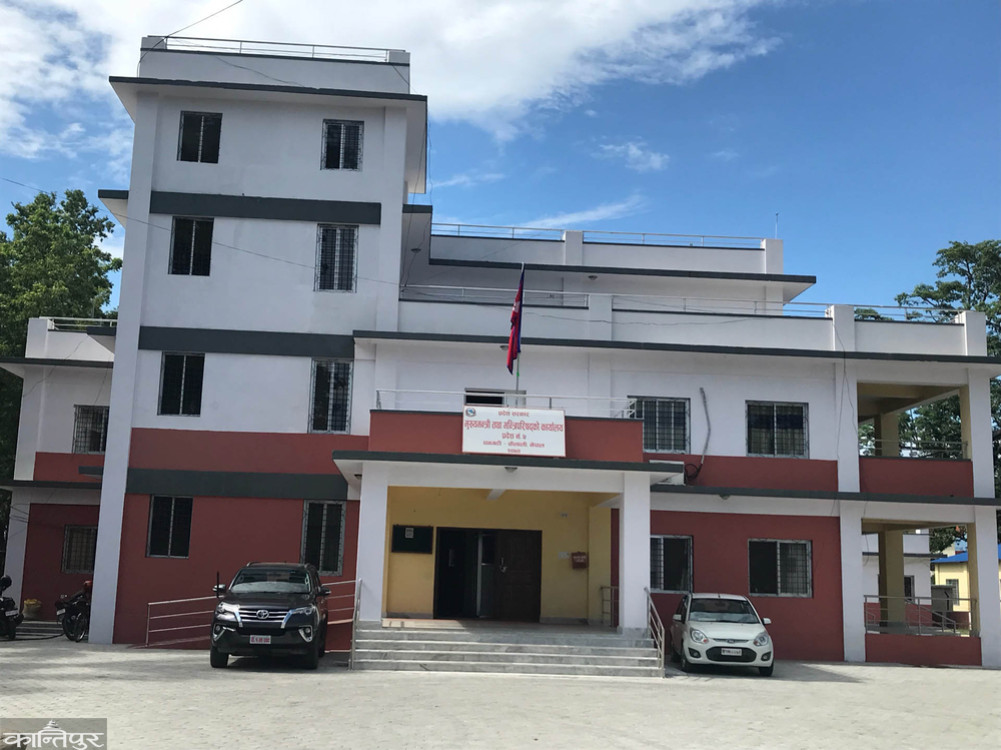
The provincial government has been without expenses since Friday.
We use Google Cloud Translation Services. Google requires we provide the following disclaimer relating to use of this service:
This service may contain translations powered by Google. Google disclaims all warranties related to the translations, expressed or implied, including any warranties of accuracy, reliability, and any implied warranties of merchantability, fitness for a particular purpose, and noninfringement.
Sudurpaschim Province has entered a budget holiday for the second time in three fiscal years . After the budget brought by the provincial government for the upcoming fiscal year 2083/84 could not be passed by the provincial assembly by mid-Ashar, the legal basis for spending with the provincial government has ended from Friday.
Earlier, the province had faced a budget holiday for about three months after the budget for the fiscal year 2081/82 could not be passed on time . This situation, which has been repeated for the second time in three fiscal years, has raised serious questions about the financial management and political leadership of the provincial government .
The main reason for the budget being stalled this time is the breakdown of the power partnership between the Congress and the UML . As the dispute over the budget intensified, Chief Minister Kamal Bahadur Shah dismissed four ministers, including a minister of state, from the UML on Wednesday . Immediately after that, the government led by Chief Minister Shah was in a minority after the UML withdrew its support to the government .
After the budget bill could not be passed, the government will not be able to spend on any topic from Friday. However, revenue collection and regular service delivery will continue as per the Current Revenue Collection Act, 2081.
Chief Minister Shah said that despite efforts to bring the PESKY Bill by reaching an understanding with the NCP till the last minute to overcome the budget vacuum, an agreement could not be reached. 'For the immediate budget vacuum has arisen,' he said, 'Discussions are being made on the option of bringing the PESKY Bill through an ordinance within the first week of Shrawan.'
According to him, if the PESKY Bill is brought, the government will be able to collect revenue, run salaries, administrative and other mandatory current expenses. But the UML has accused the province of being without a budget due to the government's own weaknesses.
UML Chief Whip Chakra Bahadur Malla said that the UML initially decided to reject it because the government moved unilaterally as soon as the budget was presented. ‘The Chief Minister kept the problem pending throughout Asad and ultimately created complications,’ he said, ‘If the PESKI bill had been discussed on time, there would not have been a situation of budget vacuum.’ Even now, we have not been consulted on this issue.’
Khagraj Bhatta, the leader of the parliamentary party of the main opposition Nepal Communist Party, also said that there was no formal initiative from the government to resolve the common problem. ‘The budget they brought was stopped due to their own internal disputes,’ Bhatta said, ‘We were ready to cooperate on issues like PESKI expenditure.’ But in the discussion on Thursday morning, they also requested to pass the old budget, which was not possible. We had called that budget unreasonable from the beginning.’
27 MPs are required for a majority in the 53-member Provincial Assembly. The Congress has 17 and the UML has 11 MPs. After the coalition collapsed, the government does not even have the necessary majority to pass the budget.
Earlier in 2081/82, the then Chief Minister Dirgha Bahadur Sodari had tried to bring a budget through an ordinance. But after the provincial chief did not issue an ordinance, the budget of the Far West went to zero for the first time.
Economist Rajendrabir Chand said that the province's lack of a budget on time was an extreme example of the irresponsibility of the political leadership. 'The trend of not being able to bring a budget on time, not being able to pass the budget it has made itself, and not even being able to manage regular administrative work is repeating,' he said. 'This situation has come about because those running the government are focusing on the interests of their constituencies rather than the overall interests of the province. This is negatively affecting the province's economic activities, development projects, and investment environment.'
With the budget being zero, the Far West province is once again trapped in a cycle of political instability and financial uncertainty. Now the government's immediate challenge will be to find a way to operate minimum government expenditure by bringing a PESKY bill through an ordinance and passing the budget through a new political equation.