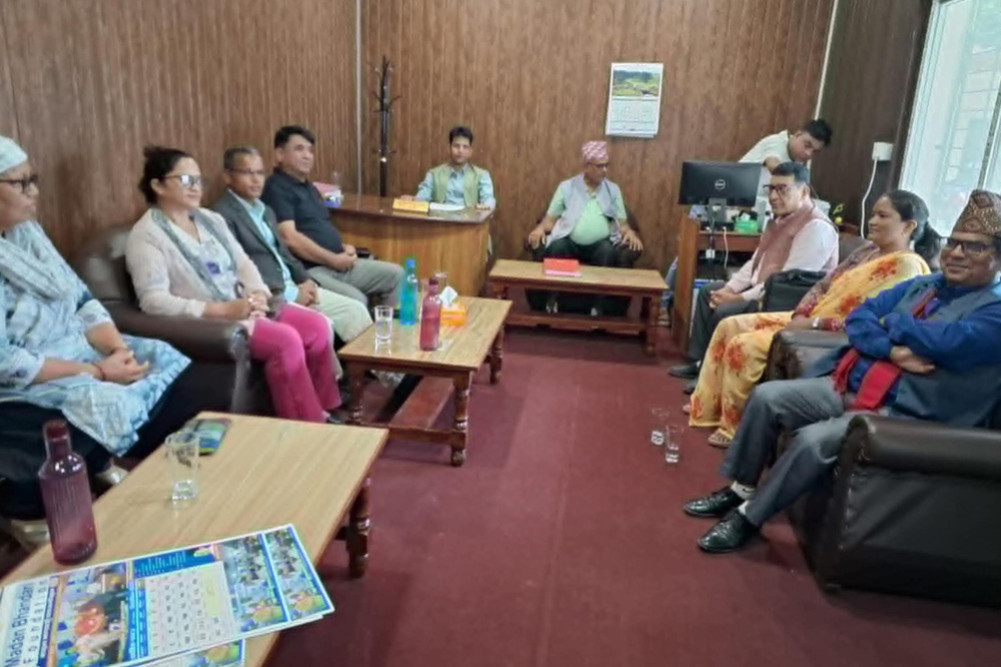
UML ministers dismissed in the Far West, mass resignation of Congress ministers in Karnali, both Congress and UML are trying to lure the NCP to take over the leadership of the province.
We use Google Cloud Translation Services. Google requires we provide the following disclaimer relating to use of this service:
This service may contain translations powered by Google. Google disclaims all warranties related to the translations, expressed or implied, including any warranties of accuracy, reliability, and any implied warranties of merchantability, fitness for a particular purpose, and noninfringement.
The Congress has decided to leave the power partnership with the UML in all seven provinces. As the Congress begins its efforts to find a new political alternative by breaking the equation with the UML, a new course for the power equation in the province is set to move forward.
The Congress and UML leadership at the center have not reached an agreement on the issue of continuing the power partnership in the province, and its aftershocks have been felt in the provincial government since Wednesday morning. Shortly after the Chief Minister of the Congress-led Sudurpaschim Province Government, Kamal Bahadur Shah, dismissed four UML ministers, the UML decided to withdraw its support to Chief Minister Shah. Four Congress ministers from the Karnali Province Government submitted their collective resignations to Chief Minister Yamalal Kandel on Wednesday. Congress leaders say that ministers from other UML-led provinces will be withdrawn by Thursday.
Congress Vice President Bishwaprakash Sharma admitted that attempts were made to exit the power partnership with the UML. He said that the Congress has reached the conclusion of breaking the power partnership with the UML after the political approach to the Gen-G rebellion and the lack of honesty in the treatment of the provincial government were not found.
The Congress had given the responsibility to Vice President Sharma to discuss with UML Chairman KP Sharma Oli towards changing the leadership of the provincial government. Sharma had been in direct and phone conversations with UML Chairman Oli. ‘When it seems like a husband and wife are going to be together but not together, we have reached a situation where we should separate from the UML’s alliance,’ Sharma said.
Sharma said that the Congress has reached the conclusion that it will remain in the opposition if an understanding is reached with NCP Chairman Pushpa Kamal Dahal and if there is no agreement to remain in the government in the province. There is a power partnership between the Congress and the UML in all seven provinces. The Congress has taken the leadership of Madhesh, Bagmati, Sudurpaschim and Gandaki provinces, while the UML has taken the leadership of Koshi, Lumbini and Karnali provinces. Congress President Gagan Thapa and NCP Chairman Dahal met on Tuesday regarding the issue of a possible equation. With the decision to break the power sharing with the UML, the NCP has become decisive for the new power equation.
Thapa and Dahal discussed the issues of power sharing and leadership in all seven provinces in an hour-long conversation. After talking to Thapa, NCP Chairman Dahal left for Sri Lanka for three days on Wednesday. Congress leaders say that further talks on the issue of power sharing will take place only after his return.
NCP leader Narayan Kaji Shrestha said that despite talks with both parties, no concrete conclusion has been reached. ‘The issue of sharing in the provinces has been raised by both the Congress and UML for some time now. At that time, we did not seek power, but now it seems that we are forced to,’ he said, ‘No conclusion has been reached on which party to enter into an alliance with.’
Currently, both parties are focused on NCP Chairman Dahal. Both the Congress and the UML have continued their parallel political efforts to win the support of the NCP, which is considered crucial for the formation of the provincial government. In informal talks, both parties have put forward the same model of equations that were used earlier.
After the 2079 elections, four equations were formed between the UML-Maoist Center (currently the NCP), the Congress-Maoist, the UML-Maoist and the UML-Congress. Provincial governments were also formed in the federation according to all three equations.
‘The talks are positive, but since parallel discussions are also underway between the UML and the NCP on the possibility of leftist unity and cooperation, there is no way to know where Dahal will be,’ said a Congress official. ‘If there is no understanding with the NCP Chairman Dahal, we will all be in the opposition in the provinces.’
NCP leader Shrestha said that the issue of cooperation and unity with the UML has only been discussed but has not progressed in practice. ‘The media has talked about leftist unity, but in practice there has been no discussion or exercise about it,’ he said.
After reaching the conclusion that the dispute that arose in the Far West would leave the equation, UML Chairman KP Oli has also started showing activeness in dialogue with the NCP. According to Oli’s aide Rajesh Bajracharya, the party has reached the conclusion that cooperation with the Congress will not proceed due to the developments in the Far West and Karnali. ‘I am not aware of any further discussions taking place on this,’ he said.
UML leader Mahesh Bartaula says that in the current complex political situation, there is still a view within the party that cooperation with the Congress should be pursued. He says that cooperation with not only the Congress but also other political parties, including the NCP, is necessary.
He said that the budget issue in particular has caused problems in the Far West government. The Congress-led Far West government had brought a budget that went against the sentiments of its ruling partners, so the UML had demanded that it be revised. After the UML adopted a policy of not passing the budget in the Sudurpaschim Provincial Assembly, the Congress had called Chief Minister Shah to Kathmandu for discussions.
‘We have already called Chief Minister Shah to Kathmandu, you should also call a representative. Then let’s discuss and find a way out,’ said another Congress leader about the recent dialogue with the UML, ‘But UML Chairman Oli said that the Congress should fail the budget in Koshi. I will give another name from the UML. In the Sudurpaschim, the UML will fail the budget. There is a Chief Minister close to Sher Bahadur Deubaji. Oliji has said that you should give another name. Our leaders have come to the conclusion that this has become very apolitical and will leave the power partnership with the UML.’
According to the agreement reached on 17 Ashad 2082, the Congress had proposed to change the leadership in all six provinces except Madhesh Province. The seven-point agreement reached at that time mentioned that ‘the provincial government will be formed in accordance with the spirit and spirit of the national consensus government and the development work at the provincial and local levels will be accelerated in accordance with the people’s will’. This means that when the leadership changes at the center, the leadership in the provinces will also change accordingly.
With the change in the leadership of the Congress, the issue of power balance in the province has been in the news. Since former President Sher Bahadur Deuba made his close friend the Chief Minister, there was internal pressure on President Gagan Thapa to change the Chief Minister. Since there was an understanding between the two parties, the homework of changing the leadership of the provincial government has been moving forward after the 21 Falgun elections. Congress Vice President Sharma had held discussions with UML Chairman Oli a month ago to reach an understanding between the two parties. In the previous conversation, the two parties had reached an understanding to change the leadership in the province after the budget.
Oli’s proposal to make the budget of Koshi and Sudurpaschim a failure and the UML’s stance that it would not relinquish the leadership in Koshi, the Congress immediately broke off cooperation with the UML.
Since Congress and UML are in the same place in parliament on national issues, it would be better to cooperate in the provinces as well, says UML leader Bartaula. ‘Consultations are being held, there is no situation that this will happen exactly, we are not in a place where we should increase our distance with Congress, discussions are going on within the party,’ he said, ‘Even if the distance with Congress increases due to the Sudurpaschim context, it can be reconciled, it does not mean that relations and contacts with Congress should be broken on this basis,’ he said.
This is the arithmetic of parties in the province
Koshi Province
47 MPs are required to form a government in the 93-member Koshi Provincial Assembly. Congress has 29 and CPN has 17 MPs. Both parties have 46. One more MP is not enough for the Congress and CPN alliance. Since JSP has only 1 MP, relying on it alone is risky, so 5 MPs from RPP seem decisive. If CPN forms an alliance with UML, the current power equation will be safe. UML has 40 and CPN has 17 MPs.
Madhesh Province
Madhesh has a Congress-led government. Madhesh-centric parties including Congress, UML, and NCP are in the government. In the 107-member Provincial Assembly, Congress has 22 MPs and NCP has 16. 54 MPs are needed to form a majority. Congress and NCP alone have 38. On the other hand, UML's 23 and NCP's 16 add up to 39. That is, two parties alone are not enough to form a majority. Madhesh-centric parties like JSP Nepal, which has 19 seats in Madhesh, Janmat, which has 13 seats, and LOSPA, which has 9 seats, have to be relied on.
Bagmati Province
In the 110-member Bagmati Provincial Assembly, 56 MPs are needed to form a government. Congress has 37 MPs and NCP has 28 MPs. A Congress-NCP government can be formed easily. If UML and NCP form an alliance, there is a possibility of forming a government even if they try. But arithmetically, one seat is not enough for this alliance to gain a majority. UML's 27 and NCP's 28 make 55. For one more MP, this alliance will have to join hands with the RPP or the Hami Nepali Party. The RPP has 13 seats and the Hamo Nepali Party has 2 seats. Gandaki Province
31 MPs are required to form a government in the 60-member Gandaki Provincial Assembly. 27 from the Congress and 7 from the NCP will make it 34. Here too, the Congress-NCP alliance will not have any problem. However, the UML and NCP alone do not have a majority. UML has 22 and NCP has 7 seats, respectively. The RPP, which has 2 seats in this province, is the main determinant for the alliance between the UML and NCP.
Lumbini Province
The current strength of the 87-member Lumbini Provincial Assembly is 83. 42 MPs are required for formation. The Congress has 27 and the NCP has 13 MPs. If both join hands, it will make it 40. 2 MPs are insufficient to form a government. If the Congress forms an alliance with the NCP, it will have to unite small parties including the Civil Liberties Party, RPP, JSP and Janamat. Small parties are decisive for this alliance. The alliance between UML and NCP will reach exactly 43. Here, UML has 29 MPs.
Karnali Province
21 MPs are required to form a government in the 40-member Karnali Provincial Assembly. There are 14 MPs from the Congress and 14 from the NCP. If both parties join, it will reach 28. A Congress-NCP government can be easily formed here. If UML and NCP form an alliance in Karnali Province, UML will have 10 and NCP 14, reaching 24. Both parties will easily reach a majority.
Sudurpaschim Province
27 MPs are required to form a government in the 53-member Sudurpaschim Provincial Assembly. The alliance between Congress and NCP will easily reach a majority. Congress has 18 and NCP has 15 MPs.
If both join, it will reach 33. If there is an equation between NCP and UML, only 26 will be enough. One MP is insufficient for that. This alliance, which will provide the insufficient MPs, will have to reconcile the civil emancipation issue, which has 7 seats. UML has 11 and NCP has 15 seats in Sudurpaschim.