Apart from some key issues of constitutional amendment, both parties appear to have similarities in their views and programs. The political documents prioritize democratic republic, rule of law, good governance, human rights, corruption control, and a competitive economy.
We use Google Cloud Translation Services. Google requires we provide the following disclaimer relating to use of this service:
This service may contain translations powered by Google. Google disclaims all warranties related to the translations, expressed or implied, including any warranties of accuracy, reliability, and any implied warranties of merchantability, fitness for a particular purpose, and noninfringement.
As the Rashtriya Swayamsevak Sangh (RSS) strengthens its democratic ideology, new pressure has been created on the Congress. The election results of 21 Falgun have shown that the people have come to trust the RSS as an alternative to the Congress, which has been synonymous with democratic politics for decades. The RSS, established with the issues of democratic republic, rule of law, and good governance at its core, has increased its influence on the traditional political basis of the Congress.
Before the rise of the RSS, the main competition of the Congress was with the leftist forces. There was no alternative political force to challenge the Congress from within the democratic camp. For a long time, the main competition was between the Congress and the communist forces. This trend continued until the 2079 elections.
If we look at the latest example of competition, in the 2079 elections, while the Congress got 25.71 percent of the votes on the proportional representation side, the UML, which was the main leftist force, got 26.95 percent and the then Maoist Center (now the CPN) got 11.13 percent of the votes. When the votes of these two big leftist parties were combined, they were almost 13 percentage points more than the Congress, or 38 percent of the votes.
The Rashtriya Swayamsevak Sangh (RSS) that entered the elections within 6 months of its establishment had already sounded the alarm bells for the Congress, UML and Maoists (now CPN) by getting 10.70 percent of the votes in the 2079 House of Representatives elections. The 2082 elections completely changed the balance of power in 2079. The RSS alone became the largest democratic force, getting 47.84 percent of the votes. The Congress shrank to 16.24 percent, the UML to 13.44 percent and the CPN to 7.49 percent.
 Political analysts say that the main challenge for the Congress now will be the RSS rather than the communist parties, as a large portion of the democratic voters are attracted to the RSS.
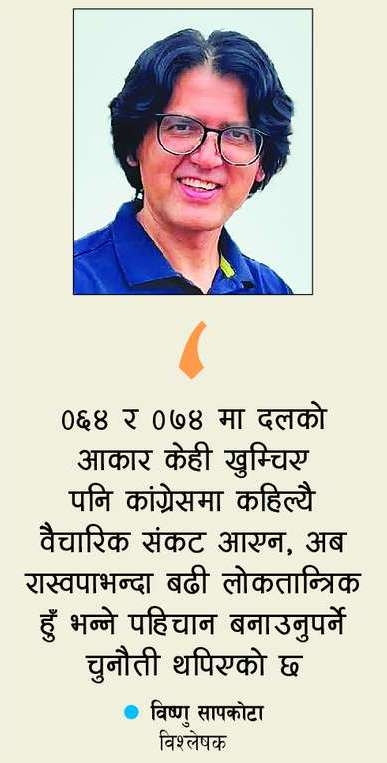
Writer and analyst Bishnu Sapkota said that the RSS has replaced the Congress, which has been a democratic mainstream institution for more than eight decades. In that sense, he calls the February 21 election a major event in democratic history. ‘It is common to say that the party will become stronger whether it wins or loses the election. However, for the first time in history, there has been a crisis in the identity of the Congress, a crisis that did not arise even when it was a small party after losing the election. For example, in 2064 and 2074, the party became small but there was no ideological crisis,’ he says, ‘The democratic mainstream was the same. This time, that mainstream has shifted from itself to the Rashtriya Swayamsevak Sangh (RSS). Now the Congress faces a challenge to establish the identity that it is more democratic than the RSS.’
Another analyst, Geja Sharma Wagle, admits that the Congress has been challenged from a theoretical, ideological and ‘narrative’ perspective based on the victories of the RSS and the defeats of the Congress in past elections and the documents passed by the recently concluded first general convention of the RSS. ‘From a theoretical and ideological perspective, the RSS seems to be trying to follow the Congress. The Rashtriya Swayamsevak Sangh (RSS) has adopted a strategy to establish itself based on the narrative of being a democrat in a democratic ‘constituency,’ he says, ‘that is why there are some similarities between the Congress and the RSS in the theoretical and ideological dimensions. Because both are democratic parties.’
Apart from some major issues of constitutional amendment, there are also significant similarities between these two parties in terms of ideas and programs. Both have prioritized democratic republic, rule of law, good governance, human rights, corruption control, and competitive economy in their political documents. The theoretical beliefs put forward by both parties are based on social democracy. The core essence of social democracy is social justice, equality of opportunity, accountable state, and democratic freedom. Which can be found in the documents of both the Rashtriya Swayamsevak Sangh (RSS) President Ravi Lamichhane and the Congress President Gagan Thapa.
Another basis of social democracy is the issue of social justice and inclusive representation. Both documents have accepted inclusiveness as not only a political achievement but also a democratic value. They have advocated an open economy. Both also admit that the market alone does not solve the problem. They have embraced an economy with social justice that requires the role of the state in improving the living standards of citizens. Programs targeting urban areas, the young generation, the educated middle class, and voters seeking change are found in both documents.
The Congress has concluded that political, administrative, and economic reforms are necessary to address the dissatisfaction that arose after the Gen-G rebellion. The Congress has accepted youth unemployment, inequality of opportunities, poor performance of state institutions, and the growing distance of parties from the people as major challenges. The report of the Rashtriya Swayamsevak Sangh (RSS) President Lamichhane has also basically focused on these problems. He analyzes that the new generation has reached rebellion due to corruption, impunity, political protectionism, lack of opportunities, youth migration, distrust of the state, and weak public services. The similarity is even more evident on the question of good governance. The Congress has prioritized restoring the credibility of public institutions, reducing political interference, merit-based appointments, and institutional reforms. The Rashtriya Swayamsevak Sangh (RSS) has also made public service reform, digital governance, reform in political appointments, corruption control and the rule of law its main agenda.
 Analyst Sapkota says that the competition between the two parties, which have similar ideological views, is about who can provide good governance and credible leadership within the same democratic values. ‘Since the RSSS has become the first mainstream force of the democratic class, the challenge for the Congress is how to appeal that they are true democrats. There is no longer a situation where they can believe in history. The main challenge is in what language Gaganji will appeal that his party is more pro-democracy than others,’ he said.
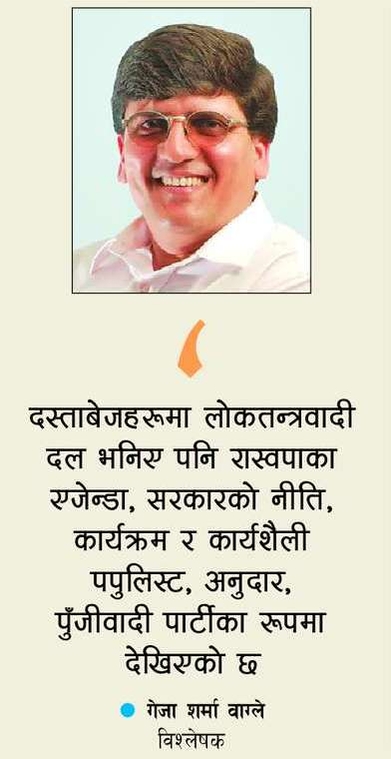
Wagle, on the other hand, says that although the RSSS has been established as a democratic party in terms of ideas and philosophy, it is yet to be tested in practice. ‘There is some similarity in the documents and manifesto in terms of political and democratic principles. They are fundamentally different in terms of inclusive democracy, pluralism, federalism, economy, social justice, and inclusion,” he says. “Although the document and manifesto mentions it as a democratic party, looking at its agenda and government policies, programs, and working style, the RSVP is seen as a populist, liberal, capitalist, and center-right party.”
Sapkota comments that the RSVP has positioned itself as a more sophisticated democratic mainstream than the Congress from the Chitwan General Convention. He claimed that there is no difference in the ‘socialism’ that the Communists and the Congress have been talking about in the past, and that political parties have been corrupting it. “From the special general convention, socialism is not seen as a priority of the Congress, which is a good thing. In the name of socialism, the Congress and the Communists have been taking the line of crony capitalism,” he says. “That path was wrong. Earlier, the RSVP had also talked about the same socialism, which was corrected from the Chitwan General Convention. Now, this is where the Congress should also come in.’
The political report and proposal of President Lamichhane, passed by the first general convention of the Rashtriya Swayamsevak Sangh (RSS) in Chitwan, have revised the line of ‘constitutional socialism’, which was previously accepted as the party’s theoretical philosophy. ‘The country’s constitution and the party’s policy, ideology, and principles are two separate issues. Based on the analysis of the current economic and social situation of Nepal and the basic character of the state that the citizens hope for, while stabilizing and consolidating the achievements achieved so far, we have concluded to adopt social democracy as the party’s main political principle,’ the RSSP document states.
On the issue of constitutional amendment, there is a difference of opinion between the two parties. The Congress does not want to go out of the parliamentary system. The RSSP stands in favor of a directly elected executive and a fully proportional electoral system. Similarly, it has a vision of making the National Assembly an assembly of non-party experts. The biggest confusion is seen in federalism. Ideas ranging from abolishing the provincial assemblies to restructuring have come within the party.
On such a sensitive issue, neither has the issue of abolishing the provincial assembly been clearly discussed, nor has any framework for restructuring been put forward. The Congress has only raised the issue of structural reforms at the federal, provincial and local levels. However, it has not sought an alternative.
Analyst Wagle says that the Rashtriya Swayamsevak Sangh (RSS) has not been able to assimilate the principles, values and norms of inclusive democracy, plurality, federalism, economy, social justice, and inclusion, not only on the issue of constitutional amendment.
Even though the Congress has accepted constitutional liberalism, pluralism and inclusion as the party's basic principles since the special general convention, there is a strong opinion within the party that the philosophy of socialism established by BP should not be abandoned. Congress President Thapa, on the other hand, is trying to move forward from the principle of social democracy. Even in the political document presented at the special general convention, there is no mention of the philosophy of socialism. ‘The Congress will provide sincere theoretical and ideological leadership to develop and transform the existing and prevalent democracy into a liberal democracy, advanced democracy, inclusive democracy and a democracy that delivers,’ is Thapa’s proposal passed by the special general convention.
Not only theoretically, but the youth of the contemporary generation in both parties have taken the reins of the party. Thapa, who arrived to extend his best wishes on the day of the inauguration of the Chitwan general convention of the Rashtriya Swayamsevak Sangh (RSS) party, had said that the public opinion received by the Rashtriya Swayamsevak Sangh (RSS) party was exceptional in history, saying, ‘You have also made us feel uncomfortable.’ Lamichhane has raised the issue of competitive relations in the document. ‘For decades, politics was viewed through the lens of ‘whose friend or who whose enemy?’ But in the politics of nation-building, parties are not enemies of each other, at most, they are competitors with different ideas, programs and priorities,’ he said.
There is also a remarkable similarity in the organizational structure of the Rashtriya Swayamsevak Sangh (RSS) party and the Congress. Both parties have a hierarchical structure from the bottom up. There is a system of inclusive representation based on membership. The Congress has a structure ranging from tole, ward, municipality, provincial assembly constituency, House of Representatives constituency, district, province and center, while the Rashtriya Swayamsevak Sangh (RSS) has also created a hierarchical structure extending to booth, ward, municipality, constituency, district, province and center.
In a short period of time, the Rashtriya Swayamsevak Sangh (RSS) led by Lamichhane has been running the government with close to two-thirds of the power. However, analysts say that for Thapa, the president of the opposition party, it is not enough to rise above the defeat in the 21 Falgun election by competing with the Rashtriya Swayamsevak Sangh (RSS).

