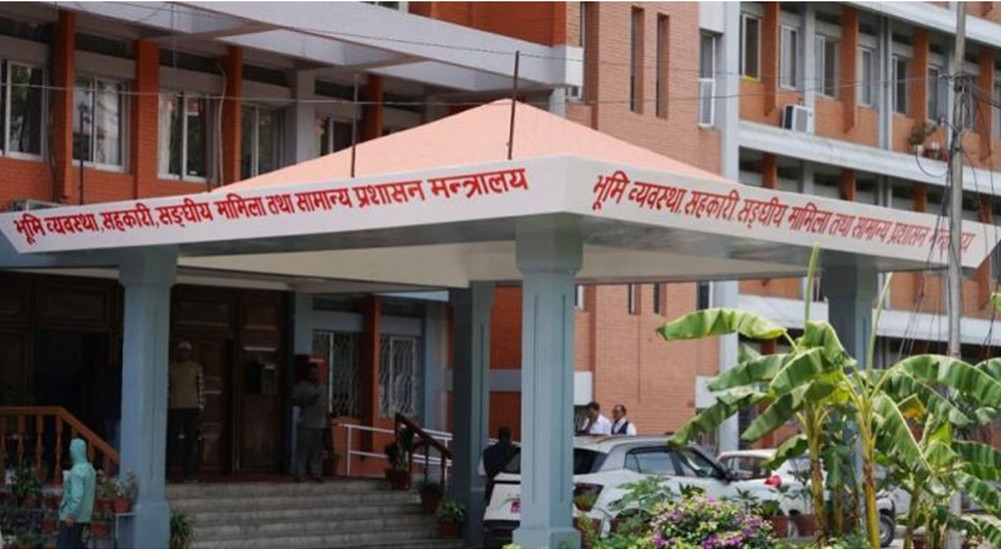
Ministry spokesperson and Joint Secretary Ekdev Adhikari said that a circular has been issued to all bodies at the federal, provincial and local levels to eliminate the system of evaluating both poor and good performing employees by treating them equally.
We use Google Cloud Translation Services. Google requires we provide the following disclaimer relating to use of this service:
This service may contain translations powered by Google. Google disclaims all warranties related to the translations, expressed or implied, including any warranties of accuracy, reliability, and any implied warranties of merchantability, fitness for a particular purpose, and noninfringement.
The government is now going to evaluate the performance of employees based on responsibility and results. The evaluation of the work done by employees throughout the year has been taking place in the month of Shrawan. The Ministry of Land Management, Cooperatives, Federal Affairs and General Administration has stated that employees will be evaluated by linking their performance to results. The Ministry of General Administration on Monday wrote to all ministries, commissions, secretariats, all seven provinces and all local levels, asking them to implement a performance-based evaluation system.
Ministry spokesperson Joint Secretary Ekdev Adhikari said that a circular has been issued to all bodies at the federal, provincial and local levels to eliminate the system of evaluating both categories of employees who have performed poorly and well. ‘There should be a difference between those who do and those who do not. Everyone should not be given the same number,’ he said. ‘For that, we have asked them to implement a performance-based and results-based evaluation system.’ He mentioned that it will also be monitored strictly.
The 100-point document on governance reforms issued by the government on 13 Chaitra mentions that the performance of employees will be linked to results. The ministry's spokesperson Adhikari said that performance evaluation numbers should be given only on the basis of various indicators to put it into practice.
He said that since according to the current method, even if the institutional progress of an office is weak, all employees working there get excellent numbers, performance is being linked to results and accountability. Spokesperson Adhikari said that the overall score should be given considering the job description, responsibilities, goals, performance and annual activities of the person in the relevant position as indicators. He said that stricter measures have been taken since the time for employees to fill out the performance evaluation form and be evaluated is in the month of Shrawan.
The ministry has identified 8 different points to implement the performance-based evaluation system and issued a circular to all agencies to work accordingly. The circular states that the annual performance evaluation should be given marks based on quarterly reviews and evaluations, and that employees who perform excellently should be given priority in awards, incentives, training and leadership opportunities. Similarly, the ministry has also asked to keep a record of employees whose performance is consistently poor, formulate a capacity development plan and implement it.
Spokesperson Adhikari said that the proposed new draft bill for the Civil Service Act mentions objective bases for performance evaluation. However, he informed that all agencies have been asked to comply with some provisions to make performance evaluation factual and objective until the new act is enacted.
The ministry has also asked each public agency/office to determine indicators based on the updated job description of each post. The ministry has also asked to link the performance indicators with the annual work plan and office results and to review the performance level by recording the set target progress, problems, solutions and other initiatives every three months.
According to the new system, performance agreements will have to be made between employees up to the office head level and supervisors based on the job description, performance indicators and annual programs and goals. Similarly, employees who enter into performance agreements will have to provide their subordinates with the expected results and goals by clearly stating the goals, achievements, deadlines and evaluation bases of the work description and performance indicators as needed.
The KASMU score is considered important in the career development, transfer, promotion, training, responsibilities, etc. of employees. The Civil Service Act has taken KASMU as one of the bases for promotion. The Civil Service Regulations stipulate that employees must submit their annual KASMU form by 7th Shrawan every year. The supervisor must evaluate the form by mid-Shrawan and submit it to the reviewer. The Civil Service Regulations state that the reviewer must evaluate it by 15th Bhadra and submit it to the Review Committee. The Review Committee must review it by mid-Bhadra and submit it to the Public Service Commission and the Promotion Committee by mid-Bhadra.
85,240 civil service employees are currently working at the federal, provincial and local levels. Of the employees registered with the Civil Service Bookstore, 46.8 percent are working in the federal, 16.2 percent in the provincial and 37 percent in the local levels.