The fundamental issues of the constitution are a federal democratic republic, a parliamentary system, a mixed electoral system, inclusiveness, and proportional representation. Congress and UML have equal votes to amend the constitution.
We use Google Cloud Translation Services. Google requires we provide the following disclaimer relating to use of this service:
This service may contain translations powered by Google. Google disclaims all warranties related to the translations, expressed or implied, including any warranties of accuracy, reliability, and any implied warranties of merchantability, fitness for a particular purpose, and noninfringement.
Congress, UML, CPN, JSP Nepal and Janamat Party are in favor of constitutional amendment. But they have backed away saying that the government has not brought a clear framework for constitutional amendment.
Congress has already made its views public for constitutional amendment. UML and CPN are in the process of preparing a constitutional amendment report. These parties have also accused the task force formed under the coordination of the Prime Minister's political advisor Asim Shah of trying to 'weaken the constitution rather than enrich it'.
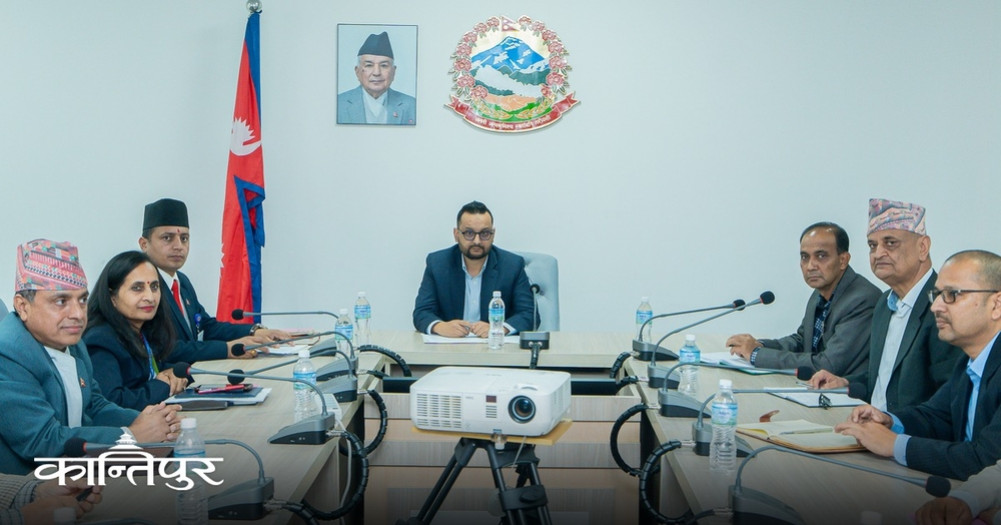
The Rashtriya Swayamsevak Sangh (RSS)-led government is preparing to write a debate paper by forming a constitutional amendment task force on a 100-point roadmap for governance reform.
Congress and UML have similar views on most issues of constitutional amendment. They agree on the basic issues of the constitution, such as a federal democratic republic, a prime minister elected by parliament, and a mixed electoral system. CPN, JSP Nepal and Janamat Party are in favor of a directly elected head of state and full proportional representation. All the old parties are united in their support for a federal democratic republic, secularism, inclusiveness, and social justice. The parties that drafted the constitution in 2072 are in favor of amending it based on the core essence of the constitution, including the federal democratic republic. They are preparing to form a common opinion on that.
The NCP, which should amend the constitution for a directly elected executive head, a fully proportional electoral system, and the Nepali Congress, which initially stood in favor of not amending the constitution by the government working party. Since the amendment of the statute is a sensitive issue, a proposal was sent to the government demanding that a commission be formed to prepare suggestions for amending the constitution by a sitting or former judge of the Supreme Court, or if not, from within the parliament. The Congress representative did not attend the discussion with the government task force. Although representatives of UML, CPN, JSP Nepal, and Janamorcha Nepal participated, they announced their withdrawal from the task force last Friday. The constitution cannot be amended by the Rashtriya Swayamsevak Sangh (RSS), which has about two-thirds of the mandate in the House of Representatives. Since the RSSS is not represented in the National Assembly, it is not possible to amend the constitution by two-thirds from both houses as per the provisions of the constitution. That is why the old parties have become a stumbling block in the government's constitution amendment process. They have said that there should be a national consensus for amending the constitution.
Accusations of being oriented towards rewriting rather than amending
The government task force has objected to going beyond its jurisdiction and being oriented towards rewriting rather than amending the constitution, and trying to interfere with the basic political consensus of the constitution.
Along with the decision not to participate in the government task force, the Congress had formed a Constitution Amendment Study and Suggestion Committee under the leadership of Vice President Pushpa Bhusal in Chaitra. Based on the initial conclusions prepared by the committee after discussions with lawyers, civil society, stakeholders, and experts, party President Gagan Thapa made public the Congress's formal view on the amendment of the constitution on Thursday.
The Congress will work with other political parties and civil society to formulate a common understanding on the constitutional amendment based on this document, informed Vice President and Committee Coordinator Bhusal.
Congress President Gagan Thapa, while making public his view on the constitutional amendment, said that the basic principles such as a federal democratic republic based on pluralism, secularism, proportional inclusive representation, fundamental rights, etc., which are basic achievements, cannot be implemented. 'We can discuss expanding and spreading the basic principles, but implementing them is not acceptable,' he said, 'We want to work together with the Rashtriya Swayamsevak Sangh (RSS) on the constitutional amendment without any prejudice.'
The Congress's constitution amendment report states that the Congress rejected the proposal to go for a directly elected president or prime minister system on the form of government.
'In the first Constituent Assembly, we ourselves had serious discussions about the option of a directly elected executive.' But when it comes to the second Constituent Assembly, we have come to the conclusion that a directly elected president or prime minister system does not work in a diverse country like Nepal,' Thapa added, 'The parliamentary system in which the prime minister is elected by the parliament should be improved, trying to go on a new 'adventure' will cause great damage to the country.'
The Congress has put forward the idea that the mixed system can be improved while maintaining the electoral system. It has concluded that proportional inclusive representation will remain in the House of Representatives, but the proportional list selection process can be made more democratic.
President Thapa said that the House of Representatives can be made inclusive, the constituencies can be reduced, and the system of being elected by party leaders in proportional representation can be changed to a system of being elected by the citizens.
Disagreeing with the proposal to abolish the provincial assemblies of the Nepali Congress, it has put forward the idea that some issues can be modified and made stronger. On the issue of federalism, the Congress is of the opinion that the law can be made by amending the schedule in the constitution to make the distribution of powers more clear while keeping the structure of the 7 provinces intact. 'Federalism in Nepal is not just a matter of governance system but a political achievement of diversity management, identity and participation, so another conflict should not be introduced by changing its structure. Even now, provinces and local governments remain. The report prepared by the Congress committee on constitutional amendment mentions that the number of provincial parliaments and the number of councils of ministers can be reduced.
The task force does not have a clear action plan for constitutional amendment: UML
Mahesh Bartaula, a member of the UML constitution amendment task force, said that the government task force does not have a clear action plan for constitutional amendment as the government cannot amend the constitution on its own.
'We went to the discussions of the government task force, but we left because it was not clear why the constitution will be amended? What is the action plan?' Even though the country's basic law is the constitution, the government has not shown a concrete plan,' he said, 'We are not destroying the major foundation of the constitution, the federal democratic republic, the form of government, strengthening inclusion, social justice, and secularism.'
He said that the federal democratic republic as the form of government and the current electoral system will be used to prepare a report on the amendment of the constitution. He accused the government of wanting to destroy the constitution rather than amend the constitution.
'The government is trying to make the local elections without parties as evidence that it does not like federalism. It is trying to rewrite the new constitution,' he said. In the first week of Jestha, the UML had formed a constitution amendment task force under the coordination of Vice President Bishnu Poudel.
The constitution cannot be amended after discussing with the task force: NCP
Dev Gurung, a member of the NCP constitution amendment suggestion task force, said that the government task force has a draft of the contents of the constitution amendment. 'The task force could not provide such a draft. The constitution cannot be amended by discussing with the task force. The party will form an opinion on the constitution amendment,' he said, 'but since this government will not amend the constitution even if it wants to, a national consensus is necessary.'
He said that the government is not trying to amend the constitution by making a national consensus. Leader Rekha Sharma stated that the NCP has not deviated from the path of amending the constitution and said that the constitution amendment should be for progress. 'Until the government makes it clear whether the constitution amendment is for progress or regression? There is no point in discussing it,' she said.
She said that there should be a discussion on whether the form of government should be directly elected or elected from parliament and whether the electoral system should be mixed and fully proportional.
‘We want to amend the constitution and improve the electoral system, including federal republic, inclusive, proportional, etc.,’ said Janata Samajwadi Party Chairman Upendra Yadav, ‘But the government does not seem to be in favor of amending the constitution.’
Janmat Party General Secretary Chandan Singh said that only if the constitution is amended on the basis of all-party consensus, everyone will have ownership.’ ‘It may be good if the constitution is amended on the basis of all-party consensus.’ He said that the government alone cannot do it.