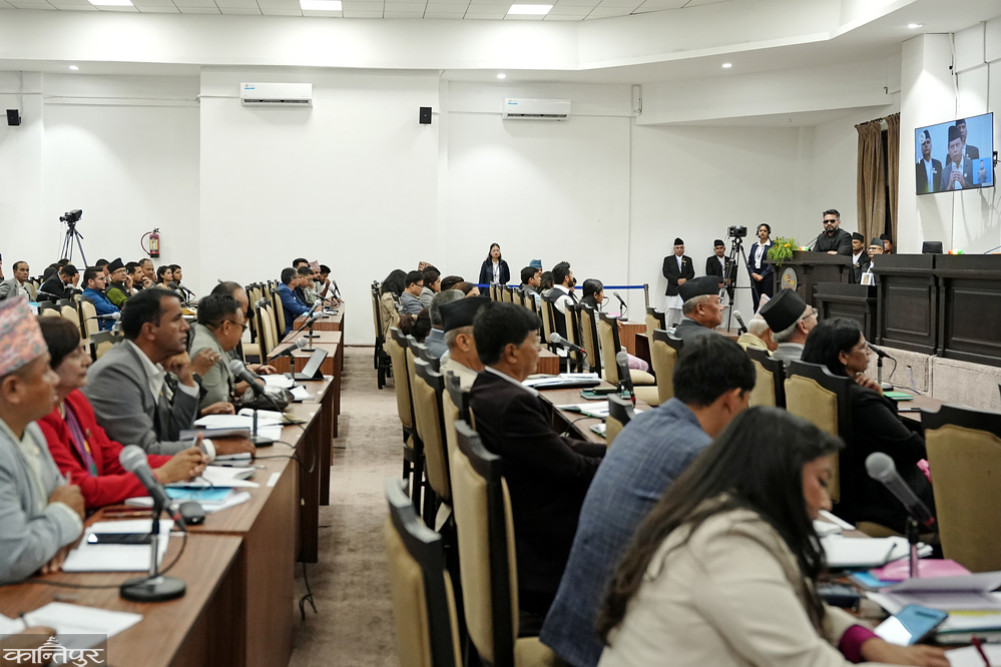
With the support of opposition parties, ordinances related to cooperatives, public procurement, money laundering, and the Health Sciences Academy have been passed by both houses.
We use Google Cloud Translation Services. Google requires we provide the following disclaimer relating to use of this service:
This service may contain translations powered by Google. Google disclaims all warranties related to the translations, expressed or implied, including any warranties of accuracy, reliability, and any implied warranties of merchantability, fitness for a particular purpose, and noninfringement.
Of the eight ordinances introduced by the government last Baisakh, four have been passed by both houses of the Federal Parliament. The other four ordinances, which could not be passed by Parliament within the constitutionally mandated 60-day period, have become automatically inactive.
On the recommendation of the Council of Ministers, President Ram Chandra Paudel issued eight ordinances between Baisakh 17 and 22. These ordinances were presented in both houses of the Federal Parliament on Baisakh 28. According to Article 114 of the Constitution, a replacement bill for an ordinance must be passed by both houses within 60 days of its presentation. Otherwise, the ordinance automatically becomes inactive. The constitutional 60-day deadline for these eight ordinances was until Thursday.
Of the eight ordinances issued by the government, four that were embroiled in political controversy from the outset were put on hold and not advanced through Parliament’s regular process. These ordinances became inactive as of Thursday. They include the Constitutional Council (Functions, Duties, Powers, and Procedures) First Amendment Ordinance, the Special Provisions on Dismissal of Public Officials Ordinance, the Ordinance to Amend Certain Nepal Acts Related to Universities, and the Ordinance to Amend Certain Nepal Acts.
Immediately after the ordinance related to the Constitutional Council was introduced, a meeting was held and the Chief Justice was recommended. A few days before the ordinance became inactive, the Constitutional Council recommended a Chief Commissioner and two commissioners to the Election Commission. Although there were 16 vacant positions in various other commissions, no recommendations were made. Based on the ordinance regarding the dismissal of public officials, around 1,500 officials, including those with political appointments, were dismissed at once.
Only after approval by both houses of the Federal Parliament can a replacement bill for an ordinance be advanced. Although the ruling party holds nearly a two-thirds majority in the House of Representatives, it has no representation in the National Assembly. The opposition Congress and UML registered proposals in the National Assembly to reject the ordinances. In discussions with the government, it was agreed to approve four ordinances. The other four ordinances, which the opposition parties wanted to reject, were put on hold. These became automatically inactive from midnight Thursday.
Sub-clause 2(1)(a) of Article 114 of the Constitution states, “An ordinance shall be presented to both houses of the Federal Parliament after its issuance, and if both houses do not accept it, it shall automatically become inactive.” Sub-clause (b) states, “It may be annulled by the President at any time,” while sub-clause (c) states, “If it is not made inactive or annulled as per sub-clauses (a) and (b), it shall automatically become inactive 60 days after the meeting of both houses.”
The Constitution itself specifies how the 60-day period is to be calculated. It states, “For the purposes of this sub-clause, the day the meetings of both houses are held means the day the session of both houses of the Federal Parliament commences or the day the meeting is held, and if the meetings of the houses are held at different times, the day the later meeting is held shall be considered.”
The four ordinances passed through replacement bills are the Cooperative (First Amendment), Public Procurement (Second Amendment), Asset Laundering (Money Laundering) Prevention (Third Amendment), and the Ordinance to Amend Certain Nepal Acts Related to Health Science Institutes. These ordinances, passed by the House of Representatives on Asar 25, were approved by the National Assembly on Thursday. According to Federal Parliament Secretary General Padma Prasad Pandey, they were sent to the President for authentication on Thursday.
Inactive Ordinances
1. Constitutional Council (Functions, Duties, Powers, and Procedures) First Amendment Ordinance
2. Special Provisions on Dismissal of Public Officials Ordinance
3. Ordinance to Amend Certain Nepal Acts Related to Universities
4. Ordinance to Amend Certain Nepal Acts