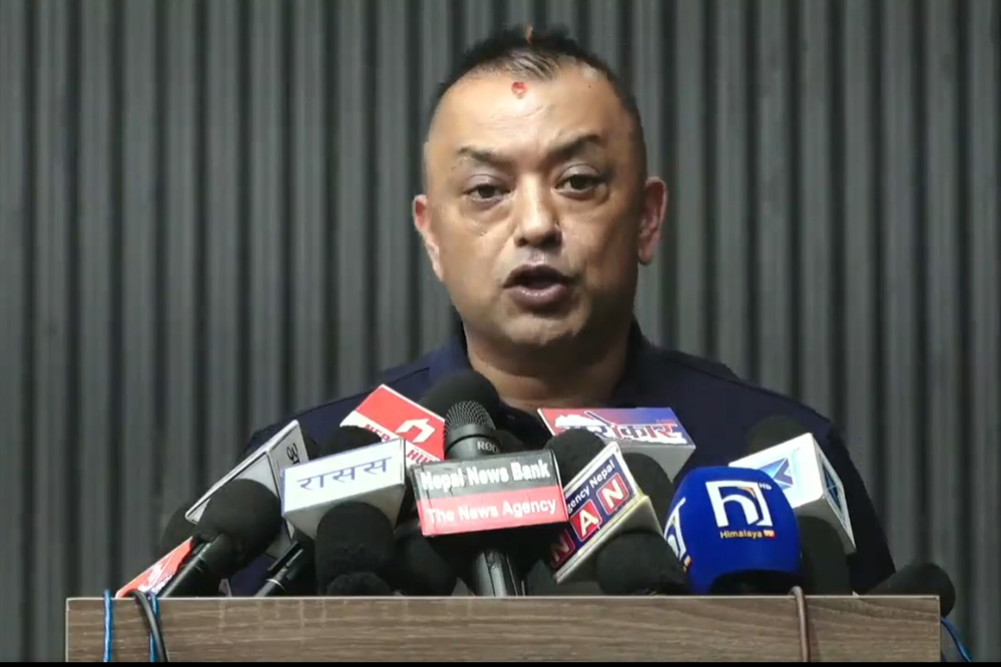
Based on the preliminary conclusions prepared after discussions with legal experts, civil society, concerned communities, and specialists, party president Gagan Thapa has made public the Nepali Congress's official position on constitutional amendment.
We use Google Cloud Translation Services. Google requires we provide the following disclaimer relating to use of this service:
This service may contain translations powered by Google. Google disclaims all warranties related to the translations, expressed or implied, including any warranties of accuracy, reliability, and any implied warranties of merchantability, fitness for a particular purpose, and noninfringement.
The main opposition, the Nepali Congress, has made its formal position public regarding constitutional amendment, taking a clear stance that there should be no changes to the fundamental structures of the system of governance, federalism, and the electoral system.
The Congress has made public its view that the constitution should be amended to address weaknesses seen in the implementation of the parliamentary system of governance, the federal structure with seven provinces, and the mixed electoral system, while keeping these structures unchanged.
The Rastriya Swatantra Party (RSP), which is leading the government, has, however, proposed in its political position a directly elected executive head, a fully proportional parliament, and a fundamental overhaul of the federal structure.
Immediately after the formation of the government, a task force was formed under the coordination of the Prime Minister’s political advisor, Asim Shah, to prepare a discussion paper on constitutional amendment. This task force is preparing a report after holding extensive discussions with legal experts, constitutional experts, civil society, and political parties.
Arguing that the government could move forward with the amendment process based on the political position put forth by the RSP, the Congress on Thursday made its formal position public on this issue through party president Gagan Thapa from the party’s central office in Sanepa.
While other political parties were included in the Shah-led task force formed by the government to prepare the discussion paper on constitutional amendment, the Congress had not participated from the beginning.
Concluding that it is not appropriate to move forward such a sensitive issue as constitutional amendment through the government’s political mechanism, the Congress had submitted a written proposal to the government stating that a commission should be formed to prepare suggestions for constitutional amendment, comprising sitting or former justices of the Supreme Court, or, if not, from within the parliament itself. After the government did not agree to this, the Congress did not send a representative to the task force.
Other parties that initially participated in the task force have also later withdrawn, expressing dissatisfaction. CPN-UML, CPN (Maoist Centre), Loktantrik Samajwadi Party (LSP), Janata Samajwadi Party (JSP), and Rastriya Janamorcha have expressed disagreement, saying the task force has gone beyond its jurisdiction and is moving towards rewriting the constitution rather than amending it, and is attempting to interfere with the fundamental political consensus of the constitution.
Along with the decision not to participate in the government’s task force from the outset, the Congress formed its own committee for the study and suggestion of constitutional amendment under the leadership of Vice President Pushpa Bhusal.
Based on the preliminary conclusions prepared after discussions with legal experts, civil society, concerned communities, and experts, party president Gagan Thapa on Thursday made public the Congress’s formal position on constitutional amendment.
According to Bhusal, the next step will be to hold dialogues with other political parties and civil society based on this document to build a common understanding on constitutional amendment.
Thapa said that since Article 265 of the constitution provides for a review of constitutional arrangements every ten years, the debate on constitutional amendment will be advanced from there. However, he made it clear that the Congress would not accept any changes to the fundamental principles such as the federal democratic republic based on pluralism, secularism, proportional inclusive representation, and fundamental rights, which are the core achievements of the constitution. “We can discuss expanding and broadening the fundamental principles, but we cannot accept changes to their operation,” Thapa said at the outset while making the party’s position public. “On the issue of constitutional amendment, we want to work together with the RSP without any prejudice. We want to work in partnership, not out of excitement or prejudice.”
On the issue of the system of governance, the Congress has rejected the proposal to move to a directly elected presidential or prime ministerial system. Thapa said that based on the debates during the constitution-making process and the experiences of various countries, the parliamentary system is most suitable for Nepal.
“In the first Constituent Assembly, we ourselves had serious discussions about the option of a directly elected executive. But by the time of the second Constituent Assembly, we concluded that a directly elected presidential or prime ministerial system would not work in a diverse country like Nepal. We should continue to improve the parliamentary system where the prime minister is chosen by parliament; seeking a new ‘adventure’ would cause great harm to the country,” Thapa said.
While accepting the argument that development has been affected due to unstable governments, Thapa said that the solution is not a directly elected executive.
“If we move to a directly elected executive on the basis that there have been 23 governments in 20 years, another problem arises. If the president is from one party and the parliament has a majority from another, governance becomes even more complicated. Nepal’s democracy is based on inclusive pluralism, not majoritarianism,” Thapa said. “We must also learn from the past.”
On the electoral system, the Congress has proposed maintaining the mixed system while making improvements. Thapa said that proportional inclusive representation should be maintained in the House of Representatives, but the process of selecting proportional lists can be made more democratic.
“The House of Representatives must be inclusive. Rather, its size should be reduced. The number of constituencies should be reduced. Let’s discuss this. For proportional representation, let’s move from a system where party leaders select candidates to one where candidates are selected from the citizen level. Let’s amend the constitution for this,” Thapa said. “Let’s discuss how to move from a system where leaders select candidates to one where citizens participate in the selection. The Congress is ready for this.”
On the issue of federalism, the Congress holds the view that the structure with seven provinces should be maintained, but the schedules in the constitution regarding the division of powers should be amended to make them clearer. Thapa said that federalism in Nepal is not just a matter of governance system, but a political achievement for managing diversity, identity, and participation, and that changing its structure would only invite further conflict.
“During the constitution-making period, the debate on federalism was not just about governance. It was about managing diversity and ensuring equal rights for all citizens,” Thapa said. “Even now, provinces and local governments will remain. But the number of provincial assembly members and ministers should be reduced. Provinces should be made effective. The lists of exclusive and concurrent powers of the federal, provincial, and local levels in the constitution should be amended to clarify the division of powers.”
He said that the federal government has been exercising powers granted to the provinces by the constitution, and that by withholding powers from the provinces, the federal government has been holding on tightly, so improvement is necessary. “The right to issue licenses belongs to the provinces. But they have not received that right yet. Everyone is questioning what the provinces are. We ourselves have created the impression that provinces are unnecessary,” he said. “Talking about abolishing or removing provinces would only lead the country into another political conflict. We should make them functional. For that, the number of parliamentarians should be reduced. The number of ministers should be reduced. Until now, provinces have been made units of expenditure. Now, they should be made units of income.”
The Congress has put forward the view that the main priority of constitutional amendment should be good governance and control of corruption. The Congress has also proposed making the Commission for the Investigation of Abuse of Authority more independent, capable, and effective, and improving the structure of the Constitutional Council and the process of appointing judges.
He said it is unfortunate that the body responsible for monitoring the prime minister is itself afraid of the prime minister. “The prime minister can look into corruption committed by others, but corruption committed by the prime minister and ministers is to be investigated by the Commission. That is why appointments are made through the Constitutional Council. In the past, party leaders tried to make the Commission a shadow of their party by appointing their own people, so we tried to improve that. But now, the Commission is afraid of the prime minister, the head of the Commission trembles at the sight of the prime minister, and the head of the Commission has to salute the prime minister,” Thapa said. “It has become impossible to monitor whether the prime minister and ministers are involved in corruption. We sought improvement in this while amending the constitution.”
He said that the Commission should be made even more independent and powerful. For that, improvements can be sought in the structure of the Constitutional Council and the Judicial Council for the appointment of judges through constitutional amendment. “We do not want any share of appointments. We are ready for open discussion on improving the Constitutional Council and the system of appointing judges,” he said.
Thapa said that if the door to constitutional amendment is opened haphazardly, the very foundations that hold society and geography together will be weakened. “Therefore, the process of amendment should move forward only with national consensus, priorities, and sensitivity,” he reiterated. “If we treat the issue of constitutional amendment as a new adventure and run the constitution haphazardly, the country will enter another new conflict.”