Only 10.5 percent support the view that Oli's leadership is appropriate
We use Google Cloud Translation Services. Google requires we provide the following disclaimer relating to use of this service:
This service may contain translations powered by Google. Google disclaims all warranties related to the translations, expressed or implied, including any warranties of accuracy, reliability, and any implied warranties of merchantability, fitness for a particular purpose, and noninfringement.
A survey has shown that 87.6 percent are in favor of restructuring the leadership of UML Chairman KP Sharma Oli. At a time when there are demands within the UML for leadership restructuring following the results of the March 4 election, a survey coordinated by central member Gajendra Thapaliya found that more than two-thirds support leadership restructuring. Only 10.5 percent are in favor of Oli’s current leadership.
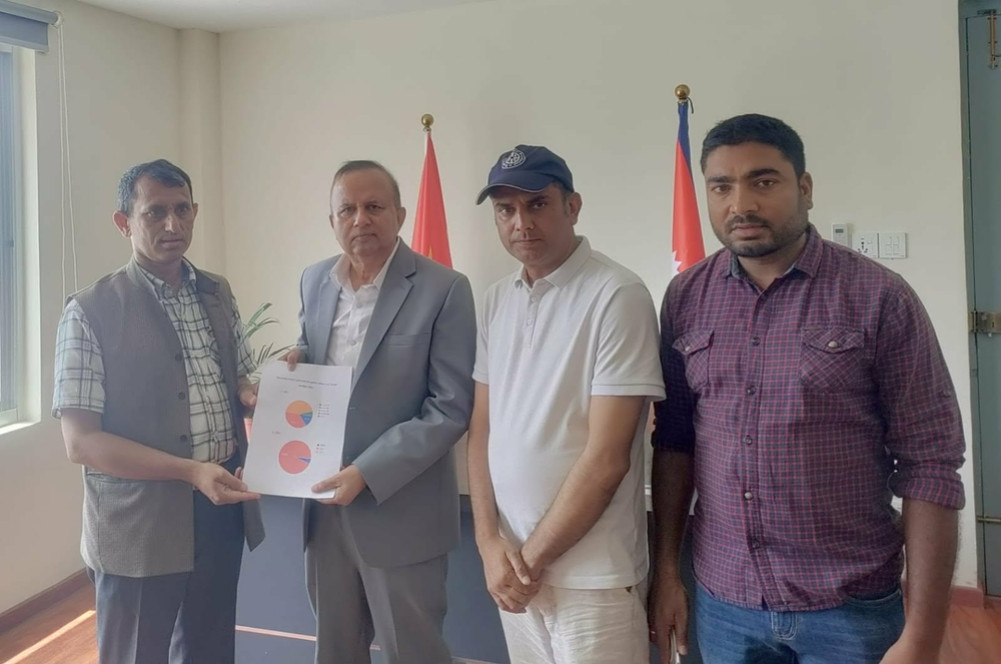
The survey report by the ‘UML Transformation and Restructuring Renaissance Campaign’ was submitted to General Secretary Shankar Pokharel on Thursday. Team coordinator Thapaliya said the survey results would help in restructuring the leadership to build a stronger party. “We have drawn conclusions based on the opinions of thousands of Nepalis living inside and outside the country, and we expect this to be useful in building the party in a new way,” he said. “We have submitted the results report to the General Secretary and requested that it be used as reliable material.”
We have drawn conclusions based on the opinions of thousands of Nepalis living inside and outside the country, and we expect this to be useful in building the party in a new way – Gajendra Thapaliya, Coordinator, UML Transformation and Restructuring Renaissance CampaignUpon receiving the survey report, General Secretary Pokharel said it would be studied. “We will look into it,” Pokharel said. UML Publicity Department Chief Neeraj Acharya said that although the report submitted to the central office is not official, it has come as a suggestion. “Anyone can give suggestions to the party,” he said. “This survey is not official for the party.”
Central members Thapaliya, Ramesh Paudel, Naresh Rokaya, and others are preparing to raise the survey results in the upcoming central committee. “We have submitted and made public the survey results to the party, and it has become a topic of discussion based on these results,” Paudel said. “The party leadership should take it seriously.”
According to the survey report obtained by Kantipur, the largest group of participants were aged 40 to 60 years at 43.7 percent, followed by those aged 30 to 40 years at 37.1 percent, those aged 40 to 60 years at 13.7 percent, and those above 60 years at 5.5 percent. Similarly, survey coordinator Thapaliya said that 94 percent of participants were men and 6 percent were women.
About two thousand people participated in the survey conducted via Google online forms, with 72.2 percent being organized UML members. Similarly, 15.9 percent were supporters, 10 percent independent citizens, and 1.9 percent affiliated with other parties.
UML Vice Chairmen Bishnu Paudel, Gokarna Bista, Prithvi Subba Gurung, Raghu Pant, General Secretary Shankar Pokharel, and Deputy General Secretary Yogesh Bhattarai are in favor of leadership restructuring.
There has been a demand within the UML for Chairman Oli of the first generation to transfer leadership to the second generation. However, the survey showed that 50 percent believe leadership should be transferred within the central committee. The figure for office bearers is 17.7 percent.
83 percent voted for selecting party leadership through direct elections. The current UML statute states that leadership is selected by convention representatives. Only 14 percent supported this method. The survey also showed that UML cannot move forward in its current state. 91.4 percent believe leadership transformation is necessary, while 7.4 percent believe the party can move forward as it is. The remaining percentage did not wish to comment.
The current party leadership has faced criticism for not being democratic and for creating self-centered procedures. “It is unfortunate that recently, the lifestyles of some of our party leaders and cadres have become extravagant and there has even been a decline in conduct,” states the report by General Secretary Shankar Pokharel, passed by the statute convention last August.
When asked about their views on the working style of the current party leadership, 95 percent said it needs improvement. There is a shared opinion within the UML that not only the leadership but also the policies need restructuring. Oli has repeatedly said that policies should be revised to connect with the people.
The survey results show opposition to the current system where the center selects candidates in all periodic elections. 88.1 percent are in favor of selecting candidates through votes from all organized members. Nine percent support the current system.
There have also been demands within the UML to bring the younger generation into leadership. The survey found that 91 percent support directly including capable and young people in all committees.
Last August, the statute convention amended the statute to remove the two-term limit for executive positions and the age limit of 70 years. This provision was removed after Oli sought a third term as chairman. The survey found that 83 percent believe one should only be allowed to serve two terms. 15 percent were opposed to this.
When asked, “Where would it be appropriate to find a solution for UML restructuring?” 25 percent supported an ‘early’ general convention, while 47.7 percent supported a special general convention. There had also been a signature campaign within the UML calling for a special general convention. About four hundred convention representatives had signed. The campaign was halted at the request of then acting chairman Ram Bahadur Thapa.