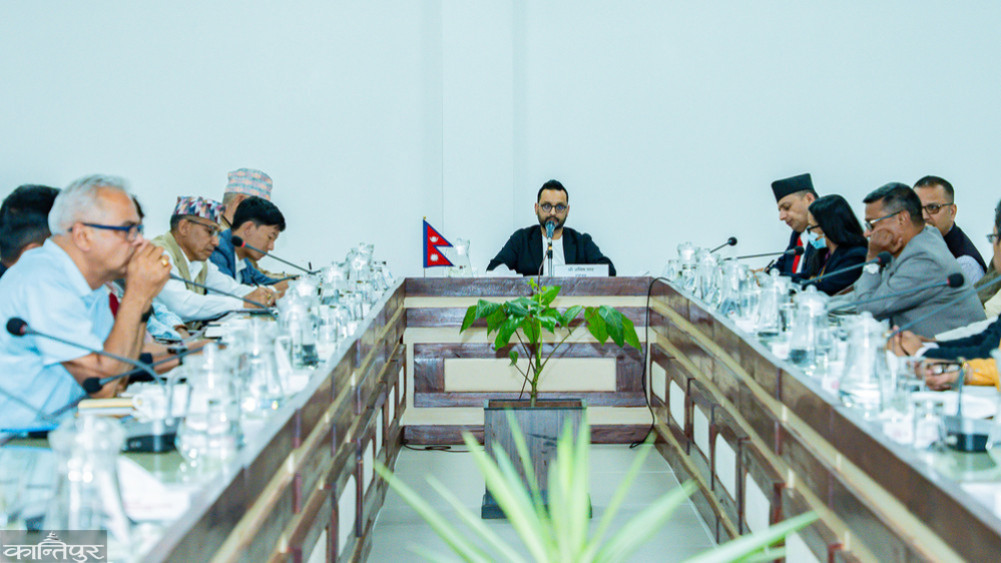
The Congress did not send a representative, the representative designated by the UML never participated in the meeting/discussion, and now only the Rashtriya Swayamsevak Sangh (RSS) and the RPP are represented in the task force.
We use Google Cloud Translation Services. Google requires we provide the following disclaimer relating to use of this service:
This service may contain translations powered by Google. Google disclaims all warranties related to the translations, expressed or implied, including any warranties of accuracy, reliability, and any implied warranties of merchantability, fitness for a particular purpose, and noninfringement.
Four parties have withdrawn from the task force formed by the government to prepare a debate paper for constitutional amendment. Representatives from the NCP, LOSPA, JSP and Rastriya Janamorcha have withdrawn from the task force, raising questions about the task force's jurisdiction. The representative appointed by the UML has not been present in the meeting of the task force since the beginning. The Congress did not send any representative.
The task force, led by Prime Minister Balendra Shah's political advisor Asim Shah, included Dev Gurung of the NCP, Laxman Lal Karna of LOSPA, Surendra Jha of JSP and Manoj Bhatta of Janamorcha. They submitted a six-point dissenting note to coordinator Asim Shah on Monday while withdrawing from the task force.
'If we are going to enter the issue of constitutional amendment, the debate paper process should first be scrapped. Second, the commitment to not implement the articles and clauses of the preamble and basic values of the constitution should be made clear,' the four parties' dissent letter states, 'The government should initiate a national consensus by holding an all-party meeting of the leaders of the parties represented in the federal parliament on which issues and for what reasons should be amended.'
Dev Gurung, a leader of the NCP who is in the task force, said that they disagreed after the task force formed to prepare the debate paper presented itself in the style of preparing a draft of the constitution amendment. 'If the constitution created by the Constituent Assembly is to be amended, it should be done with the consent of all. Since this work cannot be done under the leadership of the Prime Minister's advisor, we have explained our point in writing,' he said.
Former MP Laxman Lal Karna, who has been participating in the task force to prepare the constitution amendment debate paper from the beginning from the LSP, said that they withdrew because the task force was moving towards preparing a report rather than preparing a debate paper on the constitution amendment. ‘Initially, there were discussions with various people, including constitutional experts and former employees, about what issues should be included in the discussion paper. We actively participated in it,’ he said, ‘When the members of the task force, including the coordinator, went door to door, that’s where our disagreements started. We didn’t participate because we don’t want to go to the house and seek advice.’
According to Karna, when the question was raised at the beginning that it should be clear whether to amend the constitution or prepare a discussion paper, Coordinator Shah had said that he would prepare a discussion paper. But in the end, when the report was to be prepared by a majority-minority decision, he said that he did not want to be a witness. ‘The responsibility given to the task force by the government is to prepare a discussion paper. If we are to stay within this, a common view and point should be decided,’ he said, ‘We will tend to agree and disagree on the issue of changing the preamble of the constitution, inclusiveness and federalism itself, we cannot be a witness.’
The Congress did not send a representative, the representative appointed by the UML never participated in the meeting/discussion, now only the Rashtriya Swayamsevak Sangh (RSS) and the RPP are represented in the task force. Karna argues that the constitution itself will end if the preamble of the constitution is used now. ‘Who needs a king. Some want a Hindu state. Some want what. It is not the right of the task force to go into this,' he said.
Bhishma Adhikari, who was appointed by the UML to the task force, said that he disagreed with the process of the task force from the beginning and did not participate in any meeting. He said that the process of amending the constitution is written in the constitution and the parliament is the legal venue for it. 'Our stance has been the same since before, and it is still the same,' he said.
The coordinator of the task force, Shah, however, commented that the representatives of the opposition political parties left the task force because they were irresponsible. He said that they left the task force because they feared that the government's popularity would increase if the suggestions received from experts and stakeholders from home and abroad and from various fields were included in the debate paper. "They had been participating formally on behalf of their party since the first meeting of the task force, submitting opinions and suggestions," he said. "They were also present when the task force discussed with various stakeholders."
Shah said that after participating in the task force for 83 days, four parties suddenly informed him that they would not be able to participate in the meeting. "Until now, there had been no opposition to the issue of preparing the discussion paper. There had not even been any discussion on this issue. It seems that there is a strategy behind opposing it at the last moment to prepare the report and making it a failure," he said.
Task force coordinator Shah said that even though the parties came last and irresponsibly left the task force, preparations are being made to prepare the discussion paper and submit it to the Council of Ministers within the stipulated time. According to him, the task force report writing has reached the final stage. The deadline extended by the government for the second time is ending in mid-Asad.
The task force has so far discussed with constitutional scholars, lawyers, politicians, professionals, civil society, women's rights activists, former attorneys general and former administrators and collected suggestions. The task force has also taken suggestions from 44,700 citizens in the country and abroad online. The task force has also studied the reports of various committees of the Constituent Assembly.
Rashtriya Swayamsevak Sangh (RSS) MP and task force member Mohanlal Acharya also commented that the four parties were trying to come into unnecessary discussion by expressing their disagreement at the end. 'They have shown irresponsibility at a crucial time when it is necessary to prepare a debate paper for amending the constitution,' he said.
Comment from the four parties on the task force preparing a draft of the constitution amendment in the name of a debate paper Law Secretary at the Office of the Prime Minister and Council of Ministers Pushkar Sapkota claimed that the debate paper to be prepared by the task force will not undermine constitutional supremacy, but rather strengthen it. 'Parties need not be suspicious of the work of the task force,' he said.
He also claimed that the work is being done in a very democratic, legal, open, transparent and clean manner through debate and discussion. ‘At a time like this, it is not relevant to suddenly give a letter to the parties to leave the task force. Leaving the process of preparing a debate paper for a dynamic and vibrant document like the constitution sends a negative message to the people,’ he said, ‘This can arouse discontent towards political parties.’
Before the representatives of the four parties submitted their written dissent, the president of the main opposition Nepali Congress, Gagan Kumar Thapa, had commented on the childishness seen in the task force preparing the debate paper for the constitution amendment, while addressing the party office in Sanepa on Sunday. ‘They took the constitution like a small book in their hands and said, “Throw it away, knock it over.” The next day, they gave a speech and were applauded. This practice that is happening now, completely forgetting the sensitivity and complexity during the constitution-making process, is very dangerous,’ he had said.
Chairman Thapa had maintained that although the constitution could be amended and reviewed, it should not be made a hot-button issue. Recalling the complications he had experienced firsthand in the first and second Constituent Assembly, he said that the constitution was promulgated after a great struggle, incorporating the sentiments of the indigenous, nationalist, Dalit, Tharu and Madhesi movements.
What is in the dissenting letter?
Representatives of the four parties that left the task force have mentioned in the dissenting letter that questions have been raised about the appropriateness and validity of the title of the debate paper. ‘The jurisdiction of the task force and the issues in the constitution that are being sought to be amended and why, the government’s concept should be clear, which have not been addressed yet,’ they said.
They stated that in the second point, it seems as if the task force is trying to rewrite the constitution by opening up all the articles and clauses of the constitution and taking suggestions. ‘The act of opening up the basic issues including the preamble of the constitution and all the articles and clauses of the constitution in the name of constitutional amendment is against the people’s mandate and the spirit of the constitution,’ their dissent letter states, ‘Therefore, our agreement and participation in the process of preparing a debate paper against the general sovereign recognition of the constitution and constitutional amendment cannot take place.’
In the third point, it is recalled that the current constitution-writing process was initiated by the Constituent Assembly after reaching a mutual national consensus among all the then political parties. They say that even though the RSP was not there at that time, the constitution was drafted through democratic methods with the broad participation of other people’s representatives, constitutional lawyers, stakeholders, and the general public.
In the fourth point, it is argued that the mandate for constitution-making and the mandate for managerial functions are fundamentally and qualitatively different. They allege that the original spirit of the constitution is that the federal parliament can amend the constitution on some limited issues other than the preamble of the constitution and basic values if the state needs it, but the task force is not sticking to it now.
Similarly, in the last point, it is said that if the issue of constitutional amendment is to be entered into, the debate paper process should first be abolished, and the commitment to not implement the articles and clauses of the preamble and basic values of the constitution should be made clear. The government should take the initiative for national consensus by organizing an all-party meeting of the leaders of the parties represented in the federal parliament on which issues and for what reasons should be amended, the dissenting letter states. In the sixth point, it is stated that the status quo process cannot be participated in the task force.