The political culture of publicly presenting the constitutional basis for why the government was forced to take such a step before concluding that an ordinance was necessary has not developed in Nepal.
We use Google Cloud Translation Services. Google requires we provide the following disclaimer relating to use of this service:
This service may contain translations powered by Google. Google disclaims all warranties related to the translations, expressed or implied, including any warranties of accuracy, reliability, and any implied warranties of merchantability, fitness for a particular purpose, and noninfringement.
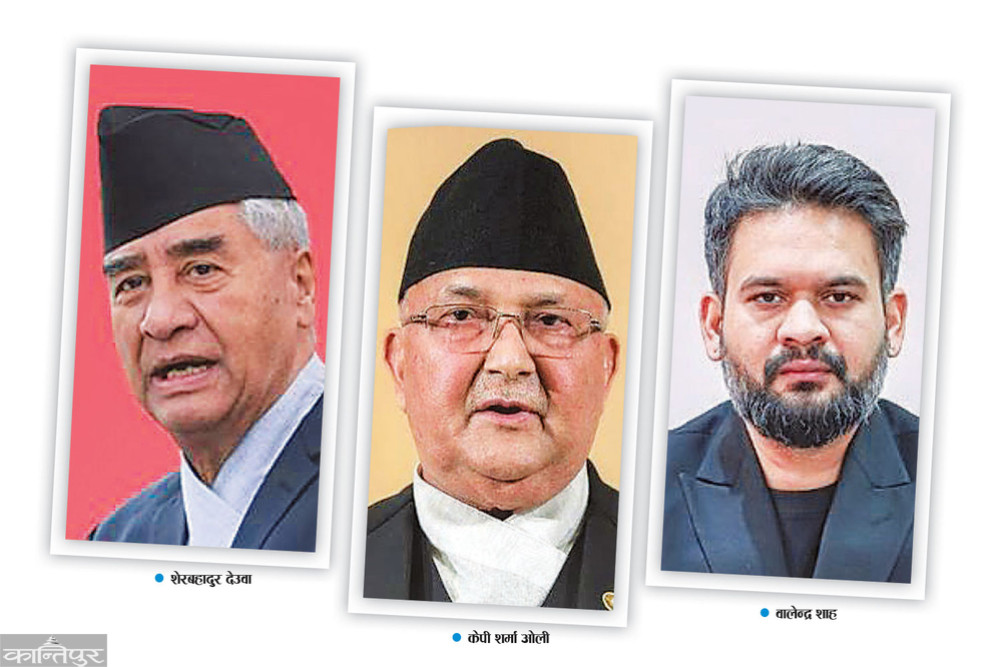
Prime Minister Balendra Shah convenes a cabinet meeting on 8th Baisakh, and the same meeting recommends to President Ram Chandra Poudel that both houses of the federal parliament be convened on 17th Baisakh. Since the recommendation was made at night, President Poudel calls a session of the federal parliament to be held at 2 pm on 17th Baisakh the next day.
Prime Minister Shah convenes another cabinet meeting on 10th Baisakh, and the meeting recommends to the President to postpone the session that has been called. The President issues a notice to postpone the session that has been called for 17th Baisakh on 10th Baisakh itself. From 14th Baisakh, the government starts bringing ordinances.
On the first day, an ordinance related to the functions, duties, powers and procedures of the Constitutional Council and a cooperative ordinance are recommended. Then, by 21st Baisakh, the government recommends eight ordinances to the President.
The provision for issuing ordinances is in the constitution. But this time, the ordinance recommended by the Balen government was widely opposed. The same parties that were accused of trying to rule through ordinances in the past have also attacked the Balen government this time, saying that they are trying to rule through ordinances.
According to constitutional experts, the reason why the Balen government is being criticized is because it brought the ordinance by adjourning the already-called parliament session, and not because of the ordinance itself. Moreover, the National Independent Party, which is currently running the government, has itself been a big critic of the ordinance in the past. Experts say that the problem is not the ordinance itself, but the fact that the ordinance was brought by adjourning the already-called parliament session or by dissolving the ongoing parliament. According to them, there is a tradition of making the facility of the ordinance provided by the constitution a practice rather than an exception.
An ordinance is an extraordinary constitutional provision used in the parliamentary system of government. Article 114 of the constitution provides for the issuance of ordinances. According to Article 114 (1), if something needs to be done immediately when both houses of the federal parliament are not in session, the President can issue an ordinance on the recommendation of the Council of Ministers. Article 114 (2) recognizes such an ordinance as a law. But there is also a constitutional provision that every ordinance issued must be presented to both houses of parliament and automatically becomes invalid if not accepted by both houses.
But there has always been a dispute whether the ordinance was brought on the basis of necessity or for the ease of governance. Another reason for the criticism that the current government faced when bringing the ordinance is that the ruling party has an extraordinary majority in parliament. The main question that has arisen is why the chief executive depends on the ordinance despite the easy position of passing the bill in parliament. But then the question is that no government—whether single or coalition—is formed without a majority in parliament. That means, the government must be so confident that the bill it brings will be passed by parliament.
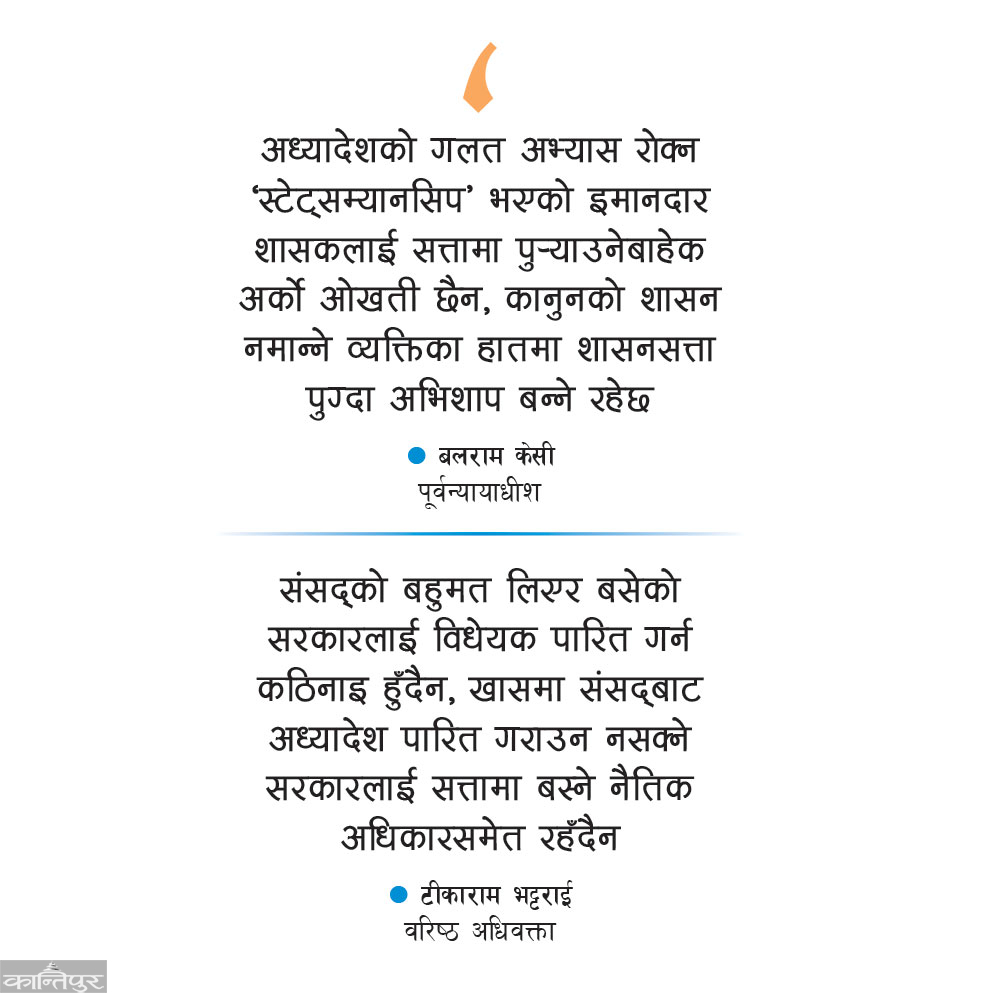
Former Supreme Court Justice Balram KC says that the most abuse of executive power occurs in the Constitutional Council and laws related to political parties. ‘Parliament meets twice a year. When parliament is not in session, MPs go to their constituencies. At that time, if there is an emergency and there is no law, the constitution has made a provision to bring an ordinance to relieve the chief executive. Such a provision is also in other countries,' he says, 'What happened is that the parliament session is closed today, and an ordinance is brought tomorrow. This is an abuse of power. Such actions are mostly done by leaders who do not believe in the rule of law.' There has also been a dual character in the parties regarding the ordinance. In addition, opposition and support for the ordinance have also depended on which party or parties are in the government.
The Congress and UML were in a coalition government until the Gen-G rebellion. There was a debate about how appropriate it was to form a coalition government of the first and second parties in parliament, but when the same coalition government brought the ordinance, there was no general opposition to it. Moreover, those ordinances were necessary and statements like bringing them would immediately bring development that had not happened for years were also popular.
Most of the time, those in the government have not explained the purpose of bringing the ordinance. There are many examples of ordinances being brought in the past for more momentary self-interest. While the constitution has clearly mentioned the reasons for bringing ordinances.
Senior advocate Tikaram Bhattarai also says that there is a tendency to repeatedly misuse executive power and issue ordinances. ‘Whether it is a single party or a coalition, the government is always in the majority. A government with a majority in parliament has no difficulty in passing a bill,’ he said, ‘Especially a government that cannot get an ordinance passed by parliament does not even have the moral right to remain in power.’
The practice of ordinances in Nepal is believed to have started after it was clearly mentioned in the 2015 constitution. According to a study report published by the Federal Parliament Secretariat in 2079, five ordinances were first issued on 26 Falgun 2016 under the leadership of the then Prime Minister BP Koirala, including ordinances on business profits and wages tax, property tax, abolition of state courts, the Supreme Court Act, and land tax.
 According to the study report, 182 ordinances were issued from the enactment of the 2047 constitution to 2063. 30 ordinances were issued from 2048 to 2059. During political instability and the direct rule of the then king, 27 ordinances were introduced in 2060, 33 in 2061, and 79 in 2062. This shows that the use of ordinances is intensified during the absence of people's representative institutions or political crises.
After the promulgation of the interim constitution in 2063, 39 ordinances were issued until 2072. After the promulgation of the new constitution, no ordinances were issued in the years 2072, 2073, and 2076. 3 ordinances were issued in 2074, 5 in 2075, and 11 in 2077, 28 in 2078, and 2 in 2079. Since then, 18 ordinances have been issued until last Jestha.
Although the constitution envisions ordinances as an exception to meet the needs of the time, the report points out that in practice, the tendency to govern through ordinances is increasing even when a bill can be brought by parliament.
The report concludes that the practice of bringing the budget through ordinances has undermined its constitutional essence. The budget was brought through ordinances in 2072, 2073, 2076 and 2078 after the constitution was promulgated. Before that, budgets were also brought through ordinances in 2051, 2052, 2059, 2060, 2062, 2069, 2070. When examining this trend, the main reasons for bringing ordinances are political transition, obstruction of parliament and dissolution of parliament.
According to former Justice KC, a lot depends on the intentions of the people in the government. He says that there is no other remedy other than bringing an honest ruler with 'statesmanship' to power to stop the wrong practice of ordinances. 'Such a system is very beautiful when there are honest leaders in government. But when the ruling power falls into the hands of corrupt and lawless people, it becomes a curse,' he says.
Looking at world practice, the use of ordinances is found to be limited and exceptional. In countries with established democracies like Britain and the US, the practice of issuing ordinances by the head of state is almost non-existent. In India, Pakistan and Bangladesh, there is a system in place where the president can issue ordinances when parliament is not in session. Ordinances are used a lot in India, but the Supreme Court there has repeatedly raised questions about the controversy over ordinances. In some cases, it has been interpreted as 'betrayal of the constitution'.
According to advocate Semant Dahal, the executive has adopted the ordinance process in three main situations. “The first situation is to gain immediate political advantage, weaken the opposition political party or group, or keep the main organs of the state under their control or influence, and gain political advantage from the ordinance even before it is passed by the parliament,” he said. “Second, there is a practice of the executive bringing an ordinance even when it is not confident that the bill can be passed by the parliament within the time it wants.”
Regarding the third situation, Dahal says, “Ordinances are brought with the intention of accelerating long-stalled reform issues rather than with the intention of harming the opposition political party or exerting influence on the organs of the state. Such ordinances cannot provide long-term and sustainable reforms.” Since political malice is clear in the first and second situations, Dahal says that ordinances of this nature only devalue the constitutional essence. He adds, “Using an ordinance as an executive order of the executive governance system is actually an abuse of the executive’s power.”
It seems that various governments have repeatedly used ordinances, especially the Act on Political Parties and the Act on the Constitutional Council. The Political Parties Act has been misused the most since 2064 in the process of maintaining power and forming a new government. The Party Withdrawal Act was introduced for the first time in 2054. It stipulated that 40 percent of the parliamentary party and the central committee would be required for party division. Based on this, the UML split in 2054 BS and the Congress in 2059 BS. Since the Constituent Assembly elections in 2064 BS, a long series of party divisions has continued.
The attempt to split political parties to change the government within 6 months increased from the Constituent Assembly elections in 2064 BS to 2072 BS. To prevent the political instability created by this, it was legally tightened in 2073 BS. The Political Parties Act 2073 BS, which was brought by replacing the Party Withdrawal Act, made a new provision requiring 40 percent of both the central committee and the parliamentary party to reach 40 percent.
The legislative intention of doing this was to prevent party division and maintain political stability. But it was first dismantled by the then Prime Minister KP Sharma Oli. On 8 Baisakh 2077, he amended the ordinance to require 40 percent from both the central working committee and the parliamentary party to split the party, and amended the act so that only one of them would have to reach 40 percent. Fearing that he would lose power due to internal conflicts within the party, Oli amended the law with the aim of splitting the then Federal Socialist Party led by Upendra Yadav and the Rastriya Janata Party led by Mahantha Thakur. The result was the opposite. Instead of splitting, the two parties merged into one. Then, on 12 Baisakh, the ordinance was revoked by the President on the recommendation of the Council of Ministers.
After Oli, Deuba went further. Deuba brought an ordinance on 1 Bhadra 2078 with a provision that a party could be split if there was 20 percent in either the central working committee or the parliamentary party. Based on the same ordinance, another new party was born from the UML under the leadership of Madhav Kumar Nepal – the Unified Socialist Party. Now, after merging with the then Maoist Center, that party has become the Nepali Communist Party (NCP).
Based on the same law, the Federal Socialist Party Nepal led by Upendra Yadav also split. Another party, the Democratic Socialist Party (LSP), was formed under the leadership of Mahantha Thakur. After the objective was fulfilled, the ordinance was repealed on 11 Asoj on the recommendation of the Council of Ministers.
During Oli's time, the ordinance related to the Constitutional Council also became the most controversial. Constitutional commissions are independent bodies that keep the government in check and balance. The Constitutional Council recommends the appointment of office bearers to the Constitutional Commission, including the Chief Justice of the Supreme Court and the Auditor General.
Not only now, the then chief executives also amended the act repeatedly by bringing ordinances to undermine the power structure of the Constitutional Council. Oli, who was the Prime Minister, had recommended 52 office bearers of constitutional bodies on 30 Mangsir 2077 and 30 Jestha 2078 under the guise of the ordinance. Both times, since the House of Representatives was dissolved, there was no parliamentary hearing. A case was filed in the Supreme Court against the recommendation made at that time.
Oli had amended the Constitutional Council Act through an ordinance so that a meeting could be held if the majority of the current members of the council were present and decisions could be made by a majority. At that time, since the post of Deputy Speaker, which is a council member, was vacant, an ordinance was brought to provide for a provision that a meeting could be held if three people were present and decisions could be made by a majority, that is, two people.
The structure of the council has been amended repeatedly so that there is no difficulty in making appointments even in cases where there is a disagreement over the distribution of shares or when the leader of the main opposition party boycotts the meeting with a policy of political non-cooperation. There is a tendency in the Congress and UML to oppose the government when it brings an ordinance when it is in opposition and to bring an ordinance of a similar nature itself after coming to power. When both the Congress and the UML formed the government on 30 Ashad 081, 6 ordinances were brought at once.
The RSVP government, which won the election with the slogan that the 'old' parties like the Congress and the UML practiced bad governance, moved forward with the same practice again. The Balen government also amended the meeting procedure in the Constitutional Council Act by bringing an ordinance. The current government amended the provisions of the Act that a quorum of 5 members including the chairperson is considered to be present in a 6-member Constitutional Council and decisions should be taken by consensus, and decisions should be made by a majority of the total number of members only if consensus cannot be reached twice, by amending the ordinance so that a meeting can be held if 4 members including the chairperson are present and decisions can be taken by a majority of three members. Immediately after the ordinance was issued, a meeting of the council was held and a Chief Justice was recommended.
Former Justice KC argues that the Supreme Court also missed the opportunity to curb such tendencies of abuse of power. He says that the Supreme Court missed the opportunity to appoint 52 office bearers to constitutional bodies when Oli was the Prime Minister. 'It was a situation where three birds could be killed with one stone. First, the misuse of the ordinance could be prevented. By doing so, the Chief Executive could be given a good education. Second, the misuse on the recommendation of the Constitutional Council could be prevented. That too was lost,' he said, 'the appointment could have been rejected without another parliamentary hearing. That too did not happen.'
Although the constitution envisages ordinances as an exception, the political culture of publicly presenting the constitutional basis for why the government was forced to take such a step before concluding that the ordinance was necessary has not developed in Nepal.
Experts say that although it is difficult to make another provision that would bind the government to use the ordinance only when it is in a difficult situation, the current problem can be solved to some extent if the government only introduces ordinances after explaining the legitimate reasons.
Senior advocate Bhattarai says that the frequent interference of the executive in the Political Parties Act and the Constitutional Council Act is nothing more than party interests to keep the government afloat and appoint people who suit them in constitutional bodies. ‘There is a tendency to do so in the party-related act to maintain power and keep the constitutional organs of the state under their control,’ he said. ‘There is a corrupt feeling among the rulers to make even constitutional organs subordinate to the executive.’
Advocate Dahal says that ordinances are misused to make the appointments of other constitutional bodies, including the judiciary, favorable to the government. ‘There is a possibility that parties in parliament will not allow it to be passed, in such a situation, the chief executive has resorted to ordinances to fulfill his interests,’ he said.
Not all ordinances are brought only for the purpose of abuse of power. The Acid and Other Hazardous Chemical Substances (Regulation) Ordinance brought by the Oli government in 2078 BS was widely welcomed. The ordinance, which was brought to make strict legal provisions after the acid attack incident, was considered one of the government’s positive interventions.
In 2079 BS, the Ordinance on the Safety of Health Workers and Health Institutions (First Amendment) was issued, which further strengthened the legal system to prevent attacks on health workers. In the same year, an ordinance was also brought to amend some Nepal Acts related to sexual violence. An attempt was also made to advance the Truth and Reconciliation Commission (First Amendment) Bill, 2075 BS, related to the conflict-era justice process, through an ordinance.
Sudarshan Khadka, coordinator of the Ordinance, Arrangements and Practice Study Report in Nepal and secretary of the Koshi Provincial Assembly, says that it would be natural and appropriate for the government to issue an ordinance in an unavoidable situation where legal arrangements need to be made immediately with only two to three months left to convene the parliament session. However, in practice, he concludes that the use of ordinances is not for such a purpose but is done according to the convenience and political interests of the executive.
‘In some cases, ordinances have also been used positively. But it seems that the government chooses the path of ordinances even when parliament can be convened immediately. This time, the ordinance was issued by postponing even the already convened parliament session,’ Khadka said.
Why does a government with a clear majority in parliament choose the path of ordinances by bypassing the constitutional process of making laws through the legislature? Usually, a government is in crisis only after it loses its majority in parliament. So why is it justified to depend on ordinances despite maintaining a majority? The government has been claiming that since the regular process of making laws is long, ordinances have to be issued to make necessary legal arrangements immediately. The Balendra Shah-led government had presented the same reason when issuing eight ordinances.
According to Khadka, who has been studying the use and trend of ordinances, the real reason is different from the argument given publicly by the government. ‘Procedural delay is not the main reason as the government claims,’ he says. ‘In practice, there is a tendency to use ordinances as a way to bypass parliament and make things easier for the executive. The practice of bringing ordinances based on political and administrative convenience rather than necessity is becoming stronger.’