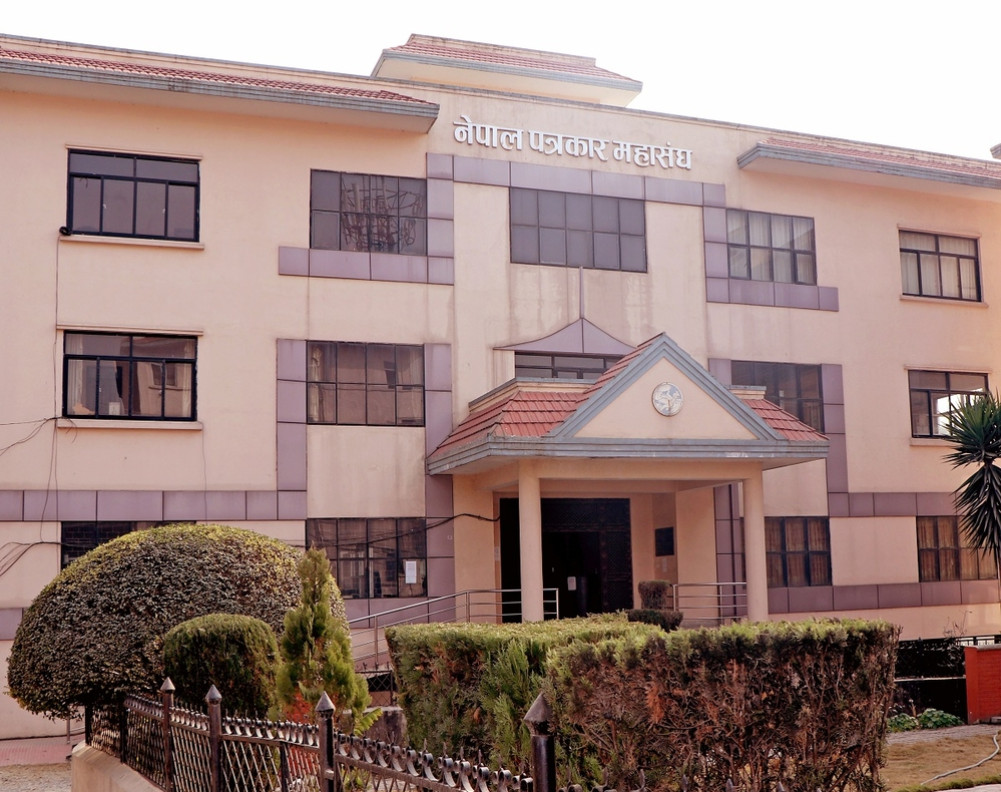
It has been analyzed that the Home Minister's statements, discriminatory advertising policies, and court orders have curtailed media freedom within 100 days of the government.
We use Google Cloud Translation Services. Google requires we provide the following disclaimer relating to use of this service:
This service may contain translations powered by Google. Google disclaims all warranties related to the translations, expressed or implied, including any warranties of accuracy, reliability, and any implied warranties of merchantability, fitness for a particular purpose, and noninfringement.
In a democratic system, the media is considered the fourth organ of the state, which constantly monitors the activities of the government and keeps the citizens informed. However, as the Balendra Shah-led government crosses 100 days of its tenure, signs of a comprehensive siege on the media and freedom of expression have begun to be seen.
Threatening language from responsible ministers, continuous 'cyber bullying' from supporters of the regime, discriminatory advertising policies imposed by the government, and recent orders from the courts have raised questions about press freedom. 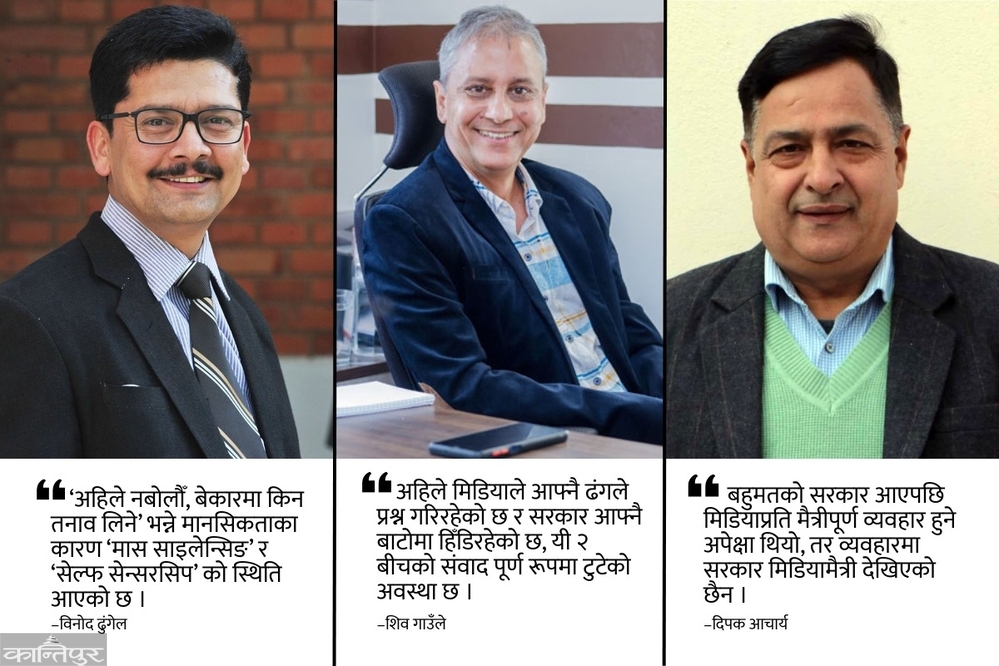
On 26 Jestha, Home Minister Sudhan Gurung took office for the second time at Singha Durbar. Home Minister Gurung, who has been given the responsibility of maintaining internal peace, security and peace in the country, seemed to be directly targeting the media and media personnel. While taking office, he had said that the Home Ministry would look into the matter if the media insulted or defamed anyone.
‘...If anyone tries to insult or character-kill any citizen from now on, the Home Ministry will be very sensitive about it,’ he said in a threatening tone, ‘the Home Ministry will look into this matter seriously.’
Due to the mentality of ‘let’s not speak now, why take unnecessary stress’, a situation of ‘mass silencing’ and ‘self-censorship’ has arisen. – Vinod Dhungel According to the prevailing law, the Press Council Nepal is the body that monitors the media and recommends action. While taking office, he ignored the council’s jurisdiction and made a comment targeting journalists, saying, ‘From now on, no one should commit suicide in the name of media trial.’
‘The Home Ministry will be very serious about the way our girls, Nepali girls in particular, are being character-killed.’ So from now on, there should be no such trend in society,’ he said, ‘As much as you want to attack, do it to me.’ It had to be done on the basis of facts, not tampering. No one should commit suicide in the name of media trial. From now on in our country.'
His statement means that the Ministry of Home Affairs will now deal with the errors or weaknesses of journalists or the media. Media expert Binod Dhungel says that the Home Minister's statement is more personal than legal.
'Instead of saying 'the law does it', the style of saying 'I will do it' or 'I will fix it' seems to be dominant in the Prime Minister or the Home Minister,' Dhungel says. 'In a democracy, the law and the constitution should be above the individual, and the attitude of demonstrating the power of an individual is considered 'scary', which creates an atmosphere of fear in the society.'
The intolerant behavior of the ruling party's supporters has also become a major reason for the entire media sector to be on the path of fear before the government has completed 100 days in power. Healthy democratic debate is shrinking due to the inability to listen to criticism and the tendency to dig in on those who question it. Dhungel analyzes that the media has gone down the path of 'self-censorship' less than 100 days after the Balen Shah-led government.
'Although there have been no major physical attacks on the media during this period, journalists have had to face 'cyber bullying' and 'cyber intimidation' (threats given through the Internet),' Dhungel told Kantipur, 'Especially, it seems that the leaders of the ruling parties and supporters who consider the Prime Minister as an 'idol' are spreading 'hate speech' on social media using aggressive language like theirs. This has created a kind of fear among content creators in both the mass media and social media sectors.'
The umbrella organization of journalists has accused the government of becoming control-oriented in the name of regulation and trying to financially collapse the independent press. Deepak Acharya, Senior Vice President of the Federation of Nepali Journalists, also argues the same. According to him, the government seems to be control-oriented in the name of media regulation.
‘We are not against media regulation, but the government seems to be control-oriented in the name of regulation. It is objectionable to try to directly control bodies like the Press Council instead of establishing the rule of law by making them autonomous and empowered,’ he said. ‘After the majority government came to power, there was an expectation that there would be friendly behavior towards the media, but in practice the government has not been media-friendly. There should be direct discussions and debates with the Federation as the main stakeholder body while making laws related to the media.’
Acharya argued that the government’s discriminatory advertising policy also seeks to impose an ‘economic blockade’ on the press. ‘The latest advertising policy is extremely discriminatory. Most media outlets have been directly affected by the decision to give advertisements only to government media outlets. This is a kind of 'economic blockade' imposed on the free press,' he said, 'The media is not a mechanism that works in favor of the government, it always plays a counterproductive role. The government should have the ability to tolerate criticism and comments. Overall, the government is not on the right track when it comes to press freedom.'
Currently, the media is asking questions in its own way and the government is walking its own path, and the dialogue between these two is completely broken. - Shiv Gaunle The government had issued a circular on Chaitra 19 to publish government advertisements only in government media. 'While publishing and broadcasting information including public procurement from public bodies through the media, the Government of Nepal, provincial governments and local levels and their subordinate bodies and all public bodies working using public funds shall arrange for their information to be published and broadcast only in government and government-owned media such as Gorkhapatra Sansthan, Radio Nepal, Nepal Television,' the letter reads.
The Federation of Nepali Journalists has been protesting nationwide against the circular. Senior Vice President Acharya said that the protest will continue until the decision is withdrawn. The federation had also raised the issue with the International Federation of Journalists. The government's letter was questioned at the IFJ World Conference held in Paris, France from May 4 to 7. The conference concluded that the decision would adversely affect editorial freedom, freedom of the press and expression, the right to information and the autonomy of journalism as a whole. However, the government has not reversed the decision.
In a democracy, the media acts as a bridge between the government and the citizens. However, journalist Shiva Gaunle says that the government has not accepted the existence of the media, not just in terms of advertising. ‘Our constitutional structure envisages the media as a bridge between the government and the people, but the government is ignoring this ‘bridging’ role and is busy building a structure to reach the people directly and tell their stories without the media,’ Gaunle told Kantipur. ‘Now the media is asking questions in its own way and the government is walking its own path. The dialogue between the two is completely broken.’
Gaunle argues that the Prime Minister is running away from the Prime Minister’s Questions because he is not communicating with editors and reporters even after 100 days of the government’s formation. ‘Even after 100 days of the government’s formation, the Prime Minister has neither communicated with editors nor organized a single press conference,’ he says. ‘This confirms that the Prime Minister is not ready to face honest and direct questions raised about his work and actions.’
Not only the executive branch but also the judiciary have started issuing orders to tighten the grip on the media in recent times. Along with the government, the court also seems to be taking a tough stance on the media. Coincidentally, on the same day the Home Minister took office for the second time, the Kathmandu District Court authenticated the full text of an order. In that order, the then editor of Rajdhani Daily, Saroj Mishra, was sentenced to 4 months in prison and a fine of Rs. 250,000 under the charge of insult. The order was issued in connection with a news item titled ‘3 Colonels’ Misleading the Army’ published on 6 Shrawan 2080.
It was expected that the media would be friendly after the majority government came to power, but in practice the government has not been media-friendly. - Deepak Acharya Nirmala Sharma, President of the Federation of Nepali Journalists, said that the court’s order is an attack on freedom of expression. ‘This prison sentence is an attack on freedom of expression guaranteed by the constitution, freedom of expression is a necessary condition for democracy. But it is regrettable that it is being weakened,’ she said. A week later, on 5 Ashar, the Kathmandu District Court ordered the removal of 66 news items published on Business News.com. But according to the journalistic code of conduct, no news can be removed or deleted. Media expert Dhungel said that such incidents have led to 'mass silencing' and 'self-censorship' in the media as the government has crossed 100 days.
'People from various sectors (investors, employees, diplomats, etc.) are afraid even without making mistakes,' he said, 'This is even more serious in the case of the media. Even if people speak openly in person, they are afraid to come to the studio or speak publicly. 'Let's not speak now, why take unnecessary stress' has led to a situation of 'mass silencing' and 'self-censorship'.