The commission urges the government to provide detailed information about party membership as soon as possible, saying that the move is against prevailing Nepalese laws and international commitments.
We use Google Cloud Translation Services. Google requires we provide the following disclaimer relating to use of this service:
This service may contain translations powered by Google. Google disclaims all warranties related to the translations, expressed or implied, including any warranties of accuracy, reliability, and any implied warranties of merchantability, fitness for a particular purpose, and noninfringement.
The National Human Rights Commission has written a letter to the ruling Rashtriya Swayamsevak Sangh (RSS) over the issue of children under the age of 18 being made party members. In a letter written by the Commission on Monday, it has reminded that distributing party membership to children under the age of 18 is against the prevailing Nepali law and Nepal's international commitments and has asked it to provide detailed information about the party membership as soon as possible.
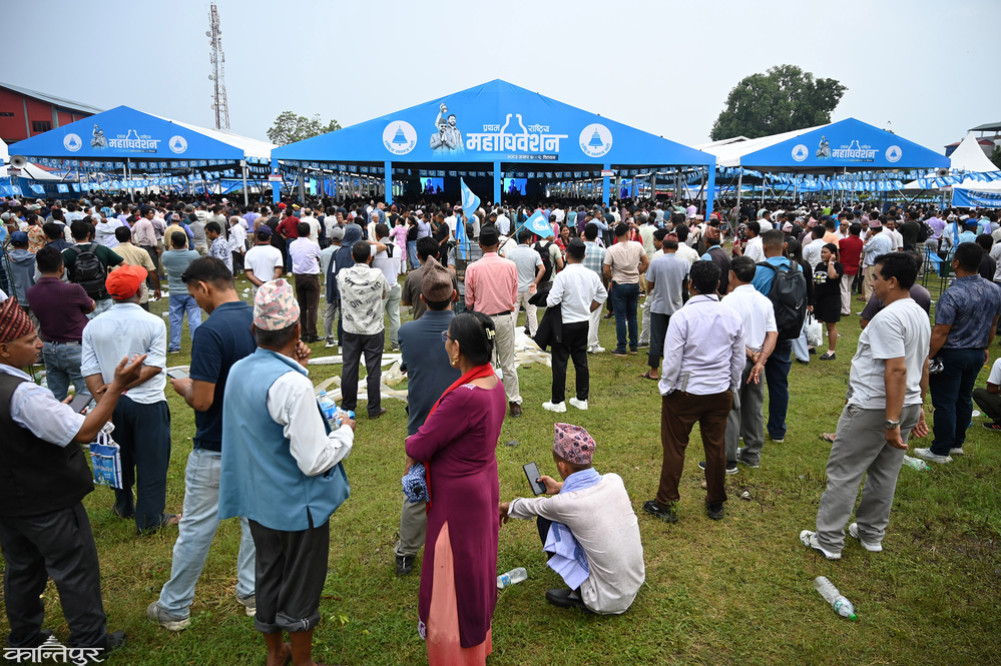
During the closed session of the RSSS general convention on 21 Ashad, the then General Secretary Kabindra Burlakoti had made public a list of 35,257 members under the age of 18 in the party. He had informed that there were a total of 523,465 members in the party and presented a list of how many were in which age group. That list was also made public in the media. The closed session passed the organizational report submitted by Burlakoti.
The Commission has drawn serious attention to the information received by the Commission and the news published in various media outlets that the RSSS has organized children under the age of 18 as party members. The Commission's Assistant Spokesperson and Deputy Secretary Shyambabu Kafle wrote to the Rashtriya Swayamsevak Sangh (RSS), saying, "If the report presented at the party general convention states that children under the age of 18 were distributed membership by the party, such an act would be against the prevailing Nepalese law and Nepal's international commitments, so please provide detailed information as soon as possible regarding whether or not they were distributed party membership."
A letter has been sent to the RSS to send details in accordance with Section 21(1) of the National Human Rights Commission Act, 2068. The said section of the Act states, "Cooperation in the work of the Commission: The concerned body or official shall provide the assistance requested by the Commission."
Organizations and individuals working in the field of child rights had objected to the RSS giving party membership to children. The Children's Peace Sector National Campaign (CJP) had objected after the then General Secretary of the RSS, Burlakoti, mentioned in the organizational report that more than 35,000 children under the age of 18 were party members.
Political parties had also urged the ruling party to act in accordance with the country's constitution and laws, saying that the issue had been drawn to their attention in the parliament. According to the report passed by the Rashtriya Swayamsevak Sangh (RSS), the highest number of children, 13,011, are RSSW members in Bagmati Province. The lowest number, 1,414, is in Karnali. Similarly, the RSSW has made 6,235 children members in Koshi, 3,030 in Madhesh, 5,116 in Gandaki, 3,648 in Lumbini, and 2,813 in Sudurpaschim.
Bipin Kumar Acharya, who was elected as the general secretary by the general convention, has clarified that the organizational report included details of children due to an error. After the Human Rights Commission wrote to him, General Secretary Acharya issued a statement on Wednesday stating that the party had made an error. Citing the data from the organizational report presented at the first general convention of the Rashtriya Swayamsevak Sangh (RSS), the statement said that serious attention has been drawn to the news published and broadcast in some media outlets that 35,257 people under the age of 18 are party members.
The RSSS is fully committed to the rights of the child and the principle of keeping children free from political activities established by the Constitution, the Political Parties Act, prevailing laws, and international treaties to which Nepal is a party. Acharya also stated that the data presented at the general convention was only a comprehensive analysis of the initial application details in the party's digital membership system. The data was not an official record of verified and finally approved members,' the statement said, 'Since there is a system for the applicant to enter the details himself during the membership application, some applications have shown the age of some applicants to be younger than the actual age due to incorrect selection of BS and IS calendar systems, typographical errors in the date of birth entry, current date instead of date of birth or other incorrect details entered, which has led to the system showing the age of some applicants as lower than the actual age.'
General Secretary Acharya has stated that as per the provisions of the country's laws and the party's statute, there is no policy, practice or institutional objective to make children under the age of 18 members party members or involve them in political activities as party members. As mentioned in the organizational report passed by the general convention, General Secretary Acharya's statement also mentions that there are no party members.
'Currently, out of the total 523,465 membership applications registered in the party's digital system, the details of 390,112 members have been verified by the concerned level on the basis of official documents including citizenship. The remaining applications are in the process of verification. Therefore, it is not factually realistic to consider or present the unverified initial application details as the final and certified membership record,' the statement states, 'taking this issue very seriously, the Rashtriya Swayamsevak Sangh (RSS) has initiated a detailed technical and administrative review of the membership system.'
General Secretary Acharya's statement also states that the mistake of making children party members will not be repeated. For that, he said, a system will be implemented to automatically identify details showing that the age is less than 18 years through the system and prevent the approval process from moving forward. The records of party members who have already been verified will be re-examined to determine whether children under the age of 18 have taken party membership or not, and if such membership is found to have been approved due to technical or human error, it will be immediately revoked, he said in the statement.
Only people who have reached the age of 18 will be kept in the membership record, Acharya said. The statement issued by him reads, "The Rashtriya Swayamsevak Sangh (RSS) expresses its regret that the raw data based on the initial application details have been included in the public report of the general convention without sufficient testing and verification, and this has led to confusion or confusion among the general public, the media and the concerned stakeholders. It also expresses its commitment to re-examine all the details and make the necessary amendments and updated data public as soon as possible."
Article 39 of the Constitution of Nepal prohibits any kind of exploitation or improper use of children. The Children's Act, 2075 BS defines children as persons who have not completed 18 years of age and prohibits their use for political purposes. The Act provides for a fine of up to Rs 50,000 or imprisonment for up to one year, or both.