Efforts to form a front against the government's actions by cooperating in parliament and on the streets, plans to form an alliance in the upcoming local level and provincial assembly elections
We use Google Cloud Translation Services. Google requires we provide the following disclaimer relating to use of this service:
This service may contain translations powered by Google. Google disclaims all warranties related to the translations, expressed or implied, including any warranties of accuracy, reliability, and any implied warranties of merchantability, fitness for a particular purpose, and noninfringement.
As the Rashtriya Swayamsevak Sangh (RSS)-led government begins to dig into the decisions of the previous government, top leaders of the UML and the NCP have begun to look for points of cooperation. Both parties are doing their homework with the aim of forming a front against the government's actions by cooperating in parliament and on the streets.
Leaders claim that an informal agreement has been reached between UML Chairman KP Sharma Oli and Pushpa Kamal Dahal on forming an alliance in the upcoming local level and provincial assembly elections. According to them, discussions have already begun on how to collaborate in the provincial government.
Even after the Rashtriya Swayamsevak Sangh (RSS) government started investigating and arresting top leaders of the old parties to find 'connections' in various crimes, it seems that Oli and Dahal are moving towards cooperation. The government has already started an investigation into the crime of money laundering against former Prime Ministers Oli and Dahal. The government arrested Oli on 14 Chaitra for investigation on charges of suppressing the Gen-G movement. He was released a few days later on a court order. UML Vice-Chairman Bishnu Poudel has been arrested and is in police custody. In the past, investigations into the assets of leaders who held public positions have also been initiated.
Since the formation of the government under the leadership of the Rashtriya Swayamsevak Sangh (RSS), steps have been taken such as banning student organizations of political parties from universities, abolishing employee unions, and removing those who had previously been politically appointed to various positions. Recently, the RSSS has also brought up the agenda of making the local level and the National Assembly non-partisan. The RSSSS has also put forward the agenda of abolishing the provincial assemblies provided for in the constitution by the old parties. For this reason, leaders say that Oli and Dahal have come to the conclusion that they should cooperate.
The cooperation between the Oli-led UML and the Dahal-led NCP (then Maoist) is not new. They have collaborated repeatedly in power. In 2074, they won almost two-thirds of the seats in the House of Representatives through an electoral alliance, and formed the NCP by unifying the parties. But the 'mania' of power could not sustain the cooperation.
Due to the power struggle between Oli and Dahal, the then CPN (Maoist) had reached a state of unity and the UML and Maoists had awakened. Due to the events at that time, Oli and Dahal had reached a state of 'water-to-water' in the House of Representatives. But after the 2079 elections, Oli and Dahal collaborated. Oli helped form a government under Dahal's leadership. That collaboration broke down within two months. Dahal formed an alliance with the Nepali Congress. The 'war of words' that began between Oli and Dahal continued until a few months ago. After the election results of 21 Falgun reminded them of the truth, they are again looking for collaboration.
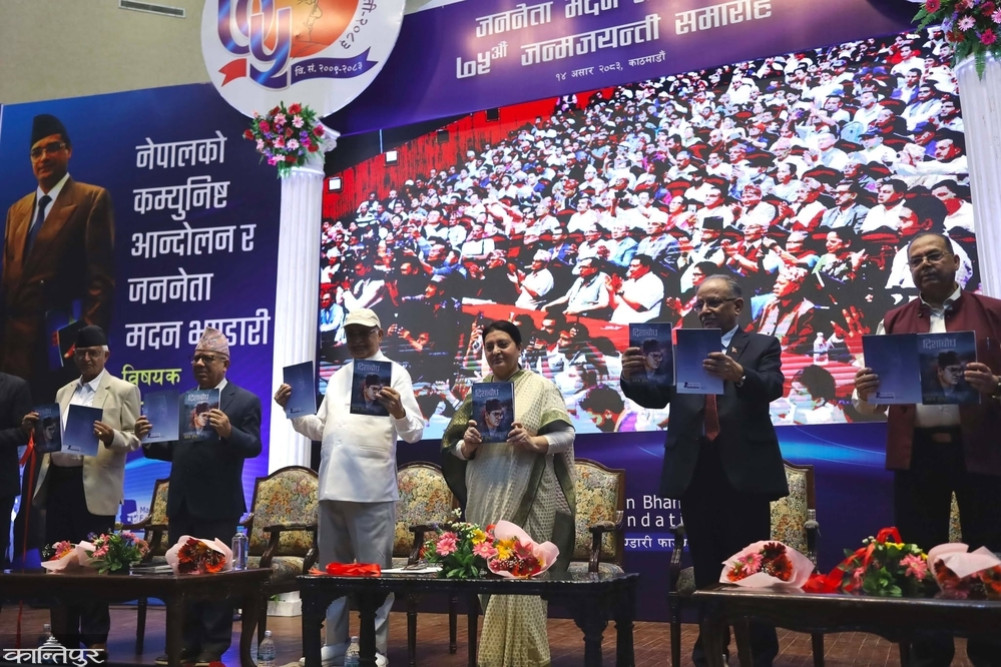
Oli and Dahal have given a message from the same platform on Sunday that leftist parties should unite. At a program organized on the 75th birth anniversary of former UML General Secretary Madan Bhandari, Oli, Dahal, along with CPN (Maoist) co-coordinator Madhav Kumar Nepal and leader Jhalanath Khanal emphasized on leftist collaboration. They say that there is a need to collaborate for nationalism, protection of the constitution and democracy. Although they have said they will cooperate in parliament and on the streets against the government's 'unconstitutional activities', their main objective seems to be to preserve the leftist vote for the local level and provincial assembly elections to be held next year.
UML Chairman Oli said that cooperation between the left and democratic forces is necessary as democracy has been lost in the country after the Gen-G movement, the 24 Bhadra protests and the 21 Falgun elections. 'Where is the talk of building socialism coming from? At this time (the government) is worried about regressing. The main task is to stop regressing. All leftist and democratic forces should come together,' he said. 'Work is being done to weaken the leftist forces. The leftist and democratic forces will have to come together to stop regressing. The constitutional amendment should be in favor of the people.'
Oli indicated that other forces had broken the unity between the UML and the then Maoists after the 2074 elections. 'There may be an attempt to prevent democratic forces from coming together and to split others. "We have seen a split,' he said, 'If someone tries to interfere within the party, we recognize it and defeat it. UML is united and strong.' He also claimed that UML's policy is correct. He said that cooperation is more important than unity.
Taking aim at NCP coordinator Dahal, Oli said that the door to cooperation should be opened in a practical way. 'We are not in favor of the so-called revolutionary narrow-mindedness. We are not so-called flexible,' he said, 'We are not in favor of being narrow-minded in practical matters. We should embark on the path of making it possible.' Oli said that cooperation is necessary again now because the 046 movement and the subsequent constitution-making were achieved in cooperation with the left and the Congress.
NCP coordinator Dahal, on the other hand, had been supporting the good governance and other steps of the RSP government in the initial days. Recently, however, he has started to be a strong critic of the government. He said that the government has engaged in undemocratic activities. ‘In this situation, the left must unite against autocracy and foreign pressure without delay. Delaying will be a big mistake. I did not say let's unite tomorrow. If cooperation can be achieved, let's do it today, tomorrow. Let's do it in parliament, on the streets and in the elections. If we delay, a terrible accident is going to happen,’ he said, ‘We must unite for cooperation.’
Dahal said that cooperation should be done by reviewing past unity and division. ‘We came together for socialism in 074. The people approved it with a two-thirds vote. Today, I am in favor of reviewing it once again. I am not in favor of unity without review,’ he said, ‘We should not unite in a hurry and cry at leisure.’
Dahal said that there has been a conspiracy to eliminate the leftist forces in recent times. ‘Counter-revolutionary developments are increasing in the country. National independence is in crisis. The government is trying to attack the fundamentals of the constitution and the oppressed classes,' he said, 'We have seen that the countries of South Asia are concerned about how to end the communist movement.'
NCP coordinator Dahal said that he has been taking new decisions from armed conflict, peace process to leftist unity. 'We have to continuously disrupt. I am a disrupter, otherwise there would have been Prachanda Path. The situation has changed, we will also change. We have to change our views according to the situation.' Oli and Dahal had held talks about leftist cooperation two weeks ago.
NCP co-coordinator Madhav Kumar Nepal and former Prime Minister Jhalanath Khanal reviewed the past and emphasized leftist unity. 'Let the leftists unite their hands, minds and perspectives. In the past, we used to call each other names. This has become a shame. Let us unify the communists by clarifying what the strategy and line of action are and move forward,' Khanal said, 'Now let us move forward with functional unity. The country, the republic and the constitution are in danger.'
Co-coordinator Nepal said that unity will be sustainable only if the leftists find a method and system through discussion and debate. 'Where did we go wrong? Why did the Communist Party, which had reached that power, become weak? Let's review,' he said.
Former President Bidya Devi Bhandari, who is directly involved in UML politics, said that the communist movement is on the verge of a challenge. She said that effective, people-oriented and timely policies should be made to strengthen relations with the people. 'It is not appropriate to predict the future of the communist movement with one election,' she said, 'We will have to introspect to strengthen the policies, working style and organizational structure in line with the times.'
While top leaders are emphasizing cooperation, some leaders are also commenting that the voices being raised in the party for leadership transfer are a ploy to divert the subject. There is a voice in both UML and NCP that leadership should be transferred. Such a voice is more pronounced in UML. The general convention held last November re-elected Oli as the chairman, but after the poor results in the House of Representatives elections, vice-chairmen Gokarna Bista, Bishnu Poudel, Raghuji Panta, Prithvisubba Gurung, general secretary Shankar Pokharel, deputy general secretary Yogesh Bhattarai and others have demanded a leadership reorganization.
Former Maoist leader and analyst Ram Karki says that Oli and Dahal are ‘pragmatist’ leaders who act based on their own interests rather than the left movement. ‘The issue of a leadership change arose within the UML. Next, the government started investigating the assets of the leaders. Both of them must have thought that foreigners would support them after they got together. That is why there is talk of collaboration again,’ he said. ‘In political terms, these two leaders are pragmatists and utilitarians. No one can stop them from merging or splitting to fulfill their interests. That is what they have done in the past.’
UML chairman Oli reached Baluwatar on 17 Ashad 081. The then Prime Minister Dahal had heard that an alliance was being formed between the Congress and the UML. Until then, there was cooperation between the UML and the then Maoists in power. Dahal asked Oli about the alliance. Oli replied, 'Now, even if we go to heaven together, we will go to hell together.' But that same night, Oli agreed to cooperate with the Congress. The Dahal government fell.
Although the communists do not believe in heaven and hell in principle, the phrase is famous in the context of the unity and division of Oli and Dahal. This context also shows that they can betray each other at any time. The communist power in the country seems to be weakening due to 'deceitful' politics. In the last election, the leftists shrank to about 21 percent of the vote.
The UML and the Nepali Communist Party have only 42 seats in the 275-member House of Representatives. In the proportional representation, the UML got 1,455,885 votes or 13.44 percent and the NCP got 811,057 votes (7.49 percent).
In 2074, the UML and the then Maoists won almost two-thirds (174) of the seats. In proportional representation, the two parties won about 47 percent of the votes. These two parties won about 42 percent of the votes in the 2079 election. In the 2064 Constituent Assembly election, the then Maoists, UML and other leftist parties had about 60 percent of the votes. In the second Constituent Assembly election in 2077, they got about 42 percent of the votes.