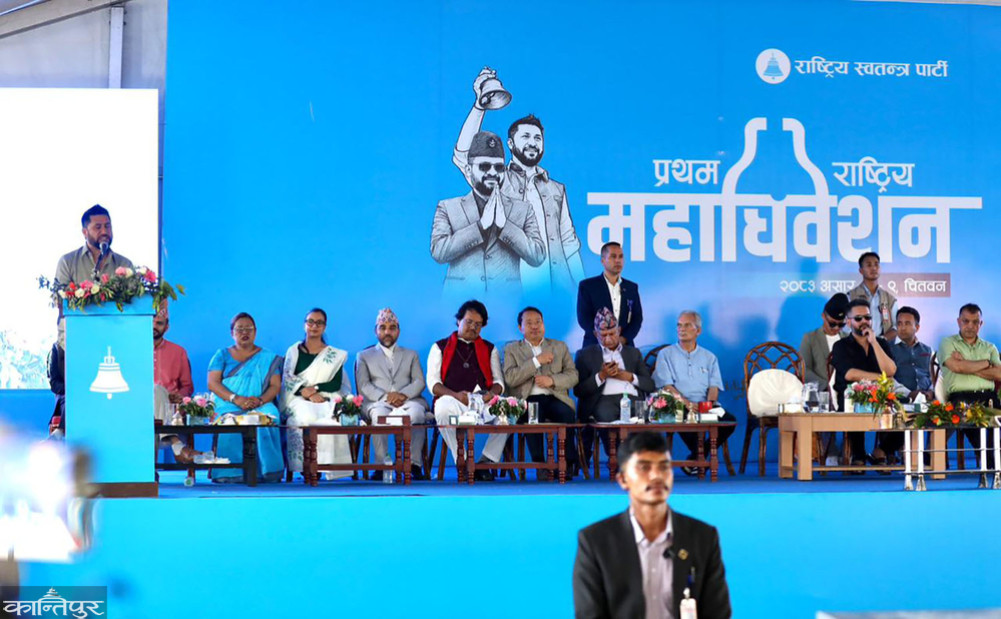
The Rashtriya Swayamsevak Sangh (RSS) is pushing forward a non-partisan local-level agenda, from its election manifesto to the party convention documents, while also setting criteria for selecting candidates for local elections.
We use Google Cloud Translation Services. Google requires we provide the following disclaimer relating to use of this service:
This service may contain translations powered by Google. Google disclaims all warranties related to the translations, expressed or implied, including any warranties of accuracy, reliability, and any implied warranties of merchantability, fitness for a particular purpose, and noninfringement.
The National Independent Party is putting forward a non-partisan local level agenda from its election manifesto to the party convention documents. This debate is not new.
During the drafting of the 2072 BS constitution, some political parties had raised the voice that the local level structure should be kept outside of political parties. The Rashtriya Swatantra Party, which won almost two-thirds of the seats in the House of Representatives, has been raising the issue of 'partyless' local levels with priority in recent times.
The Rashtriya Swatantra Party had included the issue of local government becoming non-partisan in the minimum concept of constitutional amendment in its election manifesto. The constitution itself should be amended to change the system of people's representatives coming through competition between parties in the local level structure. The Rashtriya Swatantra Party-led government has already started its homework to identify the topics that need to be amended in the constitution.
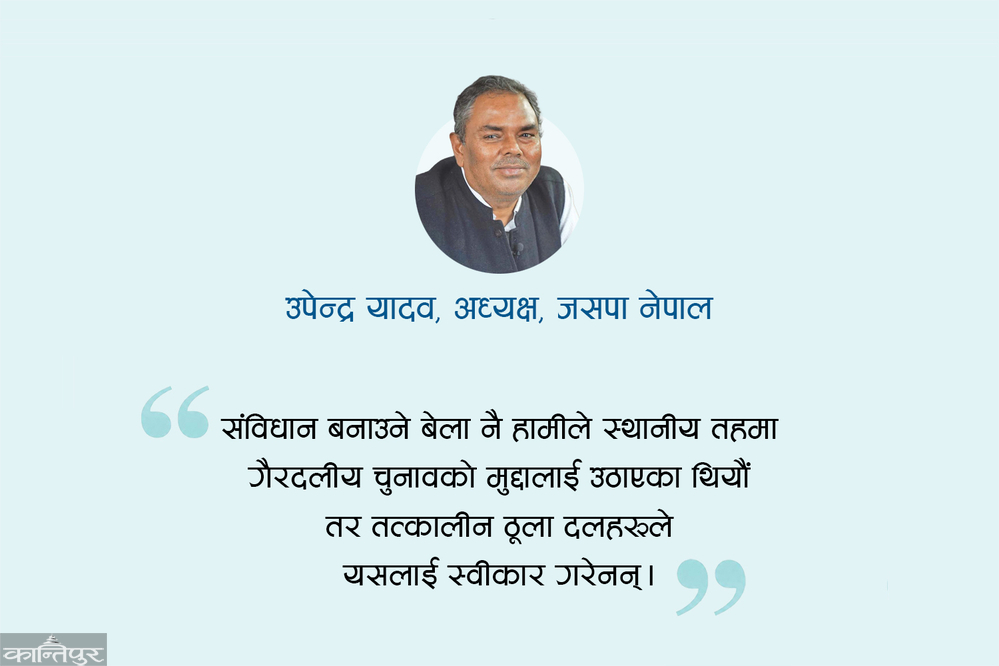
The party's economic and political proposal presented by the then Vice President Swarnim Wagle at the party's first general convention held in Bharatpur also includes agendas such as party-free local levels, a one-third reduction in the number of local levels, and the abolition of the provincial assembly. The proposal states, 'We will amend the current constitution on the day our numbers and strength reach their full potential.'
During the constitution-making process, mainly Madhesh-centric parties advocated for party-free arrangements at the local level. JSP Nepal still seems to be in favor of it. JSP Nepal Chairman Upendra Yadav says that it would be better to free the local level from party politics to develop it as an institution for development. ‘We raised the issue of non-partisan elections at the local level when the constitution was being drafted, but the then major parties did not accept it,’ he said, ‘We should bring the local level under the province and arrange for elections without parties.’
Janmat Party President CK Raut says that a strict law is needed to bind people’s representatives elected by parties at the local level to the party’s discipline. ‘In the absence of that, it would be better to hold elections without party symbols,’ he says, ‘Currently, there is a situation where people are elected by parties at the local level but the party does not care and no action can be taken.’ On the other hand, when people’s representatives do wrong things, the party is being defamed.’
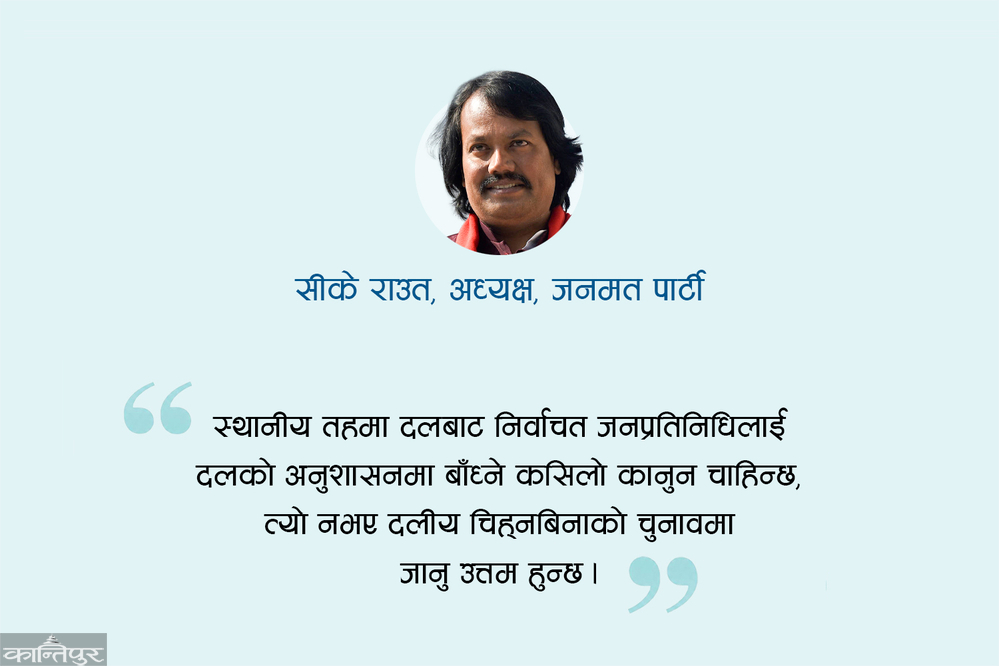
Raut also argues that a constitutional amendment is not necessary to hold local elections without party symbols. He says that the issue of party representation in the context of local government formation is not mentioned anywhere in the constitution.
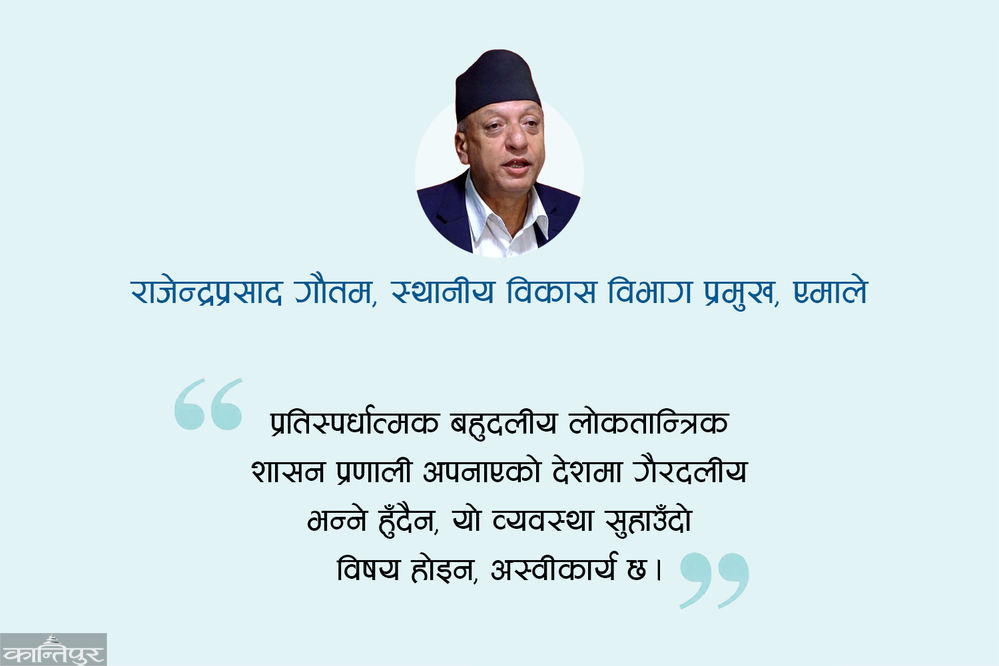
Rajendra Prasad Gautam, head of the UML's local development department, says that non-partisan elections are unthinkable in a party system. 'We are in a party-competition system. In a country that has adopted a competitive multi-party democratic governance system, it cannot be called non-partisan,' he says. 'This is not a matter that suits the system, it is unacceptable.'
He said that the contradictory character of the RSPB is seen in setting the criteria for candidate selection and preparing for local elections on the one hand, and non-partisan local elections on the other. The central committee meeting of the RSPB held on 7 Baisakh had decided to set the framework and criteria for candidate selection for local elections. UML leader Gautam has pointed to that. He said that non-partisan local elections cannot be held without amending the constitution. A two-thirds majority in both houses is required for amending the constitution. There is about a year left for local elections.
The Election Commission has also stated that local elections can be made non-partisan. The commission had sent its suggestions to the task force formed by the government to set the agenda for constitutional amendment last month. Acting Chief Election Commissioner Ram Prasad Bhandari informed that the commission had sent its suggestion for non-partisan elections after looking at the two elections held at the local level and the subsequent practice. ‘The local level is the first unit for development work and a place to provide services to the people,’ he told Kantipur. ‘It is better not to promote partisanship or politicization there.’ There are such practices in other democratic countries too.’
Bhandari claims that leaving the local level independent will yield more returns. ‘It is better to make local level people’s representatives accountable to the people rather than parties and to facilitate development work by making local level electoral competition party-free,’ he said.
Bhandari also says that there is no need to keep amending the constitution to hold elections without party competition at the local level. ‘The constitution does not prevent it.’ It is enough to amend some laws including the Local Level Election Act,' he said, who is also a senior advocate. 'The issue of going into such an exercise depends on the willpower of the government and political parties.'
Constitutional expert Bipin Adhikari has a different argument. He says that no special achievement can be achieved by making the local level non-partisan. 'The local level can be made non-partisan, but what achievement will be achieved from this should be seen,' he said, 'In non-partisan, an individual will stand in the election. In partisan, the individual also has the responsibility of the party. An individual becomes small in front of the party. A party is also a large organization.'
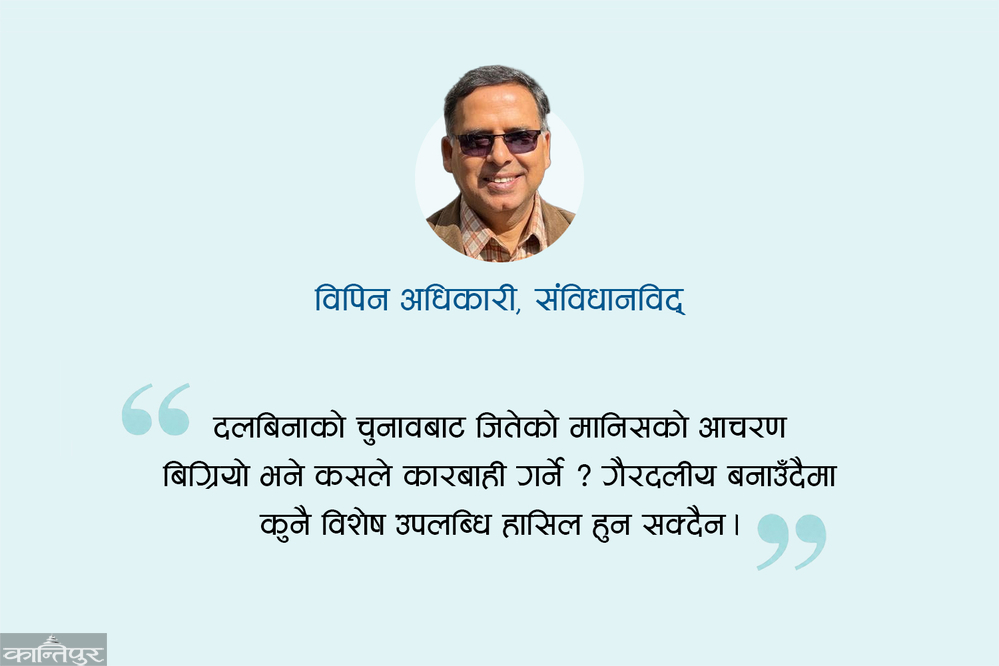
Adhikari argues that it is easier for an individual who has the support of the organization, that is, those who won from the party, to bring big policies and programs and implement them successfully than for an individual. 'In a situation where an election is held without a party, who will take action against the winner if the behavior of the person who won deteriorates? Who will hold him accountable?' he says.
Constitutional scholar Adhikari sees non-partisan elections as difficult at a time when the Nepali people's mobility and the exercise of the constitutionally granted right to organize have increased. 'The leadership level approach of the Rashtriya Swayamsevak Sangh (RSS) is not enough. If party workers do not get the opportunity to organize, where will they do politics? This question will also arise within the party,' he said, 'We are a country that has come a long way in democratic culture. We have become very open. Except for the Panchayat, non-partisan elections have never been held.' Adhikari says that the path to non-partisan elections at the local level will not be opened without an amendment to the constitution.