The basic political principle is social democracy, with the proposal for the Vice President to be the Speaker of the National Assembly.
We use Google Cloud Translation Services. Google requires we provide the following disclaimer relating to use of this service:
This service may contain translations powered by Google. Google disclaims all warranties related to the translations, expressed or implied, including any warranties of accuracy, reliability, and any implied warranties of merchantability, fitness for a particular purpose, and noninfringement.
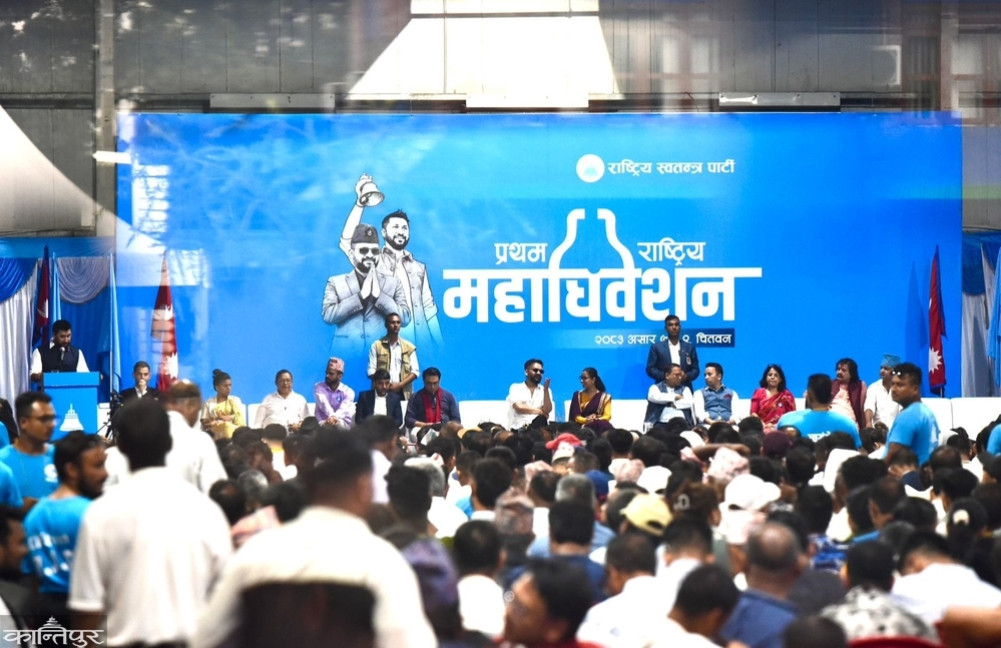
The National Independent Party has proposed to make the National Assembly a non-partisan expert assembly with the Vice President as its chairman. Presenting a political report at the closing session of the ongoing general convention in Bharatpur, Chitwan, party president Rabi Lamichhane has said that the RSP is also in favor of a directly elected executive.
While the government is discussing the constitution amendment by forming a task force under the leadership of the Prime Minister's political advisor Asim Shah, the document prepared by president Lamichhane states, 'The RSP is in favor of a directly elected executive with stable leadership and clear responsibilities.' However, stating that the constitution amendment is not a declaration of any party, he said that he wants the amendment to be guided by the long-term needs of the nation, the people's experience and democratic practice.
President Lamichhane said that the door to review and amend the implementation within a decade was opened when the constitution was written in 2072 BS. He said that the RSP is in favor of an open, honest and responsible debate on the achievements and weaknesses of the constitution and the reforms desired by the citizens. "The basis for constitutional amendment should be good governance, stability, representation and the interests of the citizens. We are in favor of a comprehensive national dialogue, expert suggestions, citizen participation and all-party consensus as much as possible," he said.
Through the report submitted to the general convention, RSP President Lamichhane has also tried to answer the question that has been raised for a long time about what the RSP's views are. He said that his report will dismiss such questions as some critics have been saying that the RSP has no views without looking at the documents.
"We are not traditional leftists or rightists and are not deliberately limited to that political polarization. We give priority to a practical, sensible, need-based and reality-based approach, not to any rigid ideological framework," he said. "We respect the historical contribution, experience and positive practices that old ideological frameworks have made to human society, but we weigh them against practical utility and social justice."
Lamichhane, who may appear ‘right-wing’ in encouraging the private sector, an investment-friendly environment and competition, and ‘leftist’ in saying that the state should ensure basic health care and education for all citizens, has maintained that they do not believe that they should move forward from any single ideological framework. ‘The leftist who does not encourage startups, private enterprises and market freedom will show labor rights, minimum wages and social security guarantees,’ he said. ‘We believe that the state, society and economy should be moved forward not from any single ideological framework, but from a mixed, balanced and situation-specific perspective. We say that we should make glasses by examining the eyes, not the eyes according to the glasses.’
After the general convention, Lamichhane said that the main political principle of the Rashtriya Swayamsevak Sangh (RSS) will be social democracy. The proposed statute of the RSSS mentions constitutional socialism. However, he stated that he has come to the conclusion in the report that it is not appropriate to adopt the constitution as an argument or principle. In the report, he wrote, "This does not mean that the constitution is unacceptable. The constitution of the country and the party's policies, ideas, and principles are two separate issues." Calling the constitution a document of the then political agreement, Lamichhane raised the question of how the goal can be achieved by making it an argument when amendments are inevitable over time.
Relationship with other political parties
President Lamichhane has also said that the Rashtriya Swayamsevak Sangh (RSS) does not view other parties as enemies of each other. "For decades, politics has been viewed through the lens of who is friend and who is enemy, but in the politics of nation-building, parties are not enemies of each other, but at most, they are competitors with different ideas, programs and priorities," he mentioned in the report. "Electoral competition in a democracy does not mean differences even on the fundamental questions of the nation." Lamichhane said that their common enemies are poverty, corruption, misrule, illiteracy and weak health services. "The enemies of this country are youth migration, economic dependence, an unproductive economy, declining trust in the state and social division and intolerance." Lamichhane said that the all-party consensus has been very discredited due to division so far and said that he wants to restore its dignity by using that consensus in the national interest. "What kind of citizens do we need? What kind of education system do we need? This question is not just about the government, but about the future of society, so education policy is a matter of national consensus," he said.
Lamichhane has said that despite the four years since the establishment of the Rashtriya Swayamsevak Sangh (RSS), the party is in a transitional period of transformation from a political campaign to an institutional political party due to various reasons. ‘A sound parliamentary form has been decided by public opinion, but popularity alone cannot be the basis of long-term political power,’ he self-assessed, ‘There is a tendency to play in the name of new and old within the party for personal gain, a factional mentality, a tendency to expand personal influence, and a person-centered mindset in the organization, which is challenging organizational unity and trust.’
Lamichhane said that there is also a weakness in developing a culture of cooperation and respect with the feeling that we are part of the same river, regardless of the source. ‘There are also complaints that group protectionism has discouraged qualified and committed members, and there is also a tendency to seek special rights based on initial contributions and prevent good people from joining the party because they may be a challenge to themselves,’ he said. Lamichhane also mentioned that there is a risk of increasing frustration and inactivity among members due to the lack of regular contact, dialogue, and capacity development. He said, ‘There is also a growing concern that the organization will depend on individuals rather than methods.’ Lamichhane also mentioned in the report that the Rashtriya Swayamsevak Sangh (RSS) needs to prove that it is not a power of momentary popularity but a long-term institutional and transformative political force, as critics have said. ‘The public opinion we have obtained is not the final achievement, but only the basis for the beginning of a great journey,’ the report said, ‘method, transparency, discipline and dedication are necessary to convert it into long-term public trust. Real reform in the party is possible only when a culture of putting methods before individuals, us before me and common objectives before self-interest develops.’
Chairman Lamichhane said that as the RSS has matured and refined, the size of public dedication has also been continuously expanding. ‘Our determination, continuous efforts and unbreakable relationship with the people are the greatest strength, so there is no reason to panic or be disappointed. We should consider criticism and condemnation as a result of the increase in our power,’ he said.