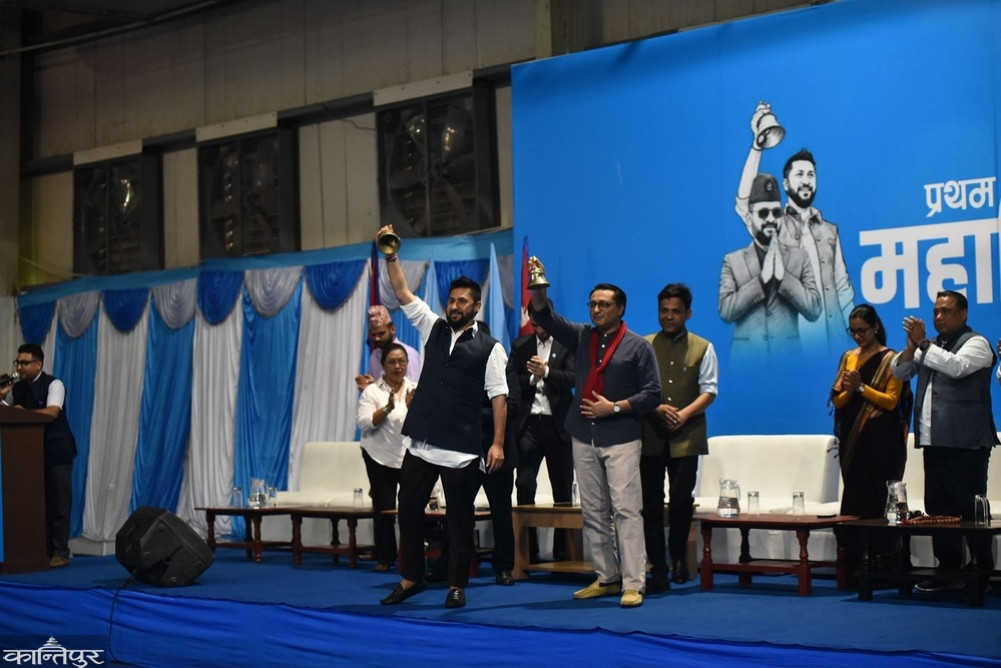
The two major documents presented by President Ravi Lamichhane and Vice President Swarnim Wagle at the Chitwan general convention show that there is no consensus among the leaders on the party's view on federalism.
We use Google Cloud Translation Services. Google requires we provide the following disclaimer relating to use of this service:
This service may contain translations powered by Google. Google disclaims all warranties related to the translations, expressed or implied, including any warranties of accuracy, reliability, and any implied warranties of merchantability, fitness for a particular purpose, and noninfringement.
The ongoing general convention of the Nepali Rashtriya Swayamsevak Sangh (RSS) in Chitwan has clarified many issues of the party's ideological direction, but there is still confusion on the issue of federalism. The two major documents presented by President Ravi Lamichhane and Vice President Swarnim Wagle at the Chitwan general convention show that there is no consensus among the leaders on the party's view on federalism.
Lamichhane's political proposal mentions 'directly elected executive, fully proportional electoral system, making the National Assembly a non-partisan expert assembly and making the Vice President the speaker' and states about federalism, 'We are also in favor of restructuring the provincial assemblies and provincial governments.' Lamichhane has mentioned restructuring in a single sentence in an 'abstract' manner without giving a roadmap on how to make the federalism that has already come effective.
The political document presented by Vice President Wagle means that the issue of abolishing federalism has entered the political document. ‘We will amend the current constitution on the day we reach our numbers and strength. The RSVP has already put forward agendas for governance reform such as a directly elected prime minister, a system where MPs do not become ministers, a one-third reduction in the number of non-party local levels and 753, restructuring of federalism including the abolition of the provincial assembly, radical reforms of other constitutional bodies including the Judicial Council, and transparent funding of recognized political parties,’ his report states.
Party leaders have been explaining the issue of abolishing the provincial assembly in different ways at different times. A year ago, Deputy Chairman Wagle had described the provincial assembly as a place for the big parties (then Congress and UML) to manage (park) workers and said that the provincial assembly would be abolished when the RSVP’s numbers and strength reached theirs.
In his recent statements, he has said that he has been saying that he has been saying that he wants to maintain the federal structure but abolish the current structure and radically restructure the provincial assembly. Even in the document, he has raised the issue of abolishing federalism on one hand and restructuring on the other.
‘The day the RSVP reaches its number and strength, federalism will be abolished’, a statement made publicly a year ago. Kantipur had questioned Wagle before the 21 Falgun elections.
‘My clear statement is that the seven-province structure of federalism will remain, but we must correct the internal irregularities and distortions. These reforms are also necessary to make the provinces more effective. The abolition of the provincial assembly may also be necessary for radical reform, so this should be done quickly,’ he had said in an interview.
Even in the RSVP’s manifesto made public before the elections, it is mentioned that the current federal practice is ‘overkill’ and that reforms are necessary.
The RSVP’s manifesto mentions that a ‘discussion paper’ will be prepared on the proposals for amending the constitution within three months of assuming power in order to establish a national consensus.
According to the pledge, the government had formed a task force on 16 Chaitra under the leadership of Prime Minister Balendra Shah's political advisor Asim Shah. The task force is currently discussing with stakeholders what amendments are needed in the constitution.
'The following concepts will be the minimum to be submitted for initial discussion by the National Independent Party,' the pledge states, stating that the issues of 'directly elected executive, fully proportional parliament, system where MPs do not become ministers, non-partisan local government, and improved provincial structure' are in the pledge.
Political analyst Tulanarayan Sah says that the Chitwan general convention sent a message that the Prime Minister will return to the backward path rather than implementing the ideas on federalism that he gave in Janakpur during the election.
'Many people also ask in Kathmandu and Janakpur, what is the National Independent Party's view on federalism and provinces? I say, provinces should be made stronger.' The province's job should not be to go to a ward and connect 50,000 people, but to connect at least three-four municipalities. Why go to Kathmandu when the Chief Administrative Officer of Janakpur needs to be changed today? Isn't Janakpur the capital of the province?' Addressing the party's general meeting held in Janakpur on 20 Magh, Shah had said, 'The province should be made so strong that there is no need to go to Kathmandu, all arrangements should be made in the province. Kathmandu should only be a place to visit Pashupatinath and Swayambhu and visit, not a place to demand rights.'
Analyst Shah says that the Chitwan general convention confirmed that the RSVP has not been a party in favor of federalism since its inception. He understands that the RSVP's view on federalism during the 21 Falgun elections was limited only to election strategy.
'If the RSVP is in favor, what is its main dispute over the ten years of federalism implementation?' "It would have been a task to analyze the problem and show solutions to find out why it could not be effective and powerful," says Sah. "What is confirmed from practice is that the union did not give the provinces the authority. The necessary laws were not given to adjust the police and civil servants. This would have raised strong arguments that federalism was paralyzed. The Chitwan general convention could have made a breakthrough and moved forward. But, now it is not a breakthrough. There has been confusion. The confusion means that the RSVP is not a party in favor of federalism."
Analyst Sah says that the two documents presented at the Chitwan general convention made it clear that the statements made by senior leader and Prime Minister Balendra Shah during the election were also strategic.
"From the beginning, there was no clarity in not only the federalism of the RSVP, but also in its ideas, philosophy, and all the structures envisaged by the constitution." "Whatever is popular at the time was mentioned," he said. "It could be called a strategy until the election. However, even after the election and the formation of the government, the same thing continued on the issue of federalism. This did not show a clear ideological trend towards federalism."
He said that the delegates to the general convention also did not study the report of the chairman and vice-chairman in depth.