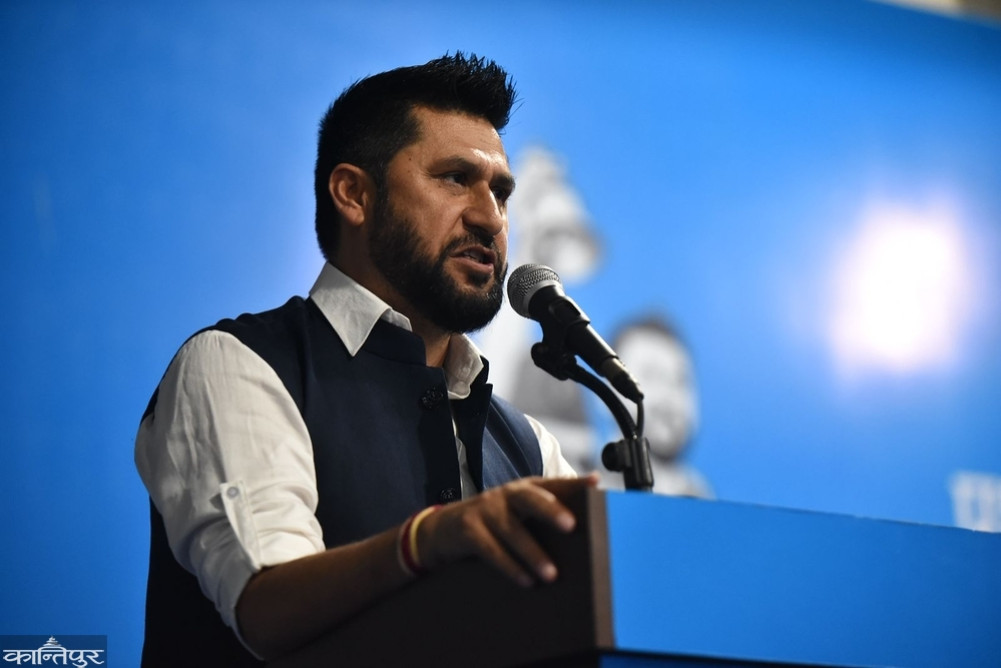
There is no reason why the entire country cannot be unanimous on production and employment, good governance, constitutional and electoral system reforms, foreign policy and national interests, climate crisis, and the use of natural resources: Chairman Lamichhane
We use Google Cloud Translation Services. Google requires we provide the following disclaimer relating to use of this service:
This service may contain translations powered by Google. Google disclaims all warranties related to the translations, expressed or implied, including any warranties of accuracy, reliability, and any implied warranties of merchantability, fitness for a particular purpose, and noninfringement.
The Rashtriya Swayamsevak Sangh (RSS) is set to adopt a parliamentary policy of consensus on long-term issues. In the political report presented at the closed session of the first general convention in Bharatpur on Tuesday, President Lamichhane said that the RSSS wants to change Nepal's political culture.
'For decades, politics has been viewed through the lens of 'Who is a friend - who is an enemy?' But in the politics of nation-building, parties are not enemies of each other, at most they are competitors with different ideas, programs and priorities. In a democracy, electoral competition does not mean differences even on the basic questions of the nation,' he said in the report.
President Lamichhane said that the common enemies are poverty, unemployment, corruption, misgovernance, illiteracy and weak health services. 'The migration of youth, economic dependence, an unproductive economy, declining trust in the state and social division and intolerance are the enemies of this country,' he said.
Chairman Lamichhane also said that the all-party consensus, which was previously discredited due to power sharing, will be improved. He said in the report, 'Until today, the all-party consensus is very discredited due to power sharing. We want to use that consensus in nation building and restore its dignity. For example, education. What kind of citizens do we need? What kind of education system do we need? This question is not only about the government, but about the future of society. Therefore, education policy is a matter of national consensus.'
Similarly, Chairman Lamichhane said that the basic health rights of citizens, health infrastructure, health insurance and quality services are not the concerns of any particular party. 'We will take the initiative to form a common opinion on projects and plans of national pride such as roads, railways, hydropower, irrigation, drinking water, digital infrastructure,' he said.
Chairman Lamichhane also said that even if the government changes, the direction, basic policies and national goals of the state will not change. "There is no reason why the entire country cannot be unanimous on issues such as production and employment, good governance, constitutional and electoral system reforms, foreign policy and national interests, climate crisis and the use of natural resources," said Chairman Lamichhane.
This is Ravi Lamichhane's political report