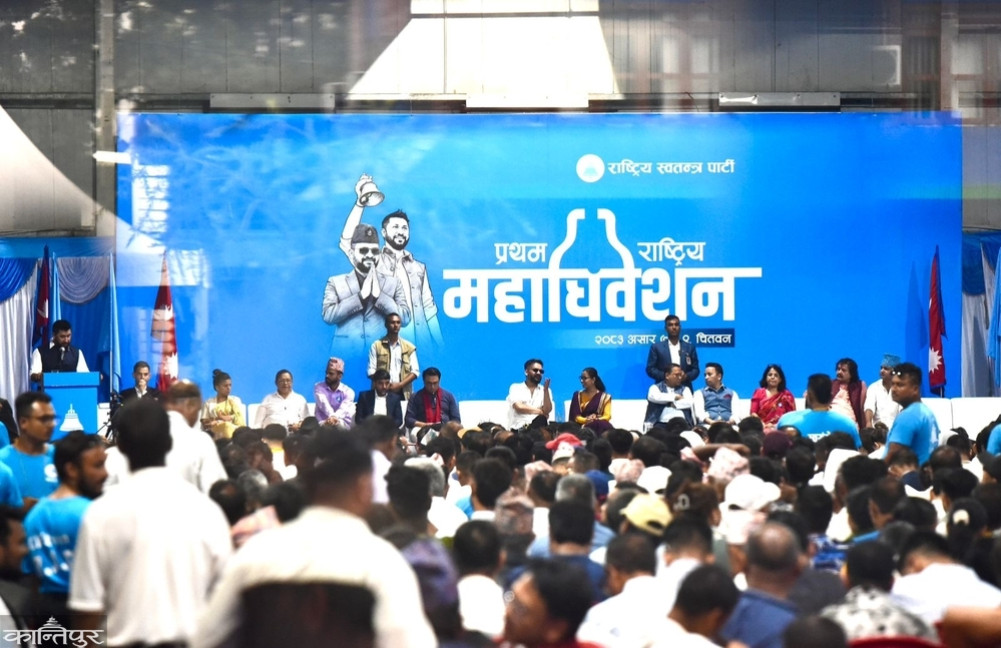
We have a long-term vision of developing Nepal not as a passive arena of competing spheres of influence, but as a 'living bridge' of economic, cultural, trade and human connections connecting South Asia and the Himalayan region: Chairman Lamichhane
We use Google Cloud Translation Services. Google requires we provide the following disclaimer relating to use of this service:
This service may contain translations powered by Google. Google disclaims all warranties related to the translations, expressed or implied, including any warranties of accuracy, reliability, and any implied warranties of merchantability, fitness for a particular purpose, and noninfringement.
President Ravi Lamichhane has said that the foreign policy of the Rashtriya Swayamsevak Sangh (RSS) will focus on 'development diplomacy and a vibrant presence on the global stage'.
In the political report presented at the closing session of the first general convention in Bharatpur on Tuesday, President Lamichhane said that the RSS is committed to an independent, balanced and national interest-centered foreign policy, considering the national interests defined by the Constitution of Nepal - independence, sovereignty, geographical integrity, national self-respect, border security, citizens' rights and interests and economic prosperity - as the basic guidelines of foreign policy.
President Lamichhane has said that the party will remain committed to the United Nations Charter, the principles of Panchasheel, the spirit of the Non-Aligned Movement, international law and the sovereign belief of world peace, while also assimilating the reality of the changing world order. In the report, he said, 'In our view, foreign policy is not just a matter of managing diplomatic relations; Rather, it is also a means of national development, economic transformation, investment attraction, trade expansion, technology transfer and international partnership. That is why the Nepali Congress has set a goal to establish 'development diplomacy' at the center of foreign policy rather than traditional power-centered diplomacy.'
Stating that Nepal is located between the world's two emerging economic and strategic powers, India and China, from a geopolitical perspective, President Lamichhane said, 'The Nepali Congress is confident that this geographical situation should and can be used as an opportunity, not a weakness. We have a long-term vision of developing Nepal as a 'living bridge' of economic, cultural, trade and human relations connecting South Asia and the Himalayan region, not a passive field of competing spheres of influence.'
President Lamichhane also stated that relations with neighboring countries will be based on mutual respect, equality, trust and common interests. He further said, 'Our priority is to expand cooperation in the areas of trade, infrastructure, energy, tourism, education, technology and regional connectivity while maintaining balanced, stable and practical relations with both India and China. We are determined to find solutions to the issues of border management, border disputes and historical treaties and agreements through facts, evidence, international practice and institutional dialogue, not emotional debates.'
President Lamichhane also said that the RSVP is in favor of expanding relations with all friendly countries of the world on the basis of national interest, mutual benefit and universal equality. 'We believe that Nepal's international role should be strengthened through partnership, strategic balance and autonomous decision-making capacity, not unnecessary inclination or dependence on any power center. In the changing world environment, we are committed to establishing Nepal as an active and effective voice on new international issues such as climate change, energy security, supply chain, technology governance, cyber security and migration,' he said.
Nepalis scattered around the world are the most important source of Nepal's soft power, President Lamichhane has mentioned in the report. 'The NCP views the Nepali diaspora not only as a source of remittances, but also as a carrier of knowledge, skills, innovation, investment, international experience and global networks. Building a special diplomatic and policy mechanism to connect the intellectual, economic and social capital of Nepalis living abroad with national development will be our priority,' he said.
Lamichhane also claims that the NCP will act as a bridge to further strengthen the relationship of non-resident Nepalis with Nepal and mobilize their knowledge, technology, investment and experience in the campaign for national prosperity. He further said, 'A successful foreign policy of the 21st century is not just a policy of protecting borders; it is a policy of seeking opportunities, building partnerships and expanding the respect and influence of the nation on the world stage.'
He also says that the RSVP's foreign policy will be based on a combination of national pride and economic realism.