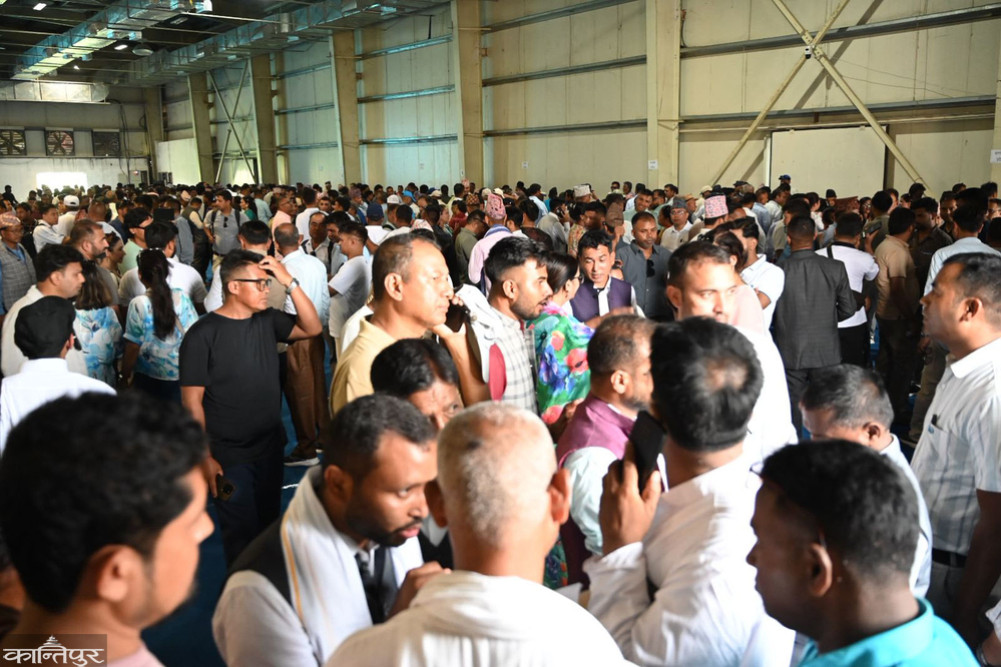
The representatives have said that representation of Madhesi, indigenous, Dalit, and indigenous communities, including women, should be ensured in the office bearers and central committee, as per the constitution.
We use Google Cloud Translation Services. Google requires we provide the following disclaimer relating to use of this service:
This service may contain translations powered by Google. Google disclaims all warranties related to the translations, expressed or implied, including any warranties of accuracy, reliability, and any implied warranties of merchantability, fitness for a particular purpose, and noninfringement.
Even before the closing session of the first general convention, the debate on inclusiveness at the leadership level has heated up within the Rashtriya Swayamsevak Sangh (RSS) party. The representatives have said that representation of Madhesi, indigenous, Dalit, and indigenous communities, including women, should be ensured in the party office bearers and central committee as per the constitution.
Representative Pavitra Thapa from Kaski said that the 33 percent representation of women should not be limited to the 33 percent ensured by the constitution. She said that a party like the RSSP should move forward to limit women to 33 percent and give them responsibility in executive positions as well.
'My personal opinion is that women's leadership should also be mainstream. We should fulfill the 33 percent participation ensured by the constitution and rather than being limited to that, we should move forward to increase it to 50 percent,' Thapa said about limiting women to the 'deputy/co-chair' position, 'This is a structural problem of society rather than a problem of a political party and an individual. Women are still not open to leadership.' We advocate outside, but everyone is hesitant to take it forward practically.'
Stating that she is confident that the 33 percent representation guaranteed by the constitution will be in the central committee and office bearers of the Rashtriya Swayamsevak Sangh (RSS) party, she opined that it should go further than that.
The issue of representation based on population in the party office bearers and central committee is likely to be raised in the closed session. Representatives from Madhesh Province have prepared to demand the presence of leaders from the Madhesh community in the office bearers and central committee. Spokesperson of the Madhesh Province Committee of the RSSP, Ramjit Ram, said, 'In the context of inclusiveness, we raise the issue that presence should also be based on population. However, friends also compete openly. Leaders are also positive about the proposal we have put forward.'
Not only representatives but also leaders are expressing the opinion that women and other communities should be brought into the party leadership and executive positions. MP Toshima Karki raised the question in the last meeting of the outgoing central committee of the Rashtriya Swayamsevak Sangh (RSS) that women were limited to the posts of 'Deputy/Co-Chairman'. She proposed adding the post of General Secretary and ensuring that one woman be nominated as General Secretary or that there should be a competition only for women.
In that meeting, the MPs demanded that the representation of indigenous, Madhesi, indigenous and minority groups should be as per the provisions of the constitution.
Krishnaman Shakya of Dhading says that the RSS should clearly implement inclusivity. He says that the RSS should accept the fact that inclusivity is an important issue for the country. 'Inclusivity is an important, big issue for the country. There was a lack of inclusivity in the past, now the RSS seems to have given importance to it in principle in the structure, but in terms of organization, we are going to hold the first general assembly. I think the inclusion policy needs to be improved further,' Shrestha said, 'The issue of inclusion has not been made clear in some of the working procedures of the Rashtriya Swayamsevak Sangh (RSS). Inclusion is theoretical in the provinces and districts, but inclusivity has not yet been achieved due to lack of clarity in the criteria.' He believes that if any community or class is not represented in various positions in the party, it should be taken into account.
Kusum Maharjan had demanded that seats be ensured for minorities in the central committee as the RSSS government had formed a ministry for minorities and brought in MPs from that community. When these questions were asked, in response, President Ravi Lamichhane said that the party leadership should be inclusive as per the provisions made in the constitution. The issue of making arrangements for inclusion according to clusters including Madhesi, Dalit, and indigenous people was also raised in the Statute Amendment Committee. However, at that time, there was no provision in the statute itself to decide which cluster.
Leaders of various parties who came to wish the inauguration of the Rashtriya Swayamsevak Sangh (RSS) had also expressed interest and concern about how the RSS will address the issue of inclusivity.
At the inauguration of the RSSS general convention on Sunday, Congress President Gagan Thapa said that the provision of inclusivity mentioned in the constitution should be taken forward with mind, word and deed. 'Democracy, rule of law, inclusivity, social justice are not just themes kept in the constitution for decoration. All these things are well integrated in the DNA of Nepali society,' Thapa urged, 'I believe that this general convention of the RSSS will not only clarify its views on these basic values of society, but also express my belief that it will pledge to move forward with these values in mind, word and deed.'
UML leader Pradeep Gyawali said that a bigger issue than the question of whether the RSSS is leftist or rightist is whether it will move forward according to the provisions of the constitution or not. 'Raswami Nepal (RSP) stands at the center politically, leans a little left or right from the center, but whether it assimilates constitutionalism, rule of law, fundamental rights, social justice, inclusiveness and social values is a bigger issue,' Gyawali said.
RSP President Ravi Lamichhane had made it clear that the party would move forward according to the values and norms of the constitution. At the inauguration of the general convention, he had said, 'The permanent values of democracy, the principle of separation of powers, the constitution, the federal democratic republic, civil rights, guarantees of human rights, an egalitarian society, inclusiveness and many other gifts are priceless gifts given to us by the previous generation and leadership like you. We will protect it, we will cherish it, we will not go beyond it. We will not have the courage to reject all the movements for that.'
Leader Sobita Gautam says that this general convention will institutionalize inclusion, women's leadership and representation of marginalized communities in the RSP. Stating that efforts are being made to make every structure of the party and the country inclusive, Gautam said, 'Our effort is to make the party structure as inclusive as possible. It is not possible to say what the final structure will be like right now. But we are committed to conducting an open and inclusive exercise to include all communities during the leadership selection. We are also sensitive to this issue.'
RSP General Secretary Bhupdev Shah said that efforts are being made to bring backward communities, along with women, into the leadership of the party. 'There was an in-depth discussion on inclusion, minority rights and various issues in the central committee meeting. Efforts are also being made to ensure representation of women and backward communities in the government. It has been decided to move towards making the party leadership structure inclusive. In the coming days, there will be clear inclusion everywhere in the central committee secretariat. Whatever the picture of the country is, it will also be reflected in the party's leadership,' he said. Shah's response to the proposal made in the statute to provide inclusive representation to women only in the vice-chairman and joint general secretary positions is, 'Which positions did we stop? The path is open for them to come to 100% positions. They can contest elections.' He also said that the path is open for women, Madhesis, indigenous people, etc. to compete openly in the positions of president, open vice-chairman, general secretary, etc.
Another general secretary, Kavindra Burlakoti, has said that the party will increase the representation of women, Dalits, Madhesis, indigenous people, etc. in the party leadership. He said that the party led by the Dalit community, the group leading the Tharuhat-Tharuwan movement, has been incorporated into the Rashtriya Swayamsevak Sangh (RSS). He said that the Rashtriya Swayamsevak Sangh (RSS) has provided adequate inclusive representation from the parliament to the council of ministers.
Rashtriya Swayamsevak Sangh (RSS) MP and member of the Legislative Amendment Committee Prakash Chandra Pariyar said that based on the issues raised in the Legislative Amendment Committee and the Central Committee, there will be representation of Dalits, Madhesis, indigenous peoples, etc. along with women. 'The constitution itself makes arrangements for nominations keeping in mind inclusiveness,' he said.
Rashtriya Swayamsevak Sangh (RSS) MP and member of the Legislative Amendment Committee Prakash Chandra Pariyar said that based on the issues raised in the Legislative Amendment Committee and the Central Committee, there will be representation of Dalits, Madhesis, indigenous peoples, etc. along with women. 'The constitution itself makes arrangements for nominations keeping in mind inclusiveness,' he said.
The number of office bearers in the Rashtriya Swayamsevak Sangh (RSS) has been increased to 19. Earlier, this number was 12. This time, after amending the statute, the office bearers include 1 President, 1 Senior Leader, 3 Vice Presidents (1 woman and 1 nominee), 2 General Secretaries (1 nominee), 5 Joint General Secretaries (1 woman, 2 nominees), 1 Spokesperson, 3 Joint Spokespersons (1 woman), 1 Treasurer, and 2 Joint Treasurers (1 woman).