Families of members of the party's central and provincial bodies are prohibited from recommending or nominating anyone for appointment to any party body or to any state body on behalf of the party.
We use Google Cloud Translation Services. Google requires we provide the following disclaimer relating to use of this service:
This service may contain translations powered by Google. Google disclaims all warranties related to the translations, expressed or implied, including any warranties of accuracy, reliability, and any implied warranties of merchantability, fitness for a particular purpose, and noninfringement.
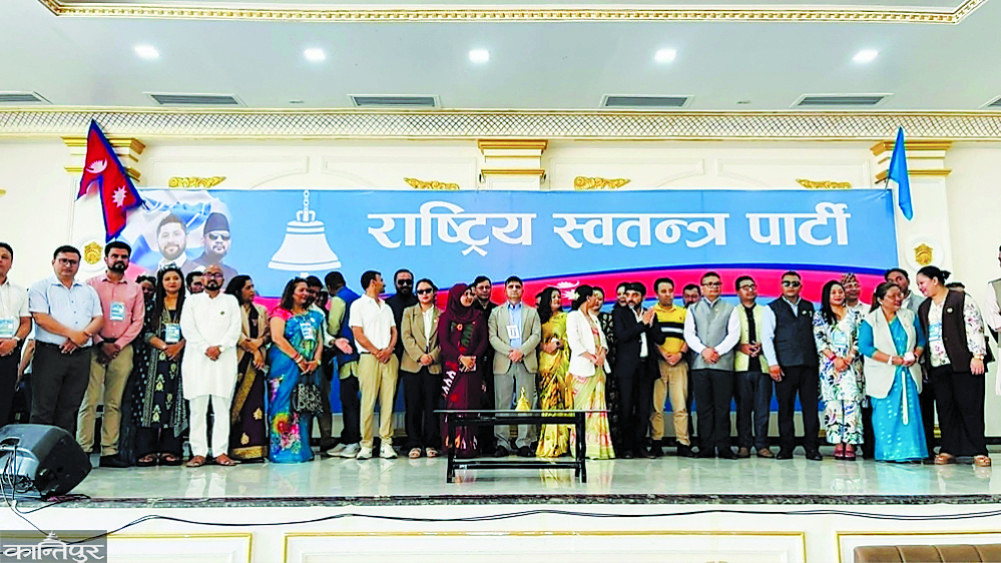
The Rashtriya Swayamsevak Sangh (RSS) party, which won nearly two-thirds of the seats in the House of Representatives elections, is setting its political philosophy and ideological outlook for the first time. The RSS has put forward a roadmap for a 'full democratic republic based on pluralism' for its first general convention to be held in Chitwan from Ashad 20 to 23. The RSS had not previously mentioned governance in its statute.
The report prepared by the Statute Amendment Committee, coordinated by party joint general secretary and MP Bipin Acharya, has clarified the party's political philosophy and ideological outlook. The committee, coordinated by Acharya, includes Ganesh Parajuli, Chanda Karki, Prakash Chandra Pariyar and Sushant Vaidhik. The committee has proposed a provision for the party's 'ideological basis and directive principles' in Part 3 of the statute.
Article 6 of the statute mentions 'political philosophy and ideological outlook of the party'. The party's main ideological outlook and ideals are stated in the statute, "A fully democratic republican system of governance based on pluralism with full guarantees of individual freedom and fundamental rights, and accountable good governance based on law."
Acharya, coordinator of the statute amendment committee, said that the party's ideological and theoretical outlook has been clarified. "The party's political and ideological outlook is advanced democracy and good governance. We are working on what are the pillars that the party will set for running the party, how to move forward as a party, and what is important for the party," he said. "We will make the party's ideological basis and what guides it clear in the statute."
The proposed statute also states that the RSVP will move forward on the path of constitutional socialism. ‘Committed to equitable progress, a liberal economy with social justice and a competitive social market system,’ the amendment proposes, ‘Achieving the main goals of socialism through peaceful means and running a state based on national policy, constitutional socialism.’
Similarly, on religious issues, the RSVP has proposed, ‘Eternal civilization and cultural coexistence: Promoting coexistence and mutual respect based on Nepal’s history, eternal civilization and religious-cultural diversity.’
The RSVP statute is about to be amended for the fourth time. Earlier, the RSVP statute stated that it would move towards a democratic state system, but the word ‘republic’ was not mentioned. Until the third amendment to the RSVP statute, 2079 BS, in 2081 BS, the principles and ideals of the RSVP were written, ‘The rule of law, a liberal economy with social justice, equality and equity-based inclusiveness, a fully democratic state system based on pluralism, a public welfare state with good governance and transparency.’
Along with the previous direct participatory, proportional, inclusive democracy, the Rashtriya Swayamsevak Sangh (RSS) has continued to uphold individual freedom and human rights as the party's core principles and ideals. Ganesh Parajuli, a member of the Statute Amendment Committee and deputy leader of the RSSSP parliamentary party, said that the party's views are clear. He said that according to the preamble passed by the expanded meeting of the central committee and the then parliamentary party held in Jaleshwor, Mahottari in November 2001, the provisions of a full democratic republic based on pluralism have been included in the statute. 'This time, we have included the issues passed by the historic Jaleshwor meeting in the statute, the party's views were written at that time, and we have clearly stated that the party will embrace constitutional socialism,' said Parajuli.
Political analyst Professor Krishna Pokharel said that the RSSSP has answered the political and theoretical questions raised against it by stating that it will move forward by accepting the constitution in the statute. 'What the RSSSP has written in the constitution is
It is our policy, the RSVP has endorsed the provisions of the constitution that provide for a federal democratic republican system of governance based on pluralism,' he said, 'Pluralism means giving space to multiple ideas in the party and in the running of the state, this means that we are trying to move forward in a constitutional manner.'
He clarified that those things were written in the statute to show that we are fully dedicated to implementing the constitution and the constitution. 'With this, there is talk that the RSVP does not accept the constitution, that it is trying to bring in a king, all those doubts have been dispelled,' he said.
Member of the Statute Amendment Committee and Whip Pariyar said that there is no doubt about anything since the party has adopted constitutionalism. 'The party has included in the statute that it will move forward in a middle-ground stream by adopting constitutionalism. With this, we have assimilated federalism. The party will move forward in restructuring, strengthening, making federalism affordable and result-oriented,' he said.
Pokharel says that the RSVP cannot back down from the federal system. Although the RSVP was skeptical about the provincial structure when it first went to the 2079 elections, he analyzed that the federal system was clear in the 2082 elections.
‘When the RSVP was formed, it was not very positive about federalism. No candidates were fielded in the provinces. At that time, people were not attracted to the RSVP and the RSVP provincial structure. Now, after realizing that if they oppose federalism, they will be boycotted by the Madhesh, indigenous, and nationalities, it seems that they have developed a positive view of federalism,’ Pokharel said, ‘The RSVP seems to have endorsed federalism. There is no place to run from federalism. It will be clear when the constitution is amended on how to run the provincial structure, but now only the RPP and the Janamorcha say they do not accept federalism in Nepal.’
The RSVP has written in its proposed statute that it will embrace a non-aligned, independent, and unbalanced foreign policy. ‘In view of the rising geopolitical importance of Asia, to keep Nepal’s sovereignty, geographical integrity and national interests paramount,’ the RSVP’s statute on international relations and foreign policy states, ‘to expand non-aligned, independent and balanced diplomatic relations with neighboring friendly countries and the international community based on the principles of universal equality and Panchasheel.’
The RSVP has proposed in its statute to completely prohibit familyism and nepotism as the cornerstone of advanced democracy, good governance and party operation. ‘No more than one member of the same family in the party will be appointed, nominated or elected to any committee, department, commission or mechanism of the same level of the party,’ the statute proposes, ‘No recommendation or nomination will be made for appointment to any party body or any state body on behalf of the party from the family of a member of the central body or provincial body of the party.’
The RSVP has also clearly mentioned the definition of family in its statute. ‘For the purpose of this statute, ‘family’ shall mean husband, wife, father, mother, stepfather, stepmother, son, daughter, elder brother, elder sister, younger sister, grandson, granddaughter, grandfather, grandmother, elder father, elder mother, uncle, aunt, uncle, uncle, brother-in-law, brother-in-law, elder sister-in-law, brother-in-law, brother-in-law, sister-in-law and their spouses,’ the definition of family in the RSVP statute states.
The RSVP has proposed in the statute to practice digital and participatory democracy within the party. It has been said that the use of technology will be used to the maximum extent possible to integrate the use of digital platforms into the party’s policy decision-making process. ‘When necessary, arrangements will be made to take direct public opinion through digital voting or surveys on important policy decisions of the party,’ the statute states, ‘complete security and confidentiality of personal data of party members collected through the digital system will be ensured. It will be completely prohibited from being used for unauthorized interests.’
Central Committee 136 members
The RSVP’s Statute Amendment Committee has proposed adding 7 members to the party’s Central Committee. Earlier, there was a 129-member Central Committee, but now a proposal has been put forward to increase it to 136 members including the President.
‘There will be a 136 (135+1) member Central Committee as the highest executive body of the party. This committee will be accountable to the National General Convention and the Central Council,’ the statute proposes. The Central Committee is proposed to have 1 President, 99 Central Members elected from the National General Convention, 29 Central Members nominated by the President, and 7 ex-officio Central Members (Province Presidents).
It seems certain that Ravi Lamichhane will be re-elected as the President of the RSVP. The senior leader of the RSVP is Prime Minister Balendra Shah. The arrangement for a senior leader was made as per the agreement reached between RSVP President Lamichhane and the then Mayor of Kathmandu Metropolitan City Balendra Shah on December 13. However, there is no provision for a senior leader in the party statute. On the RSVP website, Shah has been placed in the second priority along with senior party leaders. Leader Parajuli said that the party's secretariat meeting will decide whether to keep the provision for senior leaders in the statute or not. He said that the decision on giving current senior leader and Prime Minister Shah other responsibilities of the party or addressing him in a different way will be taken from the top level of the party. "The secretariat meeting will decide whether to keep the provision for senior leaders of the party in the statute or how to address them. The decision will be taken after considering whether the senior leader will remain for a long time or not," Parajuli said.
The statute amendment proposal proposes to have 16 office bearers. It is proposed that there will be 1 president, 3 vice presidents, 2 general secretaries, 4 joint general secretaries, 1 spokesperson, 3 joint spokespersons, 1 treasurer and 1 joint treasurer. It is proposed that 10 office bearers will be elected from the general convention. The election of the president will be held in the first phase and the election of the other 9 office bearers will be held in the second phase, as mentioned in the RSVP statute.
Initially, the election of the president and central members will be held. The elected central members will be able to compete for office bearers. Only women will be able to compete for the post of Vice-President, while there will be open competition for the remaining 2 posts. There will be open competition for the post of General Secretary only. There will be competition for the post of Joint General Secretary only among female candidates, while there will be open competition for the remaining 3 posts. The President has been given the authority to select the remaining 6 office bearers. A mandatory provision has been proposed that while the President selects the 6 office bearers, there should be 1 woman and 1 person from a marginalized community.