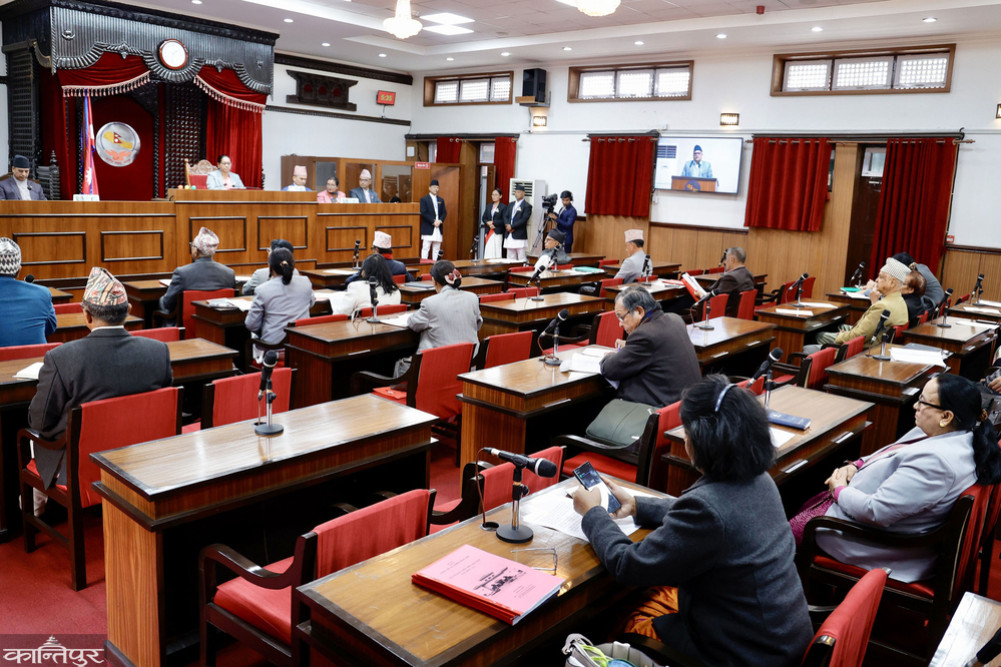
The National Assembly has failed in its role by failing to send back the bill passed by the House of Representatives within the time limit prescribed by the constitution. The National Assembly failed to send back the Alternative Development Finance Mobilization Bill within 15 days.
We use Google Cloud Translation Services. Google requires we provide the following disclaimer relating to use of this service:
This service may contain translations powered by Google. Google disclaims all warranties related to the translations, expressed or implied, including any warranties of accuracy, reliability, and any implied warranties of merchantability, fitness for a particular purpose, and noninfringement.
The National Assembly has failed in its role by failing to send back the bill passed by the House of Representatives within the time limit set by the constitution. The National Assembly failed to send back the Alternative Development Finance Mobilization Bill within 15 days. After the time limit passed, the House of Representatives sent the bill to the President for certification.
The Alternative Development Mobilization Bill, registered as a Finance Bill, was passed by the House of Representatives on 7th Jestha and sent to the National Assembly. According to the constitution, the National Assembly was supposed to send back the bill within 15 days of receiving it from the House of Representatives. But the bill was not even discussed in the National Assembly.
Experts have pointed out that the failure to send back the bill within the time limit is a weakness of the National Assembly. Former Secretary General of Parliament Surya Kiran Gurung considers this incident as the National Assembly failing to fulfill its responsibility. ‘The National Assembly should be able to send back the bill that came from the House of Representatives with or without a message within the prescribed time limit,’ he said. ‘This shows that the National Assembly has not fulfilled its responsibility. The image of the National Assembly has been tarnished.’
Gurung said that this is the first incident where a finance bill has not been sent back after wasting time while the assembly is in session. ‘I do not remember this happening before,’ he said, who was in parliament from 2049 to 2064 BS. ‘This shows that the National Assembly has not fulfilled its responsibility. The image of the National Assembly has been tarnished.’
Former Secretary of the National Assembly Rajendra Phuyal considers the failure of the National Assembly to not even discuss the bill and not even send it back as a failure. ‘The time given to the National Assembly by the Constitution in the context of the Finance Bill is 15 days. It should have been utilized properly,’ he said, ‘The National Assembly has shown weakness.’
The ruling Nepali Congress (NRC) is not present in the 59-member National Assembly. Article 111 of the Constitution states that a bill passed by one house of the federal parliament shall be sent to the other house as soon as possible and after being passed by that house, it shall be submitted to the President for certification. The National Assembly must send back the Finance Bill passed by the House of Representatives within 15 days. There is a constitutional provision that other bills must be passed or sent back with suggestions within two months of receipt.
The Alternative Development Finance Mobilization Bill sent by the House of Representatives on 7th Jestha was tabled in the National Assembly on 8th Jestha. After Prime Minister Balendra Shah's statement in the House of Representatives on 17th Jestha regarding the border problem with India became controversial, lawmakers also protested in the National Assembly. On 18th Jestha, Finance Minister Swarnim Wagle was scheduled to propose that the Alternative Development Finance Mobilization Bill be considered. Keeping in mind the pressure of time, preparations were made to submit the bill for decision in the assembly without sending it to the committee. However, due to the opposition of the members, the assembly could not enter the regular agenda.
National Assembly Speaker Narayan Dahal says that the bill could not be discussed after the lawmakers continuously obstructed the operation of the assembly. 'We made a mistake. We could not send the bill back within the time limit given by the constitution. This kind of incident happened for the first time in the National Assembly. Somewhere we made a mistake,' he told Kantipur.
Chairman Dahal had tried to move the bill forward on 18 and 20 Jestha. 'Let's move the bill forward that came to us from the House of Representatives. The bill that came was returned without doing anything. This is new in history so far,' Dahal had said in the meeting on 20 Jestha, 'Help us move the bill forward.' But the lawmakers did not listen to Chairman Dahal's request . After the opposition party continued to obstruct, the meeting was adjourned from 20 Jestha. After that, Chairman Dahal tried to move the bill forward in the meeting held on 26 Jestha, but the meeting could not proceed.
Speaker DP Aryal had informed the House of Representatives meeting on 27 Jestha that the verification process had been moved forward as the bill was not returned from the National Assembly within the period specified in the constitution. Parliament Secretariat Spokesperson Ekram Giri said that the House of Representatives has accelerated the process as the bill was not returned from the National Assembly within the stipulated time as per the procedure specified by the constitution. “This is the first time since the promulgation of the 2072 Constitution that the Finance Bill has not been returned from the National Assembly,” he said.
Earlier, on 6 Baisakh 2076, the House of Representatives had unilaterally sent the Passport Bill to the President for verification. The then Speaker Krishna Bahadur Mahara had sent the Passport Bill to the then President Bidya Bhandari for verification, saying that the National Assembly had not returned the bill within 60 days. It was not a Finance Bill. And, the members of the National Assembly had expressed dissatisfaction saying that the period when the Parliament session was not in session was counted.
The Passport Bill, passed by the House of Representatives on 10 Asoj 2075, was tabled in the National Assembly on 11 Asoj, the day the budget session ended. Parliament convened only three months later. Since Parliament was not in session, the House was unable to work on the bill. Questions were also raised about the content of the bill. Members of the National Assembly met the President and expressed their dissatisfaction that the bill was sent for verification while one house was working on it. Then, the then President Bhandari sent the bill back to the House of Representatives for reconsideration. After that, the bill was passed by both houses and sent to the President's Office.
Senior Advocate Radheshyam Adhikari, a former member of the National Assembly, says that the President provided an opportunity to improve both the legislative process and the content. 'At that time, the question arose whether to count the 'working day' when the parliament was in session or not,' he said. 'On the other hand, there were some errors in the content of the bill.'
Adhikari said that the situation then and now is different. 'Now, the weakness of the National Assembly has been seen. If there is a 15-day deadline, it should have been able to carefully send the bill back with or without its suggestions within that time,' he said. 'If the National Assembly could not send it back within the time, it raises a question mark that the National Assembly did not fulfill its duty.'
What is in the bill?
The government has brought a bill on alternative development finance mobilization to identify infrastructure sectors and projects to increase investment in the country and to raise domestic and foreign investment for that. The bill covers all issues related to the mobilization of various alternative development finance sources, institutional structure, monitoring and evaluation to provide the necessary legal basis for raising resources for the project.
The bill provides for the establishment of an alternative development finance mobilization fund as an autonomous organization. The authorized capital of the fund is proposed to be one trillion rupees and the paid-up capital is 25 billion rupees. The Government of Nepal is proposed to invest 51 percent of its shares in it. It is said that alternative development finance will be mobilized for the identification, study, development or implementation of projects that provide high returns, create additional employment opportunities, and contribute to production and economic growth.
The bill states that funds can be raised from investors or the general public by issuing project-specific financial instruments or bonds or through equity or debt or mixed financial instruments. There is also a proposal to establish an investment fund by collecting capital from domestic or foreign investors, and to establish a remittance fund with investments from foreign workers or non-resident Nepalis. It is said that the authorized capital of the Alternative Development Finance Fund of one trillion rupees will be divided into one billion ordinary shares at the rate of one hundred rupees.