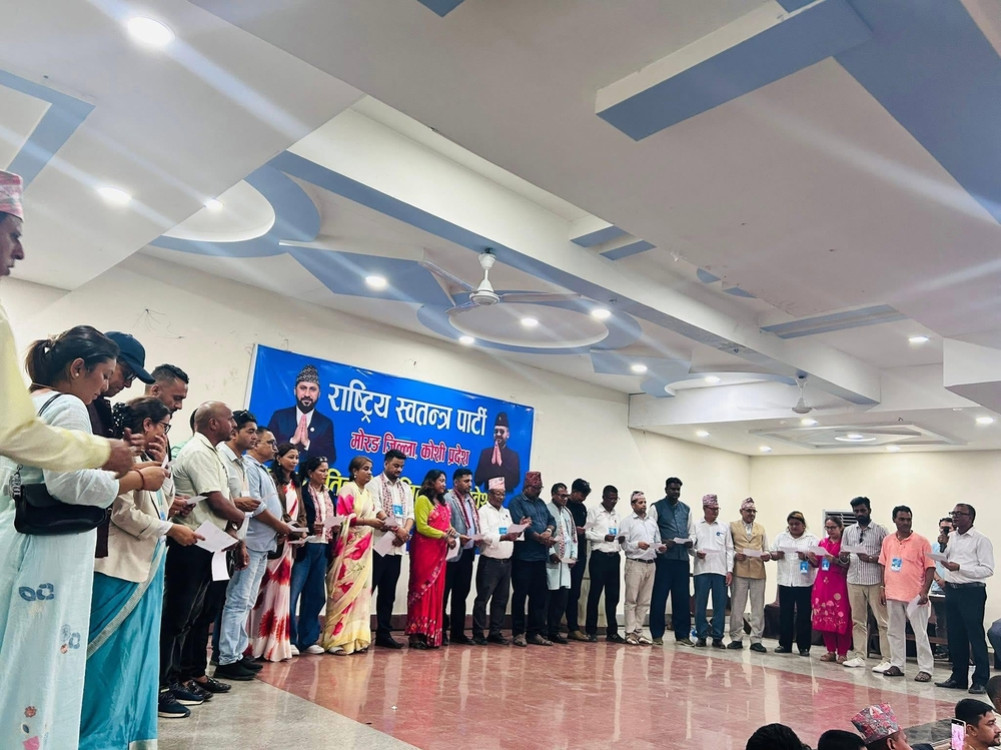
The provision of inclusive representation only among members of the Rashtriya Swayamsevak Sangh (RSS) district committee and the provision of open competition for the post of district president have resulted in low inclusive representation.
We use Google Cloud Translation Services. Google requires we provide the following disclaimer relating to use of this service:
This service may contain translations powered by Google. Google disclaims all warranties related to the translations, expressed or implied, including any warranties of accuracy, reliability, and any implied warranties of merchantability, fitness for a particular purpose, and noninfringement.
The National Independent Party (NISP), which has emerged with the slogan of alternative politics and has been criticizing the traditional style of old political parties, has completed its first district convention in 62 districts by Tuesday evening. However, the initial results of the convention show that the party is weak in inclusive political behavior. Analyzing the results of the 62 public districts, the post of district president, which is considered the chief executive, is dominated by Khas-Arya (Bahun-Chhetri) men, while the presence of indigenous, tribal, women, Dalit and marginalized communities is very weak.
According to the election statute of the NISP, there is a provision for the district office bearers to have a president, vice-president, secretary, joint secretary and treasurer. There is a provision for the treasurer to be selected by the district working committee from among the elected members. Similarly, 5 people are elected from open members by forming an inclusive cluster. Apart from that, there is a provision for the president of each constituency to be elected based on the number of ex-officio district members and other members. The statute has made provision for inclusion only in members, leaving office bearers. The statute has a provision that women, Dalits and the majority ethnic community/cluster of the district concerned should be elected as inclusive members.
However, the number of women, Dalits and indigenous people among the office bearers in the districts where the convention was held is very low. Only 2 women and 1 person from the Dalit community have been elected as presidents in the 62 districts where the convention was held. Sita Parajuli in Arghakhanchi of Lumbini Province, Shanta Budha Chhetri in Bardiya District and Prakash Nepali from Dalit in Salyan District of Karnali Province have been elected.
10 district presidents have been elected from indigenous people. 49 district presidents have been elected from Brahmin and Chhetri communities. District committees have been elected through elections in most districts. In more than 75 percent of the districts, office bearers and members in other districts were also elected through elections. A unanimous leadership has been elected in one and a half dozen districts.
Lumbini Province Vice President of the Rashtriya Swayamsevak Sangh (RSS) Shalikram Ghimire said that even though quotas have been fixed for Dalits, indigenous peoples and women in the constitution, many of the leaders who came to the current convention were elected from Brahmin Chhetris. According to him, this is the first convention at the district level, the work of building an organization is more challenging, and since they cannot immediately play a leadership role, Dalits, women or other communities may not have sought to come to the leadership.
‘In Lumbini Province, women have come to the leadership in Arghakhanchi and Bardiya,’ he said. ‘Although there is provision in the constitution, they may not have come because they did not think that they could lead in other districts.’ He said that Sita Parajuli in Arghakhanchi and Shanta Budha Chhetri in Bardiya of Lumbini Province were elected through elections.
Gunaram Ghimire, a member of the Rupandehi District Convention Election Committee, said that although the number of inclusive communities was high among the representatives selected as representatives at the convention, the number of candidates was low.
He had previously worked as a coordinator in the committee formed in the district. He said that since it is the appropriate method to come out strong in the competition, many people from other communities may have been selected in this time's district conventions.
Similarly, according to the party's Central Election Commission and Organization Department, the convention has been postponed to a later date in 5 districts, Dolpa, Humla, Rukum East, Manang and Mustang, as the minimum standards as per the statute have not been met.
The convention has been postponed for the time being due to a dispute during the leadership selection in Sindhupalchowk district, while the process has also been halted due to complaints in Baglung.
All activities related to the convention in 8 districts of Madhesh Province have been postponed until further notice. Bhuwan KC, the head of the RSP Central Election Commission, issued a statement on Tuesday and informed that the entire convention process has been postponed for the time being.
On the eve of the first historic national convention scheduled to be held in Ashar, the Rashtriya Swayamsevak Sangh (RSS) has been claiming that it has initiated internal democratic exercises by holding ward, district and provincial conventions to strengthen its organizational foundation.
Where is the president?
Koshi Province
Jhapa — Om Bhandari
Morang — Bharat Kandel
Sunsari — Sagar Dahal
Ilam — Dinesh Mahat
Dhankuta — Bhuvan Thapa
Panchthar — Prakash Gurung
Taplejung — Rajan Kumar Gurung
Tehrathum — Suman Khatri
Bhojpur — Khyam Bahadur Bhujel
Sankhuwasabha — Bhaktanarayan Shrestha
Okhaldhunga — Krishna Bahadur Thapa
Khotang — Mukunda Krishna Thapa
Solukhumbu — Narayan Kaji Karki
Udayapur — Chitra Kumar Karki
Bagmati Pradesh
Kathmandu — Raja Shakya
Bhaktapur — Rameshwar Basnet
Lalitpur — Buddha Ratna Mahajan
Chitwan — Mini Madhav Khanal
Kavreplanchok — Praveen Dhakal
Nuwakot — Rameshwar Gajurel
Dhading — Rajan Aryal
Makwanpur — Sanjeev Pathak
Dolakha — Dinesh Basnet
Ramechhap — Ramesh Kumar Rayamazhi
Sindhuli — Avinash Basnet
Rasuwa — Vasant Bhatt
Gandaki Pradesh
Kaski — Yadunath Adhikari
Syangja — Biswas Bhandari
Parbat — Jal Bahadur Purja
Myagdi — Yuvraj Roka
Baglung — Poonam Sharma
Gorkha — Suvarna Rokaha Chhetri
Tanahun — Ashok Bastola
Lamjung — Sapkota
Nawalparasi East - Doman Bhandari
Lumbini Pradesh
Rupandehi — Mahendra Prasad Upadhyay
Kapilvastu — Shiv Kumar Subedi
Dang — Kiran Khanal
Palpa — Bishnu Prasad Bhandari
Gulmi — Hari Shrestha
Arghakhanchi — Sita Parajuli
Navalparasi (Bardghat Susta West) — Ravi Pandey
Banke — Vivek Kumar Shrestha
Bardia — Shanta Budha Chhetri
Rolpa — Balram Thapa
Pyuthan — Vikas Pokharel
Karnali Pradesh
Surkhet — Ramesh Kumar Sapkota
Salyan — Prakash Nepali
Calicut — Prem KC
Dailekh — Bakhat Bahadur Bhandari
Rukum West — Dron Khadka
Jajarkot — Mahesh Singh
Jumla — Makar Bahadur Bhandari
Sudurpaschim Pradesh
Kanchanpur — Padam Bahadur Bista
Kailali — Kavindra Thakulla
Dadeldhura — Surendra Awasthi
Baitadi — Bhim Nath
Bajang — Satyaraj Upadhyay
Bajura — Navraj Jaisi
Doti — Keshav Balayar
Darchula — Rajesh Singh Samant
Achham - Omprakash Rawal