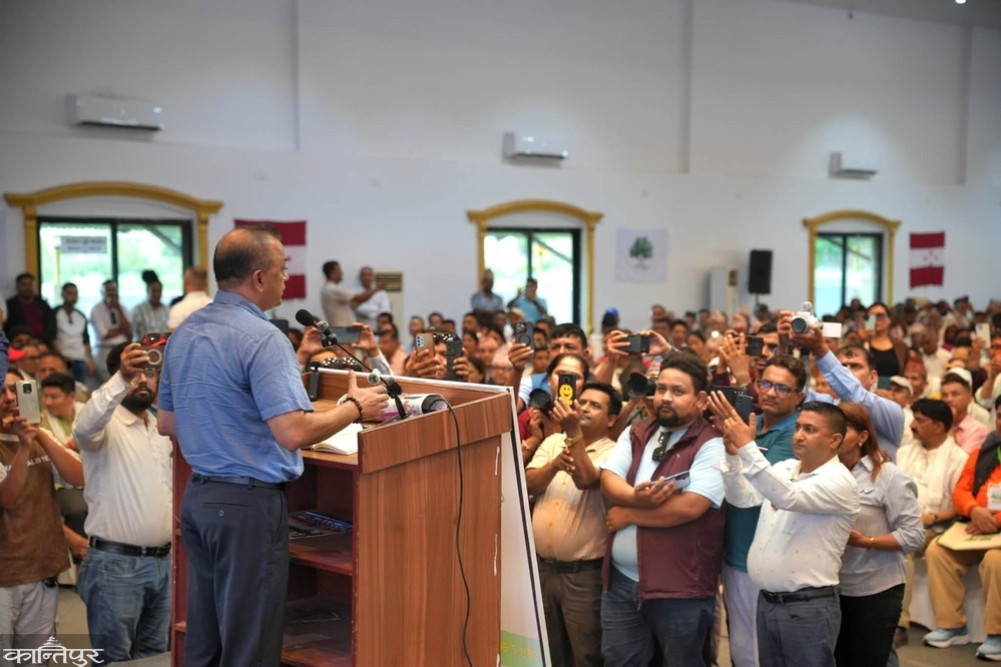
Membership renewals in Congress, UML, CPN and JSP are relatively low. Growing dissatisfaction with leadership and working style poses a challenge to organizational expansion.
We use Google Cloud Translation Services. Google requires we provide the following disclaimer relating to use of this service:
This service may contain translations powered by Google. Google disclaims all warranties related to the translations, expressed or implied, including any warranties of accuracy, reliability, and any implied warranties of merchantability, fitness for a particular purpose, and noninfringement.
Congress, UML, CPN and Janata Samajwadi Party have started renewing their membership and adding new members. The challenge facing these parties has increased as active members of these parties, who have been under criticism after the Gen-G movement, have started becoming inactive.
The huge public vote for the National Independent Party (RSP) in the last Falgun House of Representatives election has not only shown that the workers of the old parties have become inactive, but also raised questions about the policies and working style of those parties.
Only half of the Congress members renew their membership.
After the special general convention held in the last week of December, Gagan Thapa was elected as the leader, and it was defined as a 'changed Congress'. The 'new Congress' that entered the elections under Thapa's leadership could not bring the expected results. The Congress, which is the main opposition party with 38 seats in the House of Representatives, is currently on a campaign to accelerate the organization.
After interacting with provincial, district leaders and local representatives in all seven provinces last week, the Congress has called for active membership renewal through digital means. However, membership renewal has not been as expected. Leaders say that some effect of the disinterest of members of former President Sher Bahadur Deuba's faction has been seen in the membership renewal. In addition, the then Congress UML coalition government is responsible for the Gen-G movement, and it has become a topic of discussion within the Congress that young members have not been attracted.
As of Sunday, only 475,000 active members have renewed. The time for membership renewal has been extended until Jestha 28. Congress General Secretary Pradeep Poudel expressed confidence that membership will be renewed as expected within the specified time. 'Preparing a digital platform and having 500,000 active members renew within a month is not a weak number,' he said. 'Active members will renew enthusiastically by Jestha 28.'
He said that he was asked not to renew membership from within the party. ‘Can anyone who wants the interests of the Congress say not to renew their membership? But, some old active members may have become inactive, some may have died,’ he said, ‘The details of the members who will be truly active for the Congress will come on Jestha 28.’
There were 850,000 active members at the 14th general convention held in 2078. During the campaign that was conducted till 10 Poush, 450,000 renewed and 150,000 took new memberships. The Congress had launched a campaign from 1 Baisakh to update the details of those.
General Secretary Poudel said that the upcoming program would be decided after the details of the members who renewed their membership came. ‘A policy will be made to make active members truly active for party building,’ he said.
Non-establishment leader Min Bishwakarma said that there was a problem in renewing the number of active members due to the lack of party unity. ‘We were ready to merge the party. However, the establishment seems indifferent to this,' he said, 'It would be better to continue the renewal of memberships that were renewed before the special general convention and to continue the renewal of members who are currently renewing.'
He said that the members of the Congress in the villages are not technology-friendly, and it is complicated because there has been no improvement in the trend of establishment. 'Technology and the trend of establishment have betrayed us for membership renewal,' he added. The Congress has also prioritized membership renewal for the local and provincial elections to be held next year.
Five years ago, 1.1 million members in UML, now the target is to reach 1 million.
In 2078 BS, the number of organized members of the UML had reached 1.1 million. In the 11th general convention held in 2082 Poush, only 662,000 renewed. UML had set a target of reaching 1 million organized members.
After the number of members decreased significantly, the legislative general convention held in Bhadau had made arrangements for two types of members: organized and ordinary members. As the party members were decreasing, the door was opened to become ordinary members.
To speed up the renewal of membership, UML held a 2-day workshop with district chiefs, department heads and secretaries. The workshop passed a resolution and resolved to make 3 new members for every 1 member. ‘This workshop announces that the work of online renewal of the party’s organized membership will be carried out immediately in the direct presence of the concerned person,’ the UML decision said, ‘1 organized member of the party has resolved to prepare at least 3 new party members.’
It is not easy for youth to come to leadership under the leadership of UML from the center to the districts. In all committees, the dominance of traditional leaders and people around them have been taking the lead.
Central member Naresh Rokaya said that organized members fled after not being appreciated even after working tirelessly for a long time for the party. ‘The responsibility of the recent central members does not seem fair. In many districts, they have been given responsibilities for 10 years,’ he said, ‘Newcomers have not been given responsibilities. People with potential have not been given special responsibilities. Those who can work in the party mass organization in a timely manner have been sidelined.’
He said that the old trend of the party leadership has not instilled enthusiasm in the members. ‘Why was there no enthusiasm among the cadres to renew their membership?’ The old leadership did not seem to understand, he said, ‘We need to instill confidence in the cadres that the party will be reorganized and that it will give momentum.’
UML Organization Department Head and Secretary Bhanubhakta Dhakal said that making new members is a priority. ‘We have prioritized the work of recruiting new members in the party,’ he said, ‘The goal of increasing membership is constant. Sometimes it decreases and sometimes it increases. But, now we will increase the number of members significantly than before.’
UML is preparing to issue a circular to renew membership by mid-Ashar. UML has also resolved to transform party life into a digital revolution, complete membership renewal immediately, and revive the entire party from village to ward, municipality, district, and province by expressing its active presence in the revolution of science and technology and the use of social media.
According to the statistics mentioned in the report of the general convention of Poush, there were 103 districts, migration, province, contact forums, 1067 district committees, metropolitan, sub-metropolitan, municipal and rural municipality committees. Similarly, there are 7,760 ward committees and 55,776 tole committees, the report said.
It is not certain how many members of the Nepali Communist Party (NCP) are there
On Baisakh 20, Nepali Communist Party (NCP) House of Representatives candidate for Rautahat-3, Poonam Yadav, left the party . Despite having a long association with the NCP, she said that she left the party due to the party leader's style of work. Her father, Surendra Yadav, was defeated as a Maoist candidate for the Fatuwa Bijaypur Municipality mayor in the last local election. It is not certain how many members of the Nepali Communist Party, formed by the unity of the Maoists and the Unified Socialists, are there .
In the central committee meeting held in July 2080, the then Maoist Chairman Pushpa Kamal Dahal had mentioned in his report that there were 752,000 central members
The NCP had taken action against a dozen leaders including Deputy General Secretary Haribol Gajurel, former Chief Minister Kul Prasad KC, central members Maheshwor Gahatraj, Tek Bahadur Shakya, Dhiraj Pattel and others for acting against the party's policy in the elections held in Falgun.
However, despite the unity between the Maoists and the Unified Socialists in Kartik, there has still been no adjustment from the center to the local level. After the party unification, about 2,500 central committees have been formed. However, the leaders understand that the organization has not been dynamic.
'We have taken the organization adjustment and membership renewal together and moved forward,' said spokesperson Prakash Jwala, 'We will verify the details of the organized members after the integration of all the committees. Membership renewal will continue.'
Despite the unity between the Maoists and the Unified Socialists, the election did not bring the expected results. The NCP directly won only 17 seats. NCP central member Dor Prasad Upadhyay said that it would be difficult to add new members to the party unless there is a changed leadership and a clear line of action. ‘It is difficult to increase new members in the party with the same face and abstract line of action,’ he said, ‘The institutional democratic system and decision-making system, processes within the party should be changed in a general way.’
Former Maoist Secretary Ganesh Sah said that the cadres are frustrated due to the same face and traditional working style of the NCP leadership from top to bottom. ‘If you look at the Communist Party of Nepal from top to bottom, what new do you find? Leadership, ideas or something else?’ he said, ‘The cadres must be enthusiastic for the party to be vibrant. The general voters are the ones who vote during elections. However, if the cadres are not active, the party will weaken. This is what is happening in the Communist Party of Nepal now.'
'Party self-renewal causes cadres to be repelled'
Political science professor Khadga KC said that Nepal's old political parties have not renewed themselves and that they are not attractive to new members because they are more connected to daily life than political ideas. 'Various research shows that indifference towards political participation is a basic characteristic of a society with a growing middle class population,' he said. 'Although the number of the middle class in Nepal is not large, the impact of digital education and globalization has prioritized professionalism, income generation, and quality of life over political ideology, parties, and political participation. That is why full-time cadres of old parties have become less attractive.'
The old party cadres said that the self-centered working style of the leadership may be responsible for the disinterest in membership. 'Political parties have remained in the state power and mechanism for a long time. Their performance has not had a significant impact on political life, so becoming a member may be less attractive, he added, “Until now, ordinary workers have seen the changes in the lives of people around the leaders. That is why the enthusiasm and commitment that they have worked for a long time may not have come back.” He said that the rise of the political power Rashtriya Swayamsevak Sangh (RSS) has also affected the organized members of the old parties.
JSP membership renewal slow
Even though Upendra Yadav started the membership renewal campaign of the Janata Samajwadi Party, it is very slow. JSP had 145,000 members during the general convention held in 2081 Jestha. “The membership renewal campaign is underway. However, it is slow now because there is no general convention at the central, provincial, district and local levels,' he said, 'We are now preparing to accelerate it because we are united with the Democratic Socialists.'
The old members are not active in the old parties and new members are not added. Although the debate on leadership change has been going on for a long time, the new generation has not been given enough opportunities and the decision-making process is focused on a limited number of leaders.
The attraction seems to have decreased because the influence of factions is greater in the distribution of opportunities, tickets and responsibilities within the party. There is less attraction towards membership renewal due to closeness to the leader rather than hard work.
In addition, the emergence of new forces after the Gen-G movement has also affected the supporters of traditional parties. Analysts say that there is disillusionment with the old parties and attraction towards new options, especially among the younger generation.