The next meeting of the council has not been held since the appointment of the Chief Justice. It is uncertain when the meeting will be held. Meanwhile, 19 positions, including the chairperson and members of various constitutional commissions, have been vacant for a long time.
We use Google Cloud Translation Services. Google requires we provide the following disclaimer relating to use of this service:
This service may contain translations powered by Google. Google disclaims all warranties related to the translations, expressed or implied, including any warranties of accuracy, reliability, and any implied warranties of merchantability, fitness for a particular purpose, and noninfringement.
President Ram Chandra Poudel issued the 'Ordinance, 2083, to amend the Constitutional Council (Work, Duties, Powers and Procedures) Act, 2066' on 23 Baisakh after the government resubmitted it. He had earlier withdrawn the ordinance for reconsideration, saying it conflicted with the principle of balance of power.
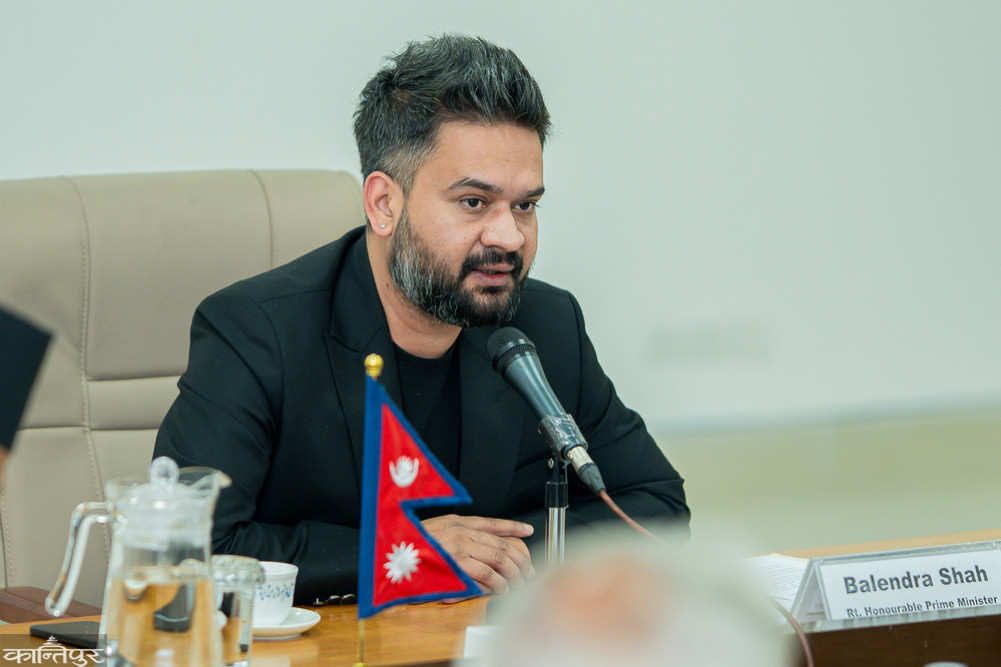
The day after the ordinance was issued, Prime Minister Balendra Shah, who is also the chairman of the council, called a meeting. The council meeting held on 24 Baisakh recommended the name of Manoj Sharma for the appointment of the Chief Justice. In the meantime, it has been 2 weeks since the parliamentary hearing was completed and Sharma assumed the responsibility of the Chief Justice.
But the next meeting of the council has not been held. It is uncertain when the meeting will be held. Meanwhile, 19 posts, including the chairperson and members of various constitutional commissions, have been vacant for a long time.
Two posts, including the Chief Election Commissioner, are vacant in the Election Commission. There are four vacant posts including the chairperson in the National Natural Resources and Finance Commission. There are two vacant posts each including the chairperson in the Muslim Commission, Tharu Commission, Madhesi Commission and National Inclusion Commission. There are one member vacancy in the Commission for the Investigation of Abuse of Authority, one member vacancy in the National Human Rights Commission and one member vacancy in the National Women's Commission. There are two vacant posts in the National Dalit Commission.
There is a provision for five members including the chairperson in the commissions. The Election Commission had to conduct the election to the House of Representatives on 21 Falgun amidst a lack of leadership. The main work of the commission is related to the preparation and management of the election. But the same commission had to conduct the election despite two vacant posts including the leadership.
However, Acting Chief Election Commissioner Ram Prasad Bhandari claims that there has been no difference in the work even though two commissioners are vacant in the commission.
‘We have already shown by holding the February 21 election whether the absence of two commissioners affected the work or not,’ he said, ‘There is no need for more than three commissioners in the Election Commission. We have also given the same kind of suggestion to the government task force in the upcoming constitutional amendment.’
In terms of work, the National Natural Resources and Finance Commission is the most important commission. Its responsibilities and jurisdiction are extensive. It works to ensure fair distribution of revenue and financial resources between the union, provinces and local levels in the federal governance system. 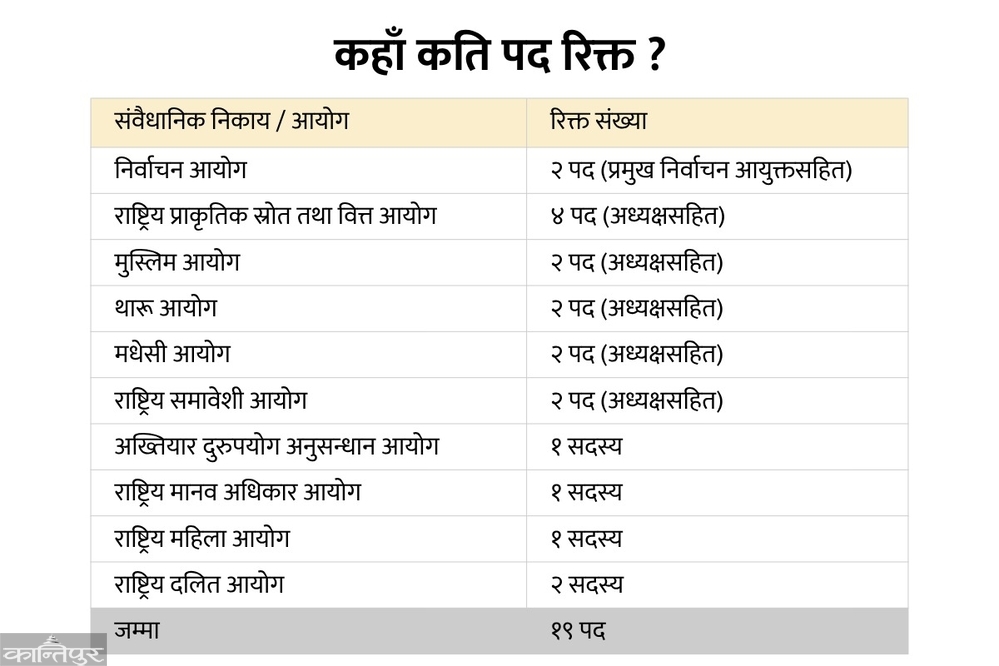
Similarly, the same commission has the authority to determine the basis and structure of distribution of revenue received from the federal consolidated fund, recommend for fiscal equalization and conditional grants, and evaluate the expenditure responsibility and revenue capacity of the provinces and local levels.
The commission also recommends the limit of internal debt that can be taken by the federal, provincial and local levels, determines the basis for sharing the proceeds from the mobilization of natural resources, and makes suggestions for resolving potential disputes related to this.
This commission has been functioning with one member since April. Four member positions, including the chairman, are vacant.
Bipin Raj Niraula, who is also the acting chairman, says that there is no difficulty in the decision-making process as there are no obstacles in the law. But he says that it has affected the direction of moving the commission forward effectively.
‘Since the work of recommending financial equalization and conditional grants was done in Chaitra, it has not affected the main work,’ he said. ‘Rather, it is having a greater impact because there are many technical staff in the commission and their transfers are happening quickly.’
The main responsibility of the Human Rights Commission and Inclusive Commissions in particular is to provide suggestions at the policy-making level and increase monitoring of government activities. Former chairman of the National Inclusive Commission, Ramkrishna Timilsina, says that when there are vacancies in commissions like the Human Rights Commission, Madhesi Commission, Tharu Commission and Muslim Commission, they cannot do more than average work.
According to him, the government's approach towards the commissions added after the constitution was promulgated is different.
'Like the old commissions, the government's attention immediately goes to the Public Service Commission or the Commission for the Investigation of Abuse of Authority.' Timilsina says, 'But the government does not prioritize the commissions that were established later. Rather than thinking of seeking support from the commissions created with the new constitution, the mentality has been that they are unnecessary structures that were brought in through a compromise when the constitution was made.' This same psychology has also played a role in the delay in filling the posts.'
After the appointment of other commission officials was not given priority, a question has been raised on Prime Minister Shah, who is also the chairman of the council - if the main purpose of bringing the ordinance was to complete the constitutional body, why did the appointment process in the commissions not proceed after the recommendation of the Chief Justice?
Bhishma Raj Angdembe, the leader of the main opposition party who is also a member of the council, says that he has not had any consultation or information about holding another meeting.
‘When the ordinance was brought, it was thought that it was only for the appointment of the Chief Justice,’ he said. ‘I do not know whether another meeting was even called after the meeting to recommend the name of the Chief Justice. There has been no discussion with the Prime Minister about this.’
According to Prime Minister Shah’s press and research expert Deepa Dahal, the government is busy in maintaining good governance and has not been able to focus on filling the posts of the commissions.
‘Nothing has been decided yet about calling a meeting of the council. The government is focusing on many good governance tasks,’ she said. ‘The government is aware of the direction of appointing officials of the Constitutional Commission and plans to work accordingly.’
The government has facilitated the meeting and decision-making process of the Constitutional Council through the ordinance so that recommendations can be made despite the opposition’s lack of cooperation.
The council has six members under the chairmanship of the Prime Minister. In addition to the Prime Minister, the Speaker of the House of Representatives, the Chief Justice, the Speaker of the National Assembly, the Deputy Speaker and the leader of the main opposition party are members.
National Assembly Speaker Narayan Dahal is from the NCP background, while Deputy Speaker Ruby Kumari was elected from the Shram Sanskriti Party. The Shram Sanskriti Party is currently in the opposition to the government. However, Deputy Speaker Ruby Kumari supported the Prime Minister's proposal on the recommendation of the Chief Justice.
National Assembly Speaker Dahal and the leader of the main opposition party Angdembe were against the Prime Minister's proposal on the recommendation of the Chief Justice.
After the appointment of the Chief Justice, it has become easier for Prime Minister Shah to hold meetings and make decisions numerically.
Earlier, there was a provision that a quorum could be reached only if at least four members including the Speaker were present, but the ordinance has made a provision that a meeting can be held if three members including the Speaker are present.
A provision has also been added that the support of at least three people, including the vote of the chairman and five members, is considered a decision of the council.
The opposition parties, constitutional law experts and civil society have been sharply criticizing the revised arrangement so that the votes of three people, including the Prime Minister, are considered a majority, while the votes of three people on the other side are considered a minority.
Stating that the ordinance paves the way for decisions to be made in the presence of a limited number of people when a broad consensus needs to be sought on sensitive issues like the appointment of office bearers of constitutional bodies, the main opposition parties have registered a proposal in both houses of the federal parliament to reject all eight ordinances brought by the government, including this one.
It was thought that the ordinance was only for the appointment of the Chief Justice. It is not known whether another meeting was held after the meeting to recommend the name of the Chief Justice. Bhishma Raj Angdembe, party leader, Nepali Congress According to the constitutional provision, the replacement bill for the passage of the ordinance must be approved by both houses before it can be moved forward. There is no problem as the ruling party, the Rashtriya Swayamsevak Sangh (RSS), has a strong majority in the House of Representatives. But the ruling party is not present in the National Assembly.
Since the National Assembly can be decisive in the process of approving or rejecting the ordinance, there is a possibility that the future of the ordinance related to the Constitutional Council will also be decided there.
Although the opposition parties registered a proposal to reject the ordinance in the National Assembly on 30 Baisakh, the process has not been able to move forward.
Nepali Communist Party parliamentary party leader Jhakku Prasad Subedi in the National Assembly said that the decision-making process could not be initiated because the government did not prioritize it.
‘The government has the power to decide which business to take to parliament and which not to take,’ he said. ‘Since it is not the government’s priority, it has not been possible to go through the process of approving or rejecting it. The day the government is ready, the opposition forms a common opinion on the same day.’
How many posts are vacant?
Election Commission : 2 posts (including Chief Election Commissioner)
National Natural Resources and Finance Commission : 4 posts (including Chairman)
Muslim Commission : 2 posts (including Chairman)
Tharu Commission : 2 posts (including Chairman)
Madhesi Commission : 2 posts (including Chairman)
National Inclusive Commission : 2 posts (including Chairman)
Commission for the Investigation of Abuse of Authority : 1 member
National Human Rights Commission : 1 member
National Women's Commission : 1 member
National Dalit Commission : 2 members
Total : 19 posts.