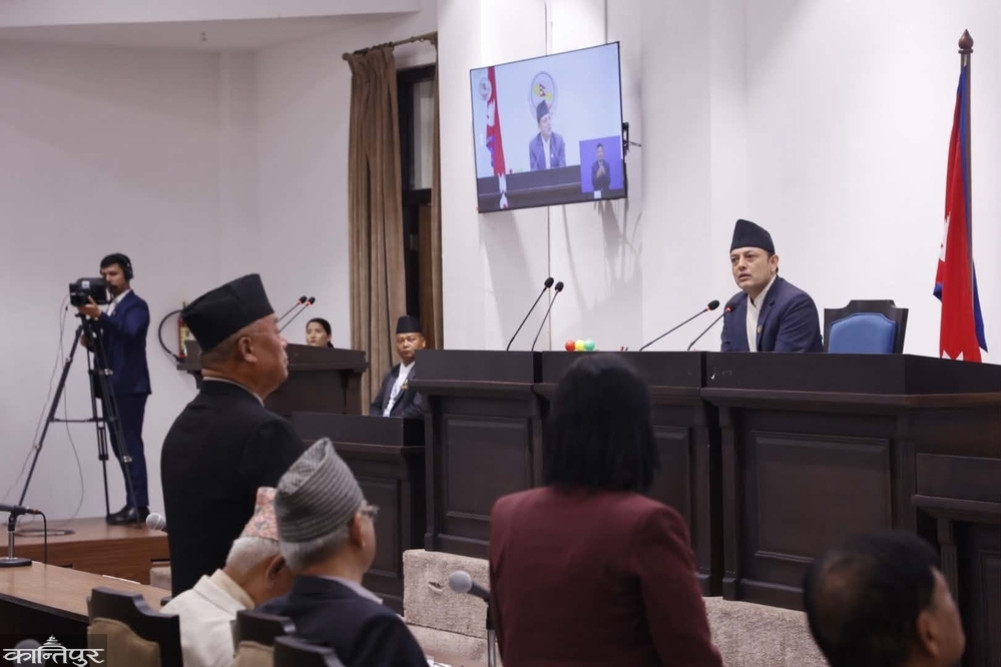
The opposition Congress, UML, and NCP have registered a notice in both houses of the federal parliament to reject the ordinance brought by the government.
We use Google Cloud Translation Services. Google requires we provide the following disclaimer relating to use of this service:
This service may contain translations powered by Google. Google disclaims all warranties related to the translations, expressed or implied, including any warranties of accuracy, reliability, and any implied warranties of merchantability, fitness for a particular purpose, and noninfringement.
The opposition Congress, UML, and NCP have registered a notice to reject the ordinances brought by the government in both houses of the federal parliament.
The 8 ordinances brought by the government on different dates were presented in both houses of the federal parliament on Monday. As per the provisions of the parliamentary rules that require a notice of rejection within 2 days, the opposition parties registered a notice of rejection on Wednesday.
The notice they registered will be presented to both houses for discussion and decision like other proposals. Only if the proposal to reject the ordinance brought by the opposition is rejected will the government be able to pass the provisions brought by the ordinance through the replacement bill. There is a constitutional provision that if only one house of the federal parliament passes the opposition's proposal, the ordinance will be deactivated from there.
Since the ruling Rashtriya Swayamsevak Sangh (RSS) has close two-thirds support in the House of Representatives, the proposal put forward by the opposition parties is unlikely to be passed. Since the government is not represented in the National Assembly, the government has to rely on opposition parties to approve ordinances.
The opposition has a strategy of rejecting some of the ordinances brought by the government from the National Assembly. However, the UML has registered a notice of rejection, saying that all eight ordinances should be made inactive. The Congress has registered a notice to reject the proposal brought to amend the Constitutional Council and some Nepal Acts. In the National Assembly, Congress MPs, including parliamentary party leader Kamala Pant and whip Padam Pariyar, have collectively registered the notice.
There is a collective notice from the leader of the parliamentary party in the National Assembly of the NCP, Jhakku Subedi, whip Garima Shah, MPs Suresh Ale Magar, Nar Bahadur Bista, Jayanti Rai, Goma Timilsina, Urmila Aryal, and others. The NCP has registered a notice to reject some Nepal Acts, constitutional, university and public officials' dismissal ordinances. 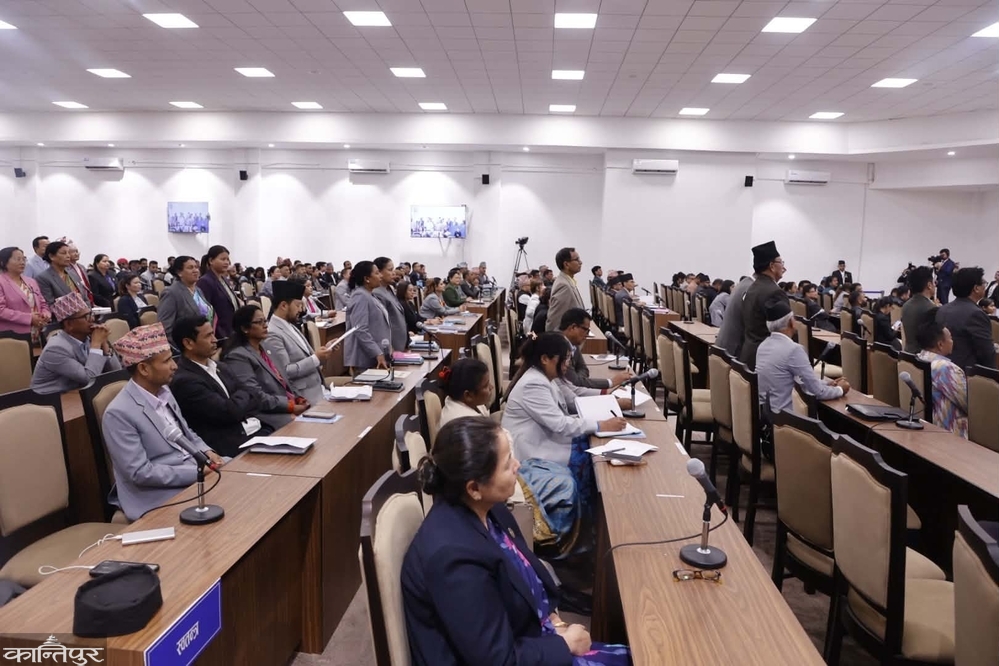
UML has registered a notice to reject all eight ordinances, said Prem Dangal, the parliamentary party leader in the National Assembly. UML MPs Roshni Meche, Som Gautam, Rekha Jha, Meena Rakhal, Samjhana Devkota, among others, have registered a notice to reject the ordinances. According to Dangal, the National Assembly has already moved forward the agenda to discuss and submit the proposals for decision on 7th Jestha. 'In the meantime, we will try to get all the ordinances rejected based on the common opinion of all three parties. An understanding will be reached after discussions with top leaders on this issue,' Dangal said.
Panta, the chief whip of the Nepali Congress parliamentary party, said that efforts are being made to reach an agreement with the three parties, including the National Janamorcha, the Democratic Socialist Party (LSP) and the Janata Samajwadi Party (JSP). Janamorcha and LSP have one MP each in the National Assembly and JSP has two MPs.
According to Clause 'A' of Article 114 of the Constitution, there is a provision that both houses of the Federal Parliament must accept the ordinance. It states, 'The ordinance shall be presented to both houses of the Federal Parliament sitting after its issuance and shall automatically become inoperative if not accepted by both houses.'
Since the government has a strong majority in the House of Representatives, there is no problem in approving the ordinance from there. However, the government does not have representation in the National Assembly. Since the opposition Congress, UML and Maoists are dominant, the future of the ordinances brought by the government is in the hands of the opposition.
Rules 89, 90, 91 and 92 of the National Assembly Rules 2075 have made provisions regarding the provisions, procedures and decisions related to the rejection of ordinances. Rule 89 states that a member who wishes to submit a motion to reject an ordinance shall give such notice to the Secretary in the format as per Schedule 12 within two days of the submission of the ordinance.
While giving such notice, the reason for rejecting the ordinance should also be mentioned and if more than one notice is received, Rule 89 provides that only one notice of the motion shall be selected for discussion according to mutual agreement or the order of registration.