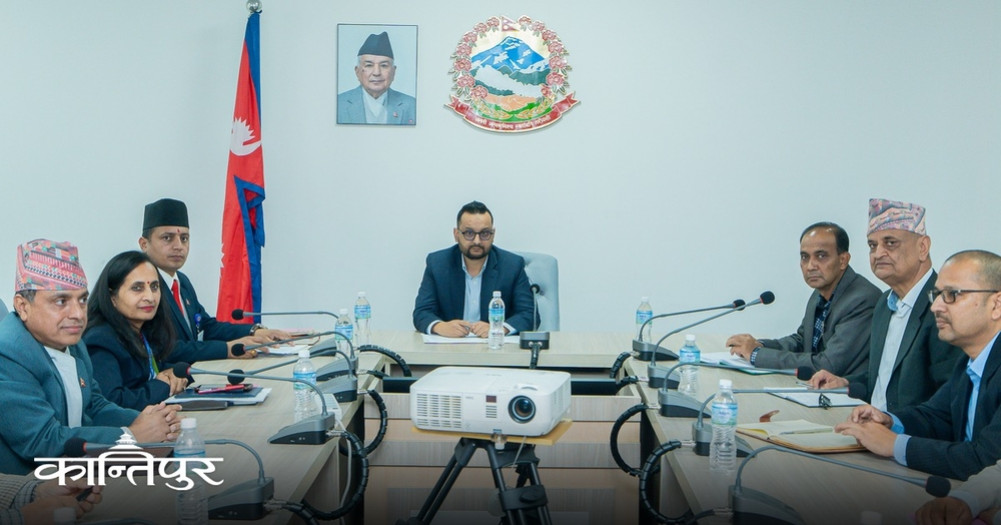
Sharam Sanskriti Party, while forming a common view on the issue of possible reconciliation between Congress, UML and NCP, has made a nine-point suggestion, including a working chief/president to be directly elected by the people.
We use Google Cloud Translation Services. Google requires we provide the following disclaimer relating to use of this service:
This service may contain translations powered by Google. Google disclaims all warranties related to the translations, expressed or implied, including any warranties of accuracy, reliability, and any implied warranties of merchantability, fitness for a particular purpose, and noninfringement.
The government has brought forward the formal discussion on the amendment of the constitution through the ‘Constitutional Amendment Discussion Paper Preparation Task Force-2082’. The committee, coordinated by the Prime Minister’s political advisor Asim Shah, is holding separate discussions with political parties, constitutional experts, and former administrators to seek their suggestions.
The first cabinet meeting led by Prime Minister Balendra Shah had decided to prepare a constitution amendment discussion paper by passing a 100-point agenda on governance reform.
‘The government’s decision to form a task force to prepare a ‘Constitutional Amendment Discussion Paper’ to build a national consensus on issues related to the amendment of the constitution, including long-term political and institutional reforms of the country, the electoral system, and to make the discussion process participatory, transparent, and fact-based has been stated. As per the same mandate, the task force is holding regular discussions with stakeholders including political parties.
After holding two rounds of discussions with the political parties, the committee has requested them to provide written opinions. Accordingly, the Congress and the NCP have formed a task force and started discussions to prepare a draft. UML, however, has not formed a committee to amend the constitution. The process was not advanced due to the ill health of UML Chairman KP Sharma Oli.
In Asad 2071, during the formation of the Congress-UML coalition government, the two parties had agreed to amend the constitution. As per the agreement, preparations were made to amend the electoral system for political stability and increase the 'threshold' percentage. Their argument was that increasing the threshold would reduce the number of parties in parliament, which would lead to political stability.
Congress and UML had prepared to increase the threshold from 3 to 5 percent for proportional representation. The then main opposition party, the Maoists, had objected to that. Congress is doing its homework based on the ideas put forward at that time.
Nepali Congress Vice President and Task Force Coordinator Pushpa Bhusal said that work is being done to amend the difficulties seen in its implementation based on the core essence of the constitution, the federal democratic republic. 'The constitution should be amended within the core essence of the constitution,' she said, 'The difficulties seen in federalism and other issues during the implementation of the constitution should be amended. The constitution is not to be rewritten, but amended.' She said that the Congress, UML and NCP will hold joint discussions after preparing their respective proposals.
Nepali Congress has prepared a report based on the suggestions of constitutional experts and other stakeholders and is preparing to hold discussions at the provincial level. It has written a letter to the government and put forward its initial views on the constitutional amendment.
'The constitution itself has also envisaged a review within itself. Since the constitution is a dynamic and changing document, the Nepali Congress is clear that it is a natural democratic process to amend, revise and update it from time to time according to the feelings and needs of the citizens,' the Congress said.
The Congress has made it clear that there can be no compromise on the democracy, characteristics of the Nepali state, republic, federalism, citizen supremacy, multi-ethnic, multi-religious, multicultural and pluralistic multi-party parliamentary system, separation of powers, and an independent judiciary as adopted by the Constitution. Similarly, it is in favor of amending the Constitution without any compromise or narrowing down on essential values and norms including freedom of expression and press, rule of law, proportional inclusive principle, open society and human rights.
The Congress has stated that the government should also be clear about the identity of parties outside the parliament and stakeholders such as Madhesi, indigenous-tribal, Tharu, Dalit and minorities while preparing the debate paper on the Constitution amendment. The Congress has also urged the government to make public its initial view on the provisions of the Constitution amendment.
Radheshyam Adhikari, a member of the Congress Constitution Amendment Task Force, said that a written view will be prepared based on the view initially put forward by the party. ‘At the political level of the party, Once a consensus is reached, more homework will be done on the provisions of the constitutional amendment,' he said.
The members of the committee formed under the coordination of Vice-Chairperson Pushpa Bhusal are senior advocates and constitutional experts Radheshyam Adhikari, Harihar Dahal, Prem Bahadur Khadka, Upendra Keshari Neupane, Sher Bahadur KC, Yadunath Khanal, Gopal Krishna Ghimire, Yogendra Bahadur Adhikari, Dinesh Tripathi, Sitaram KC, Lalit Bahadur Basnet, advocates Ran Bahadur Thebe, Sharmila Shrestha, Jhalmaya BK and Niraj Gupta.
UML Deputy General Secretary Bhanubhakta Dhakal said that there was no discussion at the office-bearer level for the constitutional amendment. The meeting called by the Prime Minister's political advisor Asim Shah was attended by the Chief Secretary of the Central Office, Bhishma Adhikari.
'There is talk of forming a team for the constitutional amendment. The party's consensus will have to be formed at the highest political level,' he said.
The Nepali Communist Party (NCP) is seeking suggestions from experts for constitutional amendments. Rekha Sharma, a member of the task force, said that a task force was formed last week and suggestions were sought from constitutional experts on the form of government, electoral system, structure of provinces, judiciary, etc.
‘We are seeking suggestions from experts on the form of government and electoral system, union and provincial structures,’ she said. ‘The party’s position will be formed by looking at the overall issue of the constitution.’
Another member, senior advocate Khimlal Devkota, said that the party’s position on the issue of a directly elected executive prime minister and full proportional representation, which it had previously held, has not changed.
‘The previous position remains. We are doing our homework to see if it can be further enriched,’ he said.
There are two opinions in the NCP on whether a directly elected prime minister or a prime minister elected from parliament. NCP co-coordinator Madhav Kumar Nepal is in favor of a Prime Minister elected from the parliament, while coordinator Pushpa Kamal Dahal is in favor of a directly elected Prime Minister.
After the task force prepares its report, it will be discussed at the political level and submitted to the government.
The task force includes Dev Gurung, Prakash Jwala, Prem Bahadur Singh, Randhwaj Kandangwa, Rekha Sharma, Ganesh Bik, Mukti Pradhan, Khimlal Devkota, Dambar Bikram Thapa, Jagdev Chaudhary and Ram Bahadur Chaudhary.
The NCP has been putting forward a proposal that the executive head should be directly elected by the people and that the parliament should focus solely on legislative work, saying that the parliamentary system has brought instability. Similarly, it has proposed that there should be a fully proportional electoral system. It argues that elections would be less expensive if there is a fully proportional electoral system.
The Shram Sanskriti Party has already made nine suggestions, including a 'directly elected executive head/president by the people'. ‘When forming the government, the Council of Ministers will be formed with the people who are close to the elected Chief Executive.’ The proposal states that the Council of Ministers should be elected on the basis of all castes, communities and genders, ‘to determine the limits of the Chief Executive.’ Explaining autocracy. If the Chief Executive becomes an autocracy, impeachment will be filed. If the impeachment is passed in the parliament, the post of Chief Executive will be vacant.’
The parliament of the legislature has proposed to ‘set the working procedures and laws for the operation of the government, study whether the work of the government is done according to the relevant working procedures, evaluate and inspect and make suggestions to the government.’ Similarly, the proposal of the Shram Sanskriti Party states that citizens of all castes will participate in all organs of the state.
The Rastriya Prajatantra Party has argued that the constitution will be completed only through a new understanding between all parties. The RPP, which had opposed the promulgation of the constitution in 2072, had voted against a Hindu state, constitutional monarchy, and secularism.
‘Now the constitution will be completed only by reaching a new understanding,’ said RPP Joint General Secretary Shyam Bahadur Shahi, ‘This is our proposal to the government task force.’