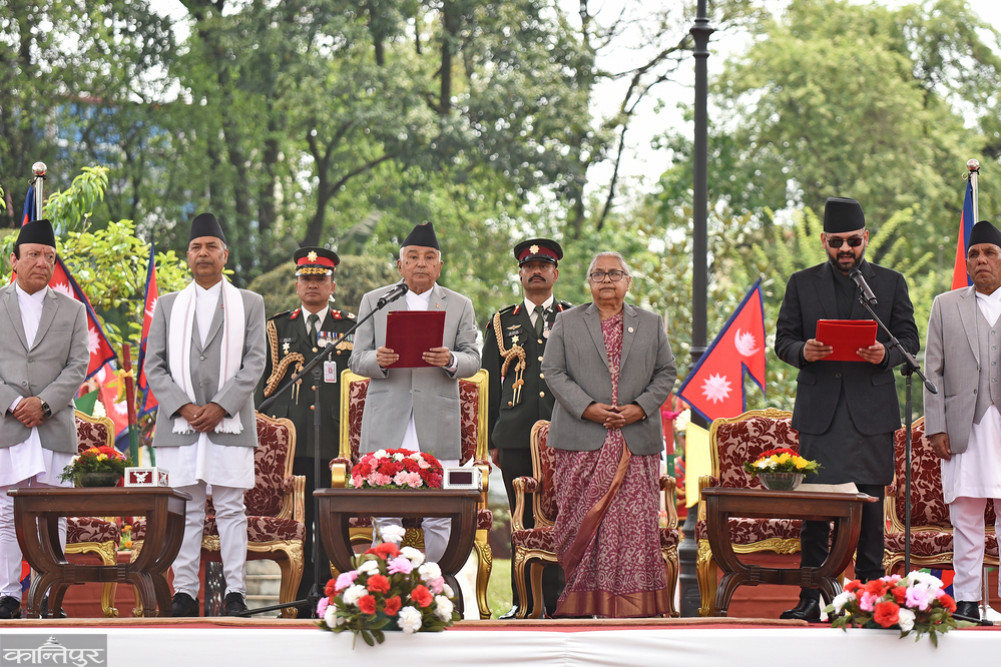
The ordinance recommended by the Sushila Karki-led government formed after the Gen-G movement was neither approved nor rejected by the President - it was placed on 'hold'.
We use Google Cloud Translation Services. Google requires we provide the following disclaimer relating to use of this service:
This service may contain translations powered by Google. Google disclaims all warranties related to the translations, expressed or implied, including any warranties of accuracy, reliability, and any implied warranties of merchantability, fitness for a particular purpose, and noninfringement.
The government has recommended the ordinance on the Constitutional Council (Work, Duties, Powers and Procedures) that President Ram Chandra Poudel sent back on Sunday to the President again without making any changes. The Cabinet meeting held on Monday decided to send the ordinance back as is.
According to Article 113 (3) of the Constitution of Nepal, if the President finds it necessary to reconsider a bill other than the Finance Bill, he can send it back to the relevant house with a message. However, there is no compulsion that the returned bill must be amended by the Parliament.
According to senior advocate Chandrakant Gyawali, after the Parliament addresses the President's concerns or sends it back as is, the President has to certify it within 15 days as per Article 113 (4). He says that the same right applies to the President in the case of an ordinance as in the case of a bill.
According to him, if the President does not comply with the Constitution and the law, he can send it back with a message for correction. However, after the government recommends it again, the President is obliged to give his approval. The constitutional President does not have the power to stop or withdraw the ordinance.
Why was the ordinance withdrawn?
The Constitutional Council is a body formed under the chairmanship of the Prime Minister, which has a total of 6 members including the Speaker, Chief Justice, National Assembly Speaker, Leader of the Main Opposition Party and Deputy Speaker.
The President has raised questions about how to determine the 'majority' in this structure. According to the President's concern, a decision should be made by a majority of the total members (at least 4). However, the ordinance proposed by the government has a different provision. Accordingly, it is said that a meeting can be held if 4 members are present and the decision can be made by the majority of the members present. This means that if 4 people are present, only 3 people can make a decision.
The President has sent the ordinance back for reconsideration, saying that this provision will weaken the essence of the 'majority of the total members'.
What is the provision in the current law?
According to the current law, a meeting can only be held if at least 5 members, including the chairman, are present. There is an obligation to make a unanimous decision in the first meeting. If no agreement is reached, a decision can be made only by majority in the second meeting. That too, there is a provision that a decision must be made by a majority of the total 6 members (at least 4).
Therefore, the current law considers the 'majority of the total members' as the final basis, while the proposed ordinance has given priority to the 'majority of the members present'.
This same controversy had arisen in the past as well. The President had sent back the bill on the same issue before. The bill, which was passed by both houses of the Federal Parliament and reached for verification on 31 Asad 2082, was returned by the President for reconsideration.
The proposed provision was even more controversial at that time. There was a provision that if the chairman and 5 members are present, 4 members can make a decision, if the chairman and 4 members are present, 3 members can make a decision, if the chairman and 3 members are present, 3 members can make a decision, and if the chairman and 2 members are present, 2 members can make a decision. The President had sent the bill back with a 5-point message, saying that such a provision would weaken the essence of the majority.
Another example of an ordinance being put on hold
In another context, the ordinance recommended by the Sushila Karki-led government formed after the Gen-G movement was neither approved nor rejected - it was put on hold. According to a source in the President's Office, the ordinance also repeated the provisions of the bill passed by the previous parliament.
Senior advocate Gyawali says that the executive will be the sharer of the honor, disgrace and accountability of the ordinance, so the President should not enter into it now. "The President has fulfilled his constitutional duty to send it back once, and now he does not have the right to send it back again or put it on hold," Gyawali said. "Since such an ordinance will be tested in Parliament, the President does not need to think further."