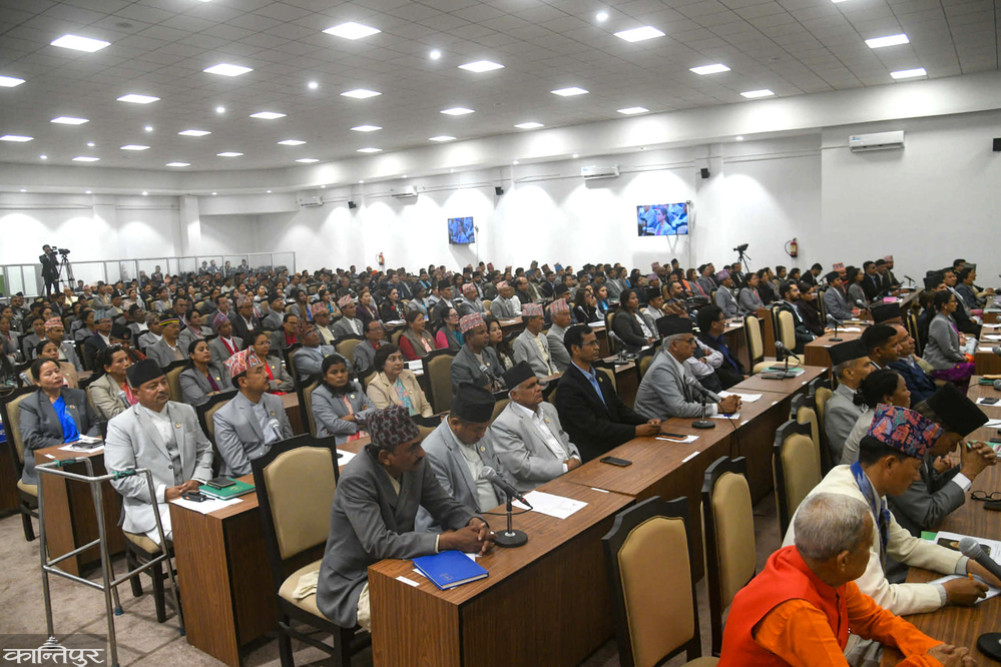
In a parliamentary democracy, the opposition holds the government accountable. The main responsibility of the opposition is to raise questions about the government's policies, programs, and budget, to bring motions of no confidence, to present alternative viewpoints in parliament, and to expose the weaknesses of the executive.
We use Google Cloud Translation Services. Google requires we provide the following disclaimer relating to use of this service:
This service may contain translations powered by Google. Google disclaims all warranties related to the translations, expressed or implied, including any warranties of accuracy, reliability, and any implied warranties of merchantability, fitness for a particular purpose, and noninfringement.
Bhishmaraj Angdembe has been elected unopposed as the leader of the Nepali Congress Parliamentary Party. The meeting of the Nepali Congress Parliamentary Party held on Monday elected Angdembe as the party leader. The Congress, which plays the role of the main opposition party in Parliament, has been in a tug-of-war for a long time regarding the selection of the party leader. Initially, three people claimed to be the leader of the Nepali Congress Parliamentary Party - Arjun Narsingh KC, Bhishmaraj Angdembe and Mohan Acharya. After all three did not give up their claims, the party prepared for the election and finally, Angdembe was elected as the leader of the party by consensus.
Angdembe has also become a member of the council as per the provision that the leader of the main opposition party is an ex-officio member of the Constitutional Council formed under Article 284 of the Constitution. How important is this position? What rights and privileges does the leader of the main opposition party get? Let's understand in five questions and answers.
What is a parliamentary party and how is its leader elected?
A parliamentary party is a group within the parliament of a political party. Only elected MPs are members of it. A party and a parliamentary party are not the same. A party is a large political organization spread across the country, while a parliamentary party is just a group within its parliament. For example, if the Nepali Congress has 38 MPs, those 38 together form the Nepali Congress parliamentary party in the House of Representatives.
The Political Parties Act, 2073 BS determines the process of forming a parliamentary party in Nepal. A party that wins at least two seats in the House of Representatives is allowed to form a parliamentary party. A parliamentary party must be formed and a leader selected within 30 days of the announcement of the election results. The leader of the parliamentary party selects the deputy leader, chief whip and whips. An important power of a parliamentary party is the 'whip'. During voting, the party can issue a 'whip' to its MPs, which must be followed. Whips are imposed on issues such as giving confidence or no confidence to the government, passing the budget or not, voting on bills of national importance, etc. The party can take action against an MP who violates the whip and may even lose his or her MP post. In 2077 BS, MP Sarita Giri did not accept the whip of the Janata Samajwadi Party and lost her MP post.
What does it mean to be the leader of the main opposition party from a constitutional perspective?
The leader of the main opposition party is an ex-officio member of the Constitutional Council formed under Article 284 of the Constitution of Nepal. This council consists of the Prime Minister (President), Chief Justice, Speaker of the House of Representatives, Speaker of the National Assembly, Deputy Speaker of the House of Representatives, and the leader of the main opposition party. The council recommends the appointment of the Chief Justice, the Commission for the Investigation of Abuse of Authority, the Election Commission, the National Human Rights Commission, the Auditor General and other important constitutional bodies.
What this means is that Angdembe is not just an ordinary opposition MP. He has a direct role in recommending appointments to the highest constitutional positions in the country. Without the participation of the leader of the main opposition party, the quorum of the Constitutional Council is not sufficient and the council cannot make decisions.
What is the importance of this position from a political perspective?
In a parliamentary democracy, the opposition is responsible for holding the government accountable. The main responsibility of the opposition is to raise questions about the government's policies, programs and budget, to bring a no-confidence motion, to present alternative views in parliament and to make the executive's weaknesses public. All of this is led by the leader of the main opposition party. From a political perspective, the leader of the main opposition party is considered the 'future prime minister' or 'head of the shadow government'. If there is a change of power tomorrow, the same leader should be ready to lead the new government. Therefore, the leader of the opposition should work as committed and systematically as the ruling party. In the current political context of Nepal, despite the majority of the Rashtriya Swayamsevak Sangh (RSS), if the Congress can play the role of an effective opposition, it can create a basis for resurgence in the next election.
What facilities does the leader of the main opposition party get?
According to the Remuneration and Facilities of Officers and Members of the Federal Parliament Act, 2073, the leader of the main opposition party gets adequate facilities from the state. Monthly salary is 60,970 rupees, special allowance 1000, meeting allowance 1000, communication facilities 3000, housing facilities 25,608 rupees per month, furniture expenses 15,000 in lump sum and private secretariat arrangements 1,750 rupees per month.
He gets 230 liters of petrol/diesel and 5 liters of Mobil per month for vehicle fuel. They get Rs 2000 towards electricity and water charges, Rs 2500 per day as daily travel allowance and Rs 2000 per month as hospitality expenses. Under the staff facilities, they get one gazetted second class personal secretary, one computer operator, two drivers and two office assistants.
For security, they get a security force consisting of one assistant inspector-level bodyguard, one badge guard and 10 army personnel. The Parliament Secretariat provides the office and staff to the leader of the opposition party. The government also provides a residence and if the government does not take a private residence, the government also bears the maintenance cost of the private residence.
What is the role of the leader of the opposition in India and the UK?
The most sophisticated form of parliamentary democracy is found in the UK. There, the leader of the main opposition party is called the 'Leader of the Opposition'. He forms an entire 'shadow cabinet'. There is a 'shadow minister' for each ministry. Who monitors and criticizes the policies and programs of that ministry.
The opposition leader here also gets government facilities and is considered the 'Prime Minister-in-Waiting'. In British tradition, the Prime Minister has to debate directly with the Leader of the Opposition every Wednesday in the Question and Answer Session, which is called 'Prime Minister's Questions'.
In India, there is also a post of 'Leader of the Opposition' in the same style as the British model. The leader of the main opposition party in the Lok Sabha is given ministerial status and facilities. From 2014 to 2024, the post of Leader of the Opposition was vacant in India because there was no single major opposition party.
Because in India, only winning 10 percent of the seats in the Lok Sabha (here, the House of Representatives) gives you opposition status. In the total of 543 members of the Indian Lok Sabha from 2014 to 2024, no party other than the ruling party won 10 percent of the seats alone. However, in the 2024 Lok Sabha elections, the Indian Congress won 99 seats. Currently, Congress leader Rahul Gandhi is the leader of the opposition.