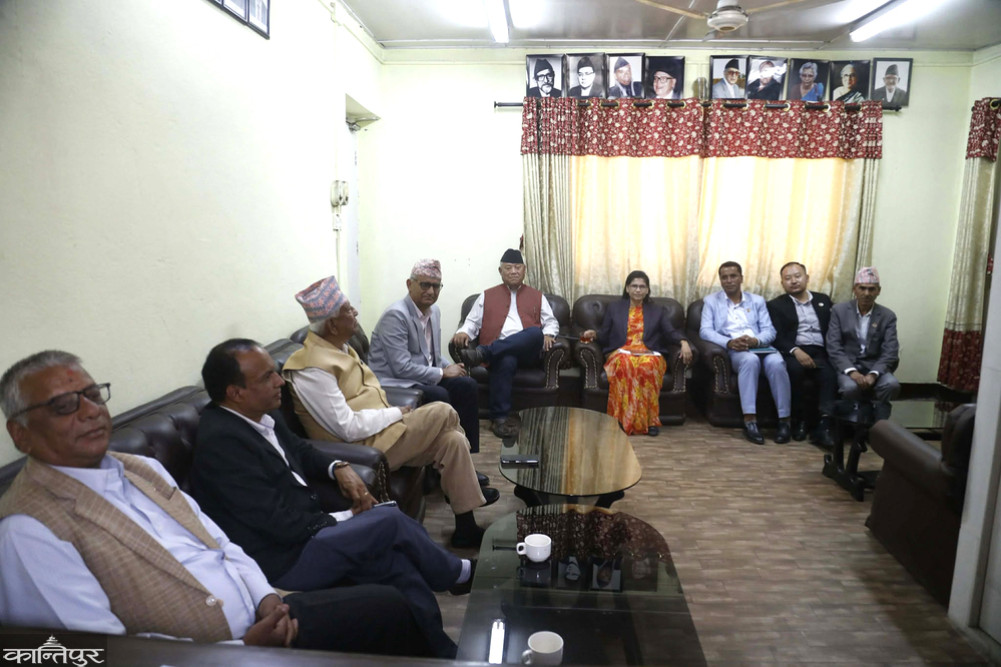
Separate dialogues have begun between leaders of the Congress, UML, and NCP to present themselves as an effective opposition in Parliament.
We use Google Cloud Translation Services. Google requires we provide the following disclaimer relating to use of this service:
This service may contain translations powered by Google. Google disclaims all warranties related to the translations, expressed or implied, including any warranties of accuracy, reliability, and any implied warranties of merchantability, fitness for a particular purpose, and noninfringement.
The opposition Congress, UML and NCP have started dialogue to form a common position on issues such as constitutional amendment, law making, and implementation of federalism.
Congress (37), UML (25) and NCP (27) have 80 seats in the House of Representatives. They estimate that if the three parties come together, they can put a strong warning to the government. That is why they have started dialogue on common issues to be raised in parliament. The Shram Sanskriti Party (7) and Rastriya Prajatantra Party (5), which are represented in parliament, have been raising issues in their own way.
While the single government of the Rastriya Swatantra Party is moving forward with the constitutional amendment process and bills, the opposition is in discussions to form a common position on issues that can be agreed upon. Since the RSVP is close to winning about two-thirds of the seats in parliament, the opposition is in discussions on issues that can be agreed upon on constitutional and legal issues.
Opposition leaders say that a strong Rashtriya Swayamsevak Sangh (RSS) government may be 'arbitrary', and that a common view in favor of the rule of law may emerge among the opposition. Leaders say that if the government tries to suppress its voice with the power of a single majority, the opposition will protest in one voice.
Congress President Gagan Thapa and NCP Coordinator Pushpa Kamal Dahal held talks on Tuesday on national issues that can be agreed upon between the opposition parties. The meeting held at Dahal's residence, Hattivan, discussed the role that the opposition can jointly play in parliament.
Dahal had visited UML Chairman KP Sharma Oli at the Maharajgunj Teaching Hospital on April 4 when he was recovering from a kidney stone surgery. During the meeting, Oli and Dahal discussed possible cooperation.
UML Vice President Ram Bahadur Thapa, General Secretary Shankar Pokharel, Deputy General Secretary Lekhraj Bhatta, Secretary Padma Aryal and NCP leaders Barshaman Pun, Dev Gurung and Shakti Basnet also held informal talks on cooperation. The three parties are trying to form a common position on national issues to emerge as an effective opposition in parliament after the February 21 election weakened them.
Nepali Congress General Secretary Guru Ghimire said that it would be good for the opposition parties to have a common position on national issues. ‘It is necessary to form a common position on national issues including the protection of the constitution and democracy,’ he said. ‘It is necessary to support the good work of the government and warn against its wrongdoing.’
He said that regular dialogue is necessary as increasing conflict between political parties affects democracy. ‘The government should also not increase conflict with the opposition parties.’ This weakens democracy,' he said, 'the voices of the opposition parties should be heard.'
UML had decided to collaborate with the old parties on the issues of the constitution, democracy and civil rights immediately after the election. The secretariat meeting held on 18 Chaitra had given the responsibility of dialogue for collaboration between the opposition parties to Vice Chairman Thapa and Secretary Padma Aryal. After Thapa and Aryal were given the responsibility of collaborating with the parties and making effective presentations within the parliament, discussions began.
After Chairman Oli was arrested on 14 Chaitra, UML sought the support of the opposition, saying it was political revenge. The NCP had also demanded an impartial investigation into the incidents of 23 and 24 Bhadra.
UML Vice Chairman Raghuji Pant said that discussions should also be held among the opposition parties to form a common opinion on the constitution amendment and necessary bills. ‘It is necessary to hold discussions between the opposition parties to finalize the bills on constitutional amendments, police, civil servants, education and others,’ he said. ‘It is necessary to alert and warn the government on the daily concerns of the people.’
Dahal, the NCP coordinator who is also a former Prime Minister, has started talks with the leaders of the Congress and UML in turn. After the election results, he has pointed out the need for cooperation between the old parties that drafted the 12-point, comprehensive peace agreement and the constitution.
Meanwhile, dialogue has also begun between the UML and the NCP on the issue of leftist cooperation. Before the House of Representatives elections, Oli and Dahal, who are fierce opponents of each other, have also recently become closer. After public opinion in the parliament has weakened, the two leaders have reached a state of mind to cooperate to warn the government on issues related to national independence, federalism, and the daily lives of the common people.
Senior NCP leader Barshaman Pun said that there is a need for cooperation between the opposition parties to strengthen the constitution and democracy.
‘The government is in danger of becoming arbitrary . Therefore, a common opinion can be formed in favor of the rule of law,’ he said, ‘The threat of an attack on the constitution is still not over . The voice against democracy and federalism has not died down . There can be cooperation between the opposition parties in this.’
He said that the opposition parties can also raise a single voice on the daily problems faced by the common people, including the high cost of living.
On Wednesday, on the NCP Foundation Day, NCP Coordinator Dahal stressed on cooperation, saying that the declaration of a federal democratic republic was possible because of the Congress, UML and NCP.
‘The declaration of a republic by the Constituent Assembly was possible because we, the political parties that waged a peaceful movement against the autocratic monarchy and those who waged an armed war, stood together. It is necessary for those who have signed a peace agreement, who are in favor of proportional inclusion, and who support a federal republic to come together,’ he said, ‘The nation faces the problem of national independence and geographical integrity. Congress, UML, Madhesh-centric parties and other communist parties are trying to move forward with discussions in a new vein. This problem can be overcome by cooperation.’