
Deuba's Politics: From the Center to the Edge of Power
Deuba continued to rise in his political journey, but the democratic values he embraced were gradually eroded, he lost the opportunity for a respectable exit from his own party, and he was dragged into a state investigation for money laundering.
We use Google Cloud Translation Services. Google requires we provide the following disclaimer relating to use of this service:
This service may contain translations powered by Google. Google disclaims all warranties related to the translations, expressed or implied, including any warranties of accuracy, reliability, and any implied warranties of merchantability, fitness for a particular purpose, and noninfringement.
Sher Bahadur Deuba had reached Biratnagar on 22 Mangsir 2081 to participate in the Koshi Province Conference of the Nepali Congress. Addressing the program, the then General Secretary Gagan Thapa said, ‘Our President does not talk much.’
When his turn came, Deuba replied, ‘The General Secretary said a lot, I will say only one thing – I talk less.’
It was a moment when Deuba defined himself. Deuba, an 81-year-old politician who has a political journey of more than 6 decades, is criticized for his low speaking habits. He is sometimes ridiculed for that same habit. He never tries to avoid it, and it does not seem to affect him much.
Deuba's political life has also shown another thing - eloquence is not mandatory to reach power and politics is an art that can be mastered even if one is not a good speaker.
The story of Deuba's political life is a list of his struggle, prison life, democratic movement and organization building. The Biratnagar program was one of the few moments when Deuba publicly expressed his reticent nature. The conversation between Deuba and Thapa there also indicated that not everything was right within the party. That is, the seeds of disagreement between them had begun to sprout right then.
Eight and a half months after the Koshi Province Conference of the Nepali Congress, the Gen-G movement took place, which not only changed the political landscape of Nepal, but also changed the citizens' perspective on society and politics. On the second day of the movement, on 24 Bhadra, Deuba and his wife Arju Rana were mistreated by protesters at their residence in Budhanilkantha, and their house was set on fire.
The Rashtriya Swayamsevak Sangh (RSS) has formed a government in the elections held after the dissolution of the then House of Representatives on the strength of the Gen-G movement, sidelining the old political parties including the Congress. The Deuba couple, who have long been seen as the ruling elite, are currently under investigation on suspicion of money laundering. The Money Laundering Investigation Department has already issued an arrest warrant against them, who are currently abroad.
How did Deuba, who came from the far west, which lags behind in the Human Development Index, become one of the most powerful people in Nepal by becoming the Prime Minister five times?
The story of Deuba's political life is a list of his struggles, prison life, democratic movements and organization building. It is as if he was born for politics. His political journey was like this - he kept rising, but the democratic values he embraced gradually eroded.
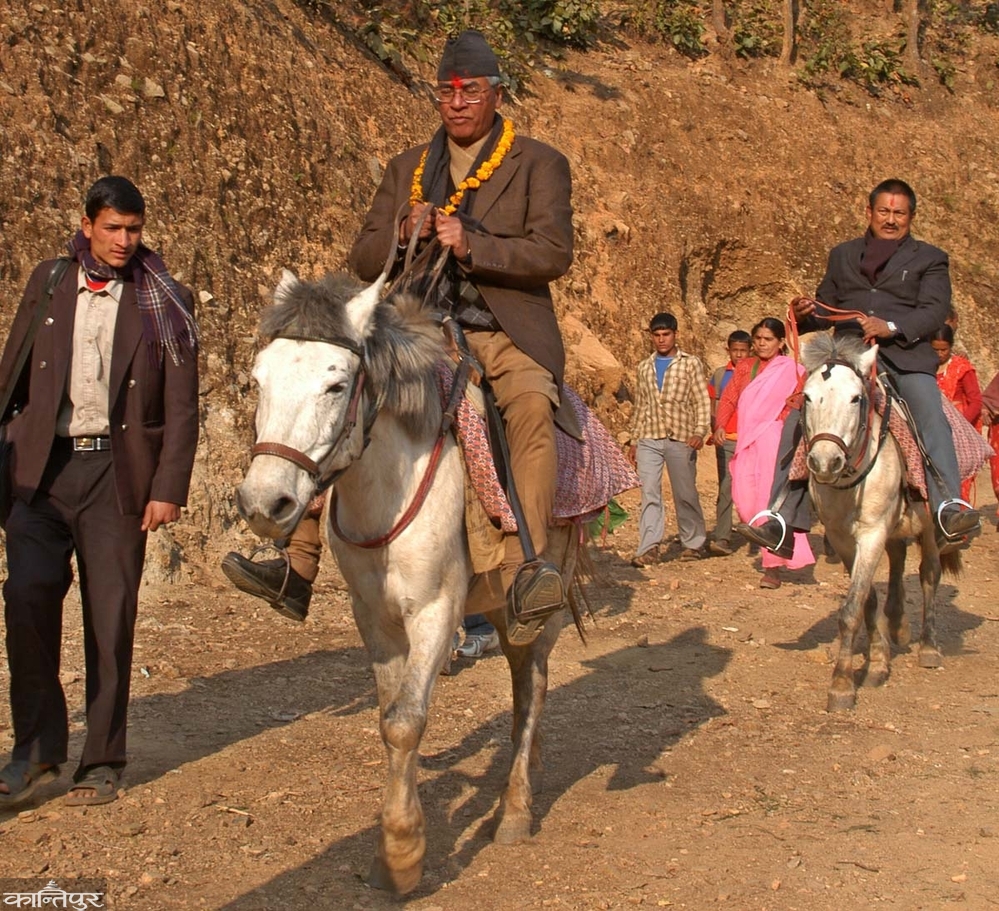
Deuba was born on 31 Jestha 2001 in Asigram, Ruwakhola, Dadeldhura. Two years ago, at a program organized in Sudurpaschim, Deuba told the story of how he first reached Kathmandu after passing his SLC in 2019. He had said, ‘I walked to Dhangadhi.’ Then I went to India and took a train and reached Lucknow the next day. From there, I took another train and got off at Raxaul in Bihar via Muzaffarpur. From there, I entered Nepal (Birgunj) and reached Kathmandu.’
While recounting the difficult journey of three to four days, people in the same area were still complaining that Sudurpaschim was lagging behind in the economic index.
After coming to Kathmandu, Deuba enrolled in Trichandra College in 2021. Later, he completed his master’s degree in political science from Tribhuvan University. Congress leader Chiranjeevi Wagle (who left active politics after corruption allegations) was Deuba’s classmate in Trichandra.
Deuba started politics as a student leader. At that time, the founding leader of the Nepali Congress, BP Koirala, was in exile in Banaras, India. In 2028, Deuba became the candidate for the presidency of the Nepali Congress in Bharatpur. He was elected unopposed with the support of leaders like BP Koirala, Suvarna Shamsher, Ganeshman Singh and Krishna Prasad Bhattarai.
Contemporaries say that if it were not for the support of BP, Ganeshman and Krishna Prasad Bhattarai, Deuba, who came from a simple family in a remote area, would not have become the 'lion' of Nepali politics.
According to leader Bal Bahadur KC, Deuba was first promoted as a regional leader. 'It is not that there were no other leaders in the Far West.' But Deuba had support, he was already established in the top leadership,' he said, 'he appeared in national politics over time, which was natural.'
Power became a way of life for Deuba, he exchanged principles with power, he saw in him the belief that there is no existence without power, so he formed all kinds of alliances, natural and unnatural: Bipin Koirala, Founding President, Nepali Sangh Nepali Sangh Founding President Bipin Koirala also links Deuba's rise to the lack of competition. According to him, Deuba got an opportunity in the far west when other leaders were active in relatively accessible and urban areas like Koshi and Gandaki.
'After the referendum was announced in 2036 BS, BP took Deuba with him when he went west. Deuba got the opportunity to sit on the same stage with BP, which paved the way for him to enter national politics,' recalls Bipin Koirala.
In the first parliamentary election held in 2048 after the restoration of the multi-party system, Acting President Krishna Prasad Bhattarai and General Secretary Girija Prasad Koirala gave Deuba the responsibility of distributing tickets in all 19 regions of the Far West.
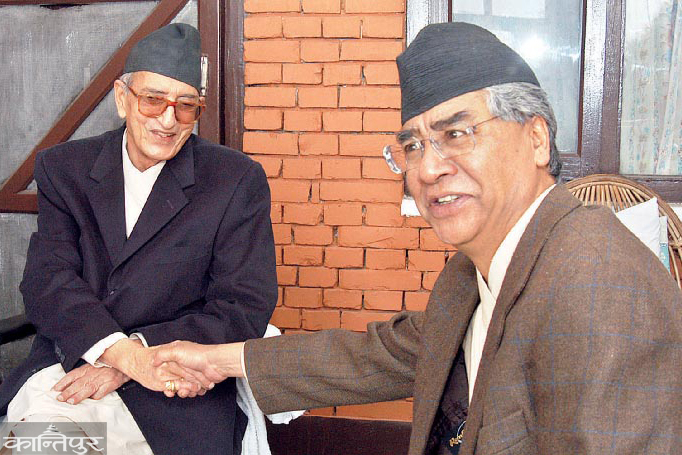
The Congress won in the remaining 18 regions except Darchula-2. As a reward for this, Girija Prasad Koirala made him the Home Minister. From this point on, his journey to power began and his hunger for power continued to grow. ‘After becoming the Home Minister, Deuba was never out of power,’ says Bipin Koirala.
Deuba often became an ‘inevitable alternative’. Deuba’s rise to power was partly the result of luck and partly the result of political skill. Contemporaries call Deuba a skilled player in power and equations. That is why he became the Prime Minister five times, and he always played a decisive role in forming or toppling the government. ‘Power became a way of life for Deuba.’ He exchanged principles with power,’ says Bipin Koirala, ‘He believed that if you are not in power, you cannot win elections, and that you cannot exist without power.’ That is why he formed all kinds of alliances, both natural and unnatural.’
000
When Kantipur spoke to more than a dozen contemporaries and analysts, most of them said that Deuba was not a leader focused on personal gain until he became Prime Minister for the second time. According to them, he was a politician focused on power games more than money.
Chiranjivi Wagle, who has been a minister twice in the Deuba-led government, says, ‘Until he became Home Minister, Deuba’s image was as a person without material greed.’ He had not caused any political controversy. According to Wagle, the seeds of greed in Deuba started to sprout after he became Prime Minister.
Wagle recalls an incident – when Deuba was the Home Minister, the government had decided to buy 20 vehicles for the Home Ministry. An agent made a proposal to Deuba, if 20 vehicles were purchased through him, Deuba would receive one vehicle as a gift.
‘After buying the vehicle, the agent asked in whose name the gifted vehicle should be registered,’ Wagle said, ‘Sher Bahadurji asked to keep it in the name of the Home Ministry.’ Then the vehicle was registered in the name of the ministry.’
Many say that after marrying Arju Rana in 2050, Deuba’s life and personality changed a lot.
After Deuba’s marriage, a joke was widely circulated in Congress circles. Krishna Prasad Bhattarai had said, ‘Until today, Sher Bahadurji was our man, now he is Arju.’
There is no consensus among Congress leaders on the real meaning of Bhattarai’s statement. Some say that Bhattarai was hinting that the Rana family lifestyle had entered Deuba's life. Others say that it was just a light joke about the possible changes in Deuba's married lifestyle.
Whatever Bhattarai meant, a belief has gradually developed within the Congress in the last decade - that 'brothers and sisters-in-law' have woven a web of money by abusing power, Arju controls appointments and sets their 'prices'. Arju's involvement in the recent fraud of sending Nepali citizens to the US as Bhutanese refugees has also become a subject of public debate.
000
During the 2046 BS movement, Deuba was studying in Britain. There was also talk that Krishna Prasad Bhattarai sent him to Britain on the assumption that he was leaning towards the Panchayat system. He returned only after repeated requests from Nepal after the movement. When the 2046 BS democratic movement reached its peak, Deuba was studying in Britain. At that time, some leaders speculated that Deuba was leaning towards the Panchayat system, and there was talk that Bhattarai had sent him to Britain to keep him away.
Some claim that Deuba was not interested in returning to Nepal immediately even after the 2046 BS movement. He had planned to stay in Britain for some time and returned only after repeated requests from Nepal.
But Deuba's close aide Gyanendra Bahadur Karki rejects such a claim. 'He returned as soon as the movement ended.' It is not true that he wanted to stay in Britain,' he says.
According to another close aide, Deuba had also considered going from Britain to the US for an internship. 'He had contacted a leader who was studying in the US and expressed his desire to do an internship there. I told him that democracy has come to Nepal, he should not stay abroad anymore, he should return,' the leader told Kantipur.
According to the leader, Deuba then said, ‘I have not seen America yet, I want to go. I am not Krishna Prasad Bhattarai or Girija Prasad Koirala’s first choice, why return immediately?’ The leader said that Deuba returned to Nepal without going to America after other friends from Nepal kept urging him.
000
Krishna Prasad Bhattarai was defeated in the first election held in 2048 after the fall of the Panchayat. Then Girija Prasad Koirala made Deuba the Home Minister.
Deuba was fine as the Home Minister and the Prime Minister in his first term, but then he changed, committed and honest workers gradually fell away, flatterers and rich people became closer: Soviet Bahadur Adhikari, Congress leader Soviet Bahadur Adhikari, a former Congress leader who sat on Deuba’s committee in the Nepali Sangh, says that Deuba is changing over time. ‘He is not what he used to be,’ he says, ‘before, he was a leader who instilled simplicity and confidence in his workers. He was frugal. Until he became the Home Minister, he had the image of a leader who was not greedy for money.’
But it is not possible for everyone to maintain simplicity forever. For Deuba, the taste of power was like a lion tasting blood.
After Deuba became Prime Minister for the first time in 2053, Koirala began to suspect that Deuba was creating his own power center. According to a former minister, Deuba once told some ministers that Koirala was becoming suspicious of him. According to a leader, Chakra Prasad Bastola (late), who was the Foreign Minister at the time, suggested a solution – ‘If you want to have a good relationship with Girija, go to him every morning and give him cash.’ Girija needed money to run the party.
Deuba accepted the suggestion . But the relationship with Girija did not last long .
It was just after the 9-month-old government led by Manmohan Adhikari fell, Deuba had become the Prime Minister with the support of the Rastriya Prajatantra Party and the Sadbhavana Party . At that time, he was 49 years old .
Deuba had quickly learned how to control power – instead of giving money to Girija to improve relations, he would use the same resources to strengthen his own power center .
000
Although Deuba married Arju while serving as the Home Minister, he built his own house only after becoming the Prime Minister for the second time in 2058 . When he first became the leader of the opposition party in 2051, he lived in the government residence in Maharajgunj . For some time, he also lived in a rented apartment in Chundevi . He also lived in Bharatshamsher Rana's house in Thapathali .
Lately, he had been living in a palace-like house in Budhanilkantha, which has now turned into ruins. Half-burnt bundles of cash were found there after protesters set fire to it during the Gen-G movement.
‘No matter how you explain it, the change in Deuba is after marriage,’ said a leader who has known him since 2036 BS. ‘The reason why Deuba has sunk so deeply into power and money in recent times is Arju.’
The general understanding among party leaders seems to be that the unnatural greed and ambition seen in the latter half of his life led to such a decline in his political career.
According to Sobiat Bahadur Adhikari, an unusual change has started to be seen in Deuba after he became Prime Minister for the second time. ‘He was fine while he was Home Minister and during his first term as Prime Minister.’ After that, ordinary Congress workers started to feel that he had changed,' he says, 'Selfless, committed and honest workers gradually became sidelined. Flatterers, sycophants, greedy and rich people became closer to him.'
Budhanilkantha's house was initially on about three ropanis of land. Arju has repeatedly said that she received the land as a gift from her parents. According to leaders close to the Deuba family, the land was added over time and now the property is spread over an area of more than seven ropanis. This is a very large area for a family residence by Nepali standards.
Former minister Wagle also says that Deuba has been succumbing to financial temptations in recent years. 'Initially, he was a leader with enthusiasm to do something. A person who had come after a long struggle and had served time in prison. But in recent years, especially after 2070, he seems to have been more affected by greed,' he says, 'During the Panchayat period, the king himself was fine, people around him were said to be spoiled, even now some say he was negatively affected by Sher Bahadur Arju.'
He added, 'But instead of blaming Arju alone, Sher Bahadur himself should also introspect.'
000
Another aspect that makes Deuba's political life infamous is the distorted culture he introduced into parliamentary democracy.
Journalist Hari Bahadur Thapa, who has done in-depth parliamentary reporting after the restoration of democracy, recalls that Deuba's first government had decided to provide 90 percent customs duty exemption on Indian vehicles and 50 percent discount on expensive vehicles for MPs.
'Deuba approved that decision saying that it was an all-party consensus,' Thapa says, 'MPs bought Prado and Pajero.' What's worse is that they started buying and selling cars with tax exemptions. This incident marked the beginning of the Pajero-Prado culture in Nepali politics.'
Another incident also shows that Deuba can go to any extent to stay in power. In 2053, the UML filed a no-confidence motion against Deuba with the support of the Lokendra Bahadur Chand group of the Rastriya Prajatantra Party. The vote was scheduled for 9 Poush 2053. Deuba, who became Prime Minister with the support of the RPP and the Sadbhavana Party, was in crisis. After that, Deuba kept the MPs who could vote against him in a five-star hotel in Kathmandu.
Journalist Thapa says, ‘At that time, there was talk of a 17-kilogram bag of cash in the parliament premises, meaning that about one crore rupees (in thousand-rupee notes) weighs 17 kilograms.’
According to Thapa, Deuba had given five ministers who could vote against him $2,000 each and sent them to Bangkok. ‘He tried all means to stay in power,’ says Thapa, ‘he passed the no-confidence motion, but he did not last long.’
UML could not muster a majority to form the government, which forced Deuba to seek a vote of confidence again. Then, after Deepak Bahadur Shahi and Chakra Bahadur Shahi of his own party were absent, the 575-day term ended.
000
Deuba’s second term as Prime Minister began on 7 Shrawan 2058. After the Maoists attacked the Holeri police station in Rolpa on 28 Ashad 2058 and took control of a large number of police officers, the then Prime Minister Girija Prasad Koirala tried to mobilize the Nepali Army. But Deuba became Prime Minister after he resigned, saying he did not receive support from the king.
The then King Gyanendra appointed Deuba as Prime Minister with the aim of controlling the armed Maoist rebellion. Immediately after assuming office, Deuba declared a 'period of emergency'.
A cabinet meeting held on 10 Baisakh 2059 set a price for the heads of underground Maoist leaders, which became controversial. Whoever captured Maoist leaders alive or handed over their heads, it was said, would be given a reward of 2.5 million to 5 million rupees. The first 'most wanted' list included Pushpa Kamal Dahal, Baburam Bhattarai and Mohan Baidya, each of whom was given a price of 5 million rupees.
In response, a bomb attack was launched on Deuba's vehicle. He managed to save his life.
The emergency period imposed to take strict action against the Maoists eventually led to a split within his own party.
On 8 Jestha 2059, when a dispute arose over the announcement of new elections, the party asked Deuba for an explanation. He was then expelled for three years. On 5 Ashad 2059, the Congress formally split and Deuba formed the Nepali Congress (Democratic).
On 18 Asho 2059, King Gyanendra Shah removed Deuba from office. But fate was on his side again. King Gyanendra reappointed Deuba as Prime Minister on 20 Jestha 2061 to crush the seven-party movement.
At that time, Deuba had responded that 'the Gorkhali king had done justice'. But eight months later, on 19 Magh 2061, King Gyanendra dismissed Deuba in a coup and seized power.
The same Gyanendra, whom Deuba called a 'just' Gorkhali king, later imprisoned him on corruption charges. Deuba was released only after the Supreme Court quashed the royal commission that had accused Deuba of corruption.
On 9 Asoj 2064, Deuba returned to the main party, the Nepali Congress. He was later elected party president at the 13th General Convention (Falgun 2072) and 14th General Convention (Mansir 2078).
000
According to a leader close to Deuba, the real downfall of Deuba and the Congress began in 2073, when the Congress and the Maoists jointly brought a no-confidence motion against the KP Sharma Oli government. After Deuba reached an agreement with Maoist Chairman Pushpa Kamal Dahal, Dahal removed Oli and became Prime Minister. Dahal became the Prime Minister for 10 months and then handed over power to Deuba. Deuba, the 'master player' of Nepali politics, became the Prime Minister for the fourth time.
At that time, the strange equations of Nepali politics were clearly visible. Dahal and Deuba had together removed Oli. But in the elections held during Deuba's tenure, Dahal's then Maoist Center and Oli's UML formed an alliance and contested the elections. Later, the two parties merged to form the NCP.
‘From here, Deuba started pushing the Congress down a downward path and also prepared the ground for his own downfall,’ says a leader who has worked with Deuba for a long time, ‘He started making unethical alliances, which gave him the image of an unreliable politician.’
Bipin Koirala says, ‘Deuba is a subject of study on how an honest and committed worker gradually becomes unethical and corrupt.’
000
In the early days, Deuba was a leader committed to democratic values—equality and social justice—as evident from his work. The Mahakali dispute was resolved during his first term.
With the support of the main opposition UML, he got the Mahakali Treaty with India passed by the parliament. This treaty, which ensured equal rights of Nepal and India over the waters of the border river Mahakali, had been controversial since the time of Girija Prasad Koirala.
At the same time, Deuba put forward the concept of 'Kadamjam' (Karnali, Dalit, Women, Janajati, Madhesh) with the aim of bringing backward areas and communities into the mainstream. The decision to form the Women, Indigenous Peoples and Dalit Commission was also made during his tenure. The Kamaiya Labor (Prohibition) Act was also brought during Deuba's tenure.
Deuba has been mentioning this as one of the most positive works of his tenure. In 2058 BS, it was decided to implement modern land reform, which ended dual land ownership.
During Deuba's second term, an important step towards economic reform was taken by implementing VAT. Under his leadership, a law was passed to empower the Commission for the Investigation of Abuse of Authority. 22 permanent bridges, including the Karnali Chisapani Bridge, were built, which connected the Far West with the capital.
000
According to Congress leaders, after Deuba became the party president, politics began to become power-centric. From here, his downward journey began both within the party and in the government. He embraced the idea that ‘power is everything’.
Meanwhile, the unity of the communist forces in 2075 did not last long. While the struggle between Dahal and Oli was going on, the Supreme Court delivered its decision in 2077 on the party name dispute, bringing the NCP to a state of unity. The Oli-led UML and the then Maoist Center led by Dahal were revived.
Deuba became Prime Minister in Asad 2078 after the Supreme Court issued a mandate on a writ filed against the decision to dissolve the House of Representatives for the second time on the recommendation of the then Prime Minister Oli. Deuba, who has been Prime Minister four times, was probably not very interested in the post this time for the first time.
The 2079 elections were approaching. Deuba decided to go to the polls in an alliance with the then Maoists and made the Congress the largest party. Naturally, he was in the running to become the Prime Minister, but Dahal went to Oli - Oli had offered him the post of Prime Minister.
Deuba made a surprising decision when he gave a vote of confidence to Dahal. This left the parliament without an opposition. This is a rare event in Nepal's parliamentary history.
Deuba, who was seeking a sixth term, was looking for an opportunity to remove Dahal. For Dahal, who was supported by the UML, the challenge was to preserve his legacy as the party structure weakened.
At the same time, the government took forward some corruption cases, including the Bhutanese refugee case. Congress leader Balkrishna Khand was in jail. UML leader Top Bahadur Rayamajhi was also arrested.
Arju's name was also mentioned in the media, but no formal case was registered against him. In the analysis of many, staying in power was the only way to avoid such action. And, Deuba knew that Oli would not give him that opportunity.
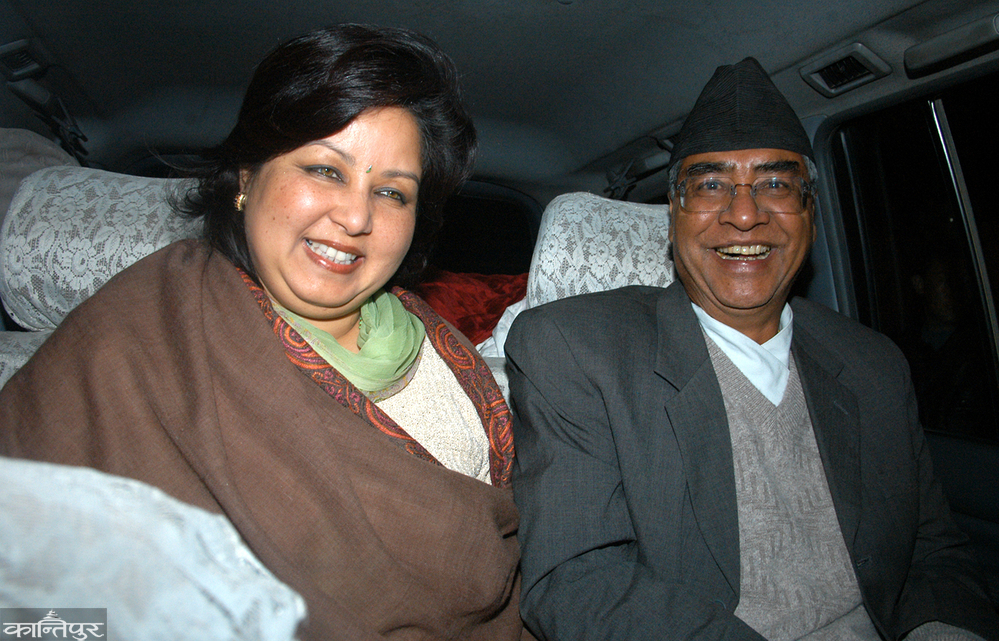
Deuba, who had become a 'master manipulator' with decades of experience, suddenly visited Oli's residence on Ashad 15, 2002 - on the pretext of eating 'curd and chiura' on Ashad 15. On Ashad 17, a seven-point agreement was reached between Deuba and Oli. Oli replaced Dahal and took over the leadership of Singha Durbar. Deuba made Arju the Minister of Foreign Affairs in the Oli government. According to the agreement, Oli was supposed to hand over power to Deuba after two years.
Before that moment came, the 'Gen-G' movement came, which changed the entire political equation.
Deuba was not seen in public for about a month. In late Ashad, he appeared at the party office and announced that he would step down and gave the responsibility of acting president to Purna Bahadur Khadka. Then he went to Singapore for treatment. At that time, his party was struggling to find its role in the new political context. The month-long central committee meeting failed to make any concrete decisions. Deuba returned from Singapore a month later - in his old style, speaking less but showing influence. But in the meantime, differences were deepening. The Gen-G movement had intensified it even more.
The demand for a special general convention was not heard by the leadership. Then, a disgruntled group led by the then general secretary Gagan Thapa called a special general convention, from which Thapa was elected president. Deuba was not even given a ticket for the 21 Falgun elections. Deuba, who had never lost an election since 2048, went to Singapore before voting, Arju also went to Delhi before the elections, and from there reached Singapore.
The Congress suffered a historic defeat in the elections. New President Thapa also lost to Amresh Kumar Singh of the Rashtriya Swayamsevak Sangh (RSS) in Sarlahi-4. The RSS emerged as a major force in the elections. After that, the government was formed under the leadership of senior RSS leader Balendra Shah.
After the new government took office, an investigation into money laundering has been launched against the Deuba couple. An arrest warrant was also issued by the court for that. After the investigation into money laundering began, Deuba denied the allegations on social media Facebook, saying, ‘The truth will unfold over time.’ I appeal to everyone not to be misled by the exaggerated details that have been made public.’
‘After coming to power, everyone raises money to gain influence, win elections, protect workers, donate to temples – all these things.’ Sher Bahadurji must have done the same,' says a leader who has been close to Deuba since 2036, 'Sher Bahadur Deuba and Prachanda once together toppled the Oli government. Not only did they share power and form various alliances, people like Deepak Bhatta, who is now facing a money laundering case, were also raised under political patronage at that time.'
Whether Deuba will return to Nepal or not - no one knows. But many have understood - the story of the end of Deuba's political life, who rarely speaks, is being written.