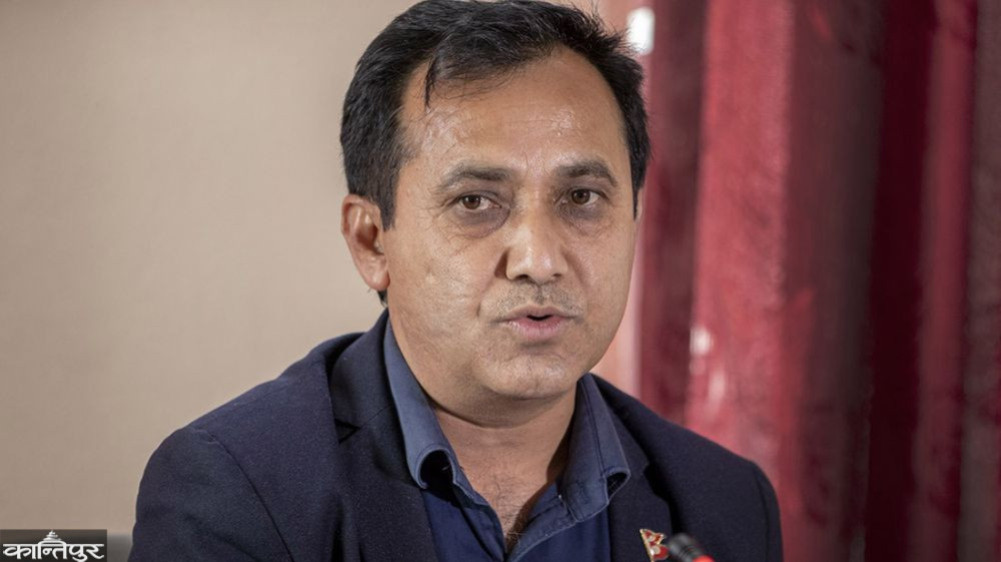
Presenting his argument in the Supreme Court, Sharma argued that the rationale for a special general convention does not end even though a regular general convention has been announced.
We use Google Cloud Translation Services. Google requires we provide the following disclaimer relating to use of this service:
This service may contain translations powered by Google. Google disclaims all warranties related to the translations, expressed or implied, including any warranties of accuracy, reliability, and any implied warranties of merchantability, fitness for a particular purpose, and noninfringement.
Congress Vice President Bishwaprakash Sharma has argued in the Supreme Court on a writ petition regarding the party's legitimacy, arguing that the special general convention is completely legal. He has urged the court to dismiss the writ petition and pave the way for the party to move forward.
Presenting his argument in the Supreme Court, Sharma argued that the justification for the special general convention does not end even after the regular general convention is announced. 'This was a compelling situation,' he said, 'The Supreme Court itself has established a precedent that the written demands of the general convention delegates cannot be made useless under any pretext.'
He emphasized the importance of written demands by quoting a Supreme Court precedent of Magh 21, 2054. Referring to the suggestion given by the court on the question of the dissolution of the House of Representatives or the convening of a convention in the then constitutional dispute, he said, 'No one has the right to make a written demand ineffective, the same principle applies here too.'
Sharma termed the special general convention as a 'democratic rebellion within the party' and interpreted it as a legitimate and necessary step. 'The right of inheritance ends when the landlord is present,' he said, giving an example, 'The general convention representatives are the sovereign power of the party, they can select and change the leadership.'
He argued that according to Article 17(2) of the party statute, there is a clear provision that the special general convention can select the leadership. 'The general convention representatives are the originators of the central committee and the general committee, they can both form and change the leadership,' he said.
Similarly, he claimed that this dispute was only an update process under Section 51 of the Political Parties Act. 'This is not a dispute under Section 44,' he said, 'The decision made by the Election Commission is completely in accordance with the statute and the constitution.'
During the debate, Sharma also pointed out the importance of democratic culture within the party. 'Not the leader, but the members should be the head of the party,' he said, 'This is the main message of the special general convention, which should bring about transformation in the entire politics.'
He mentioned that the situation within the party has changed after the special general convention and said that there has been an effort to move forward by including even the dissenting leaders. 'When selecting candidates on Falgun 21, even the dissenting leaders were included,' he said, 'Now we will move forward by holding a regular general convention in Asoj and taking all the elders with respect.'
During the debate, Sharma also presented a shadow copy of the tickets given to leaders Bimalendra Nidhi and Prakash Sharan Mahat before the bench.