The visit will take place only after preparations are completed at the technical and political levels from both Nepal and India, so that it can yield concrete results: Foreign Minister Khanal
We use Google Cloud Translation Services. Google requires we provide the following disclaimer relating to use of this service:
This service may contain translations powered by Google. Google disclaims all warranties related to the translations, expressed or implied, including any warranties of accuracy, reliability, and any implied warranties of merchantability, fitness for a particular purpose, and noninfringement.
Indian Prime Minister Narendra Modi has invited Prime Minister Balendra Shah to visit India. Foreign Minister Shishir Khanal said that Modi extended the invitation through a congratulatory message immediately after Prime Minister Shah assumed office on Chaitra 13.
Minister Khanal, who is in Mauritius, revealed to Indian media outlet BN that Modi had extended the invitation and that Prime Minister Shah had accepted it.
Speaking to Kantipur from Mauritius, Khanal also said that homework is being done to make the visit result-oriented. ‘The Prime Minister has accepted the invitation,’ he said, ‘The visit will take place only after preparations are completed at the technical and political levels from both sides, so that it can yield concrete results.’ Minister Khanal said that the date of the visit will be decided after discussions in the bilateral mechanism.
He said that both sides aim to achieve concrete achievements from the visit. Minister Khanal has arrived there to participate in the 9th Indian Ocean Conference (IOC) organized by the Ministry of External Affairs of India, the Government of Mauritius and the India Foundation. According to a foreign ministry official, there is a clear objective to not limit this high-level visit to formalities. Both Kathmandu and New Delhi are working to ensure concrete achievements, he said.
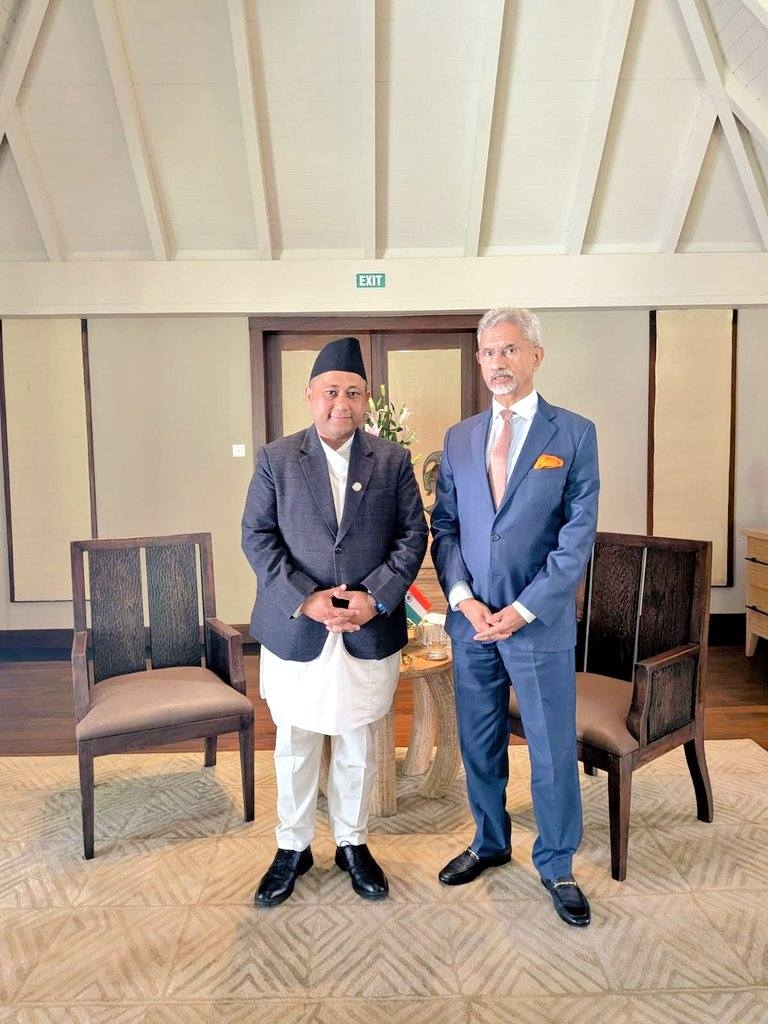
Khanal and Indian Foreign Minister S Jaishankar agreed in the IOC sideline meeting on Friday to schedule the visit only after projects and programs are decided according to Nepal's priorities. "It has been agreed to activate all bilateral mechanisms and find new areas of cooperation by focusing on the priorities set by both countries," Minister Khanal said. He said that once Kathmandu sets a clear roadmap and priorities, it will be discussed with the Indian side.
In the talks between Khanal and Jaishankar, it was also agreed to review the feasibility of ongoing projects and programs and find new areas of cooperation. After that, Nepal will formally request India to send a foreign secretary for further talks. After Kathmandu completes internal preparations, the Indian side will be informed about the next round of talks, after which the Indian foreign secretary is expected to visit Nepal.
Nepal and India have about three dozen mechanisms ranging from the district level to the Foreign Minister level in areas including security, water resources, irrigation, border management, border-related issues, trade, commerce and agriculture. Some of the mechanisms meet regularly, while some have been inactive for years. Similarly, dozens of projects and programs are in various stages of implementation in Nepal with India's financial and technical assistance.
Some projects have made good progress, while others have not been able to move forward as expected. The current government is planning to find new areas of cooperation by organizing these mechanisms and projects.
In an interview with Indian media outlet WOIN News, Foreign Minister Khanal said that the Prime Minister has already accepted the invitation, describing it as a positive step after the recent political changes in Kathmandu. He said, 'Prime Minister Modi had spoken to our leaders immediately after the elections.' On 25 Falgun, immediately after the election results were announced, Indian Prime Minister Modi had spoken to Rashtriya Swayamsevak Sangh (RSS) President Ravi Lamichhane and Balendra Shah.
Similarly, after Shah took oath as Prime Minister on Chaitra 13, Modi congratulated him and said that his appointment reflected the faith of the Nepali people in their leadership. ‘I look forward to working closely with you to take Nepal-India friendship and cooperation to greater heights for the mutual benefit of the people of both countries,’ Modi had said on his various social media platforms.
Khanal said in an interview that there will be continuity in Nepal’s foreign policy but it will be strongly linked to national interest. ‘New does not mean the end of continuity, our core values remain the same, relations with neighbors and partners will be linked to national interest,’ he said.
Sea is not only a matter of coastal countries: Minister Khanal
Foreign Minister Khanal has said that common international cooperation is necessary to address the challenges related to good governance, climate crisis and world peace in the Indian Ocean region. At the 9th Indian Ocean Conference held in Mauritius, he said that the world should take the relationship between the mountains and the sea seriously. Although Nepal is a landlocked country, Nepal has historical, cultural and environmental ties with the Indian Ocean.
Stating that there is an inseparable relationship between the mountains and the ocean as the water flowing from the glaciers and glacial lakes in the Himalayan region ultimately reaches the Indian Ocean, he said that the Hindu Kush Himalayan region is the basis of water resources for billions of people.
 He drew the attention of the international community to the rapid melting of glaciers in the Himalayan region and the increased risk of glacial lake outbursts due to climate change. He mentioned that the rapidly increasing temperature and rising sea levels in the Indian Ocean region have put bilateral and coastal countries at risk. He said that shared responsibility and multilateral cooperation are indispensable to solve the climate crisis. He also reminded that Nepal has been continuously raising this issue at the United Nations and climate conferences.
The Indian Ocean Conference being held in Mauritius on 27, 28 and 29 Chaitra has issues of governance of the Indian Ocean region, maritime security, climate crisis and economic cooperation. ‘Collective Responsibility for Good Governance of the Indian Ocean’ is the slogan of this time’s conference. Pointing to the slogan, Minister Khanal emphasized that the protection and management of the ocean should be through an international system based on regulation, transparency
and cooperation. He said that the sea is not only the subject of coastal countries but also the common property of the entire world and its governance should be inclusive, equitable and based on international law.
He mentioned that landlocked countries have the right to access the sea and participate in the maritime economy as per the commitments of the United Nations. He said that Nepal, as a signatory to the Convention on the Law of the Sea, is committed to the basic framework of the law of the sea. He mentioned that Nepal is concerned about wrongdoings such as maritime terrorism, piracy, drug trafficking and human trafficking.
The conference was addressed by speakers including Indian Foreign Minister Jaishankar, Bangladesh Foreign Minister Khalilur Rahman, Sri Lankan Foreign Minister Wijitha Herath, Bhutanese Foreign Minister DN Dhungel, Omani Foreign Minister Badr Hamad Al Busaidi, Seychelles Foreign Minister Barry Faure and others.

