Those who say party competition at the local level is inappropriate have supported the RSVP's cause, while some have called the idea of banning political parties wrong.
We use Google Cloud Translation Services. Google requires we provide the following disclaimer relating to use of this service:
This service may contain translations powered by Google. Google disclaims all warranties related to the translations, expressed or implied, including any warranties of accuracy, reliability, and any implied warranties of merchantability, fitness for a particular purpose, and noninfringement.
The local elections are a year behind schedule. The ruling National Independent Party has raised the issue of non-partisan local government. This has started a debate on whether non-partisan elections are possible in a country that has embraced a multi-party system. Those who say that partisan competition at the local level is inappropriate have supported the RSVP's issue, while some have called the idea of banning political parties wrong.
The RSVP has included the issue of non-partisan local government in the minimum concept of constitutional amendment. The RSVP's election manifesto has called a directly elected executive, a fully proportional parliament, a system where MPs do not become ministers, non-partisan local government, and a reformed provincial structure the minimum issues for constitutional amendment.
Senior advocate Chandrakant Gyawali, a constitutional expert, says the proposal to keep the local level outside party politics is good. 'This issue was also included when the constitution was being drafted. However, it did not move forward,' he said. 'The RSVP should also move forward if it is not just an election issue.'
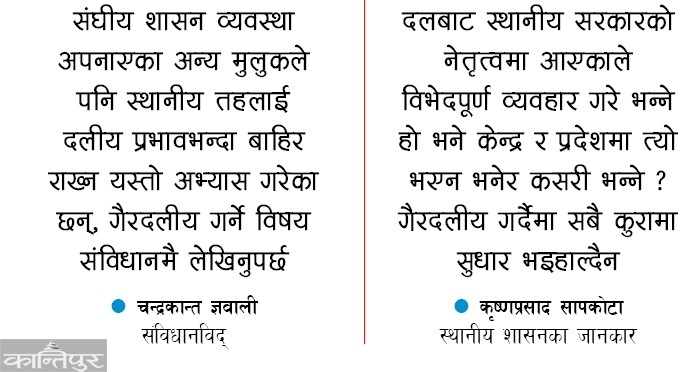
Constitutional scholar Gyawali says that the issue of non-partisan electoral competition at the local level should be written in the constitution. ‘The current system is a party-based governance system. Parties nominate candidates,’ he said, ‘The local level can only be made non-partisan to enhance it as a development, record-keeping and recommendation body. There should be no partisanship in the amenities available to the people.’
Constitutional scholar Gyawali mentioned that two-tier governments are practiced in countries with federal rule, but 761 governments with three tiers are being practiced in Nepal. He says that the number of local levels should be reduced and brought under the provinces and the provinces should be strengthened in the federal structure.
During the drafting of the constitution, mainly Madhesh-based parties advocated for a party-free system at the local level. JSP Nepal Chairman Upendra Yadav says that they emphasized this proposal during the drafting of the constitution. ‘The then big parties, especially the UML and the Maoists, did not accept it,’ he said, ‘There should be elections without parties by bringing the local level under the province. The local level should not be made a political arena and should be made an institution for development.’
Krishna Prasad Sapkota, former president of the Federation of District Development Committees and an expert on local governance, says that the current system should be improved as there is no guarantee that everything will improve by making it non-partisan. ‘Voices are heard that party competition in local elections has increased politicization to the grassroots level, discrimination is being done in development construction, and impartiality has not been maintained in budget allocation, recommendations, and employment opportunities. It is wrong to propose non-partisan elections based on that, there is no guarantee that everything will improve by making it non-partisan,’ he said, ‘The government, whether central, provincial or local, should be impartial. Governance should be based on legal values. Weaknesses should be corrected by law.' Sapkota suggests that the law should emphasize the need in budget allocation and development plan selection and that it should be tightened.
The argument that capable people have not been able to reach the leadership of the local level through party elections is on the other hand. The candidate nominated by the party would have come in the competition. Only in exceptional cases have independent people won the election by challenging the party competition. Dr. Shyam Krishna Bhurtel, an expert on federalism and local governance, says that non-partisan elections will also provide opportunities for people outside of those who are active in politics to lead at the local level.
He believes that people who have gained expertise and experience in various fields but are not affiliated with a particular party can have a positive impact on development and good governance when they lead the local level. 'This debate has been going on since 2048. Discussions are made and then lost. There is no need to form parties at the local level,' he said. 'The constitution also does not say to hold party elections everywhere. There is no discussion of party elections in the provisions of the constitution related to local levels.'
At the local level, ward chairpersons, vice-chairpersons, mayors and deputy mayors are elected by direct vote of the people. There is no practice of ruling and opposition parties like in the federal and provincial levels. There is no provision for those who win the election to seek a vote of confidence or to be removed by bringing a motion of no confidence. Those who win through party competition are forced to abide by the party's instructions and discipline.
However, since they are independent candidates, they will be in a position where no one will listen to them and they will not be removed for five years. Bhurtel also accepts that there is a possibility of autocratic behavior from some people. However, he believes that such negative possibilities that may occur from time to time should not be looked at only.

