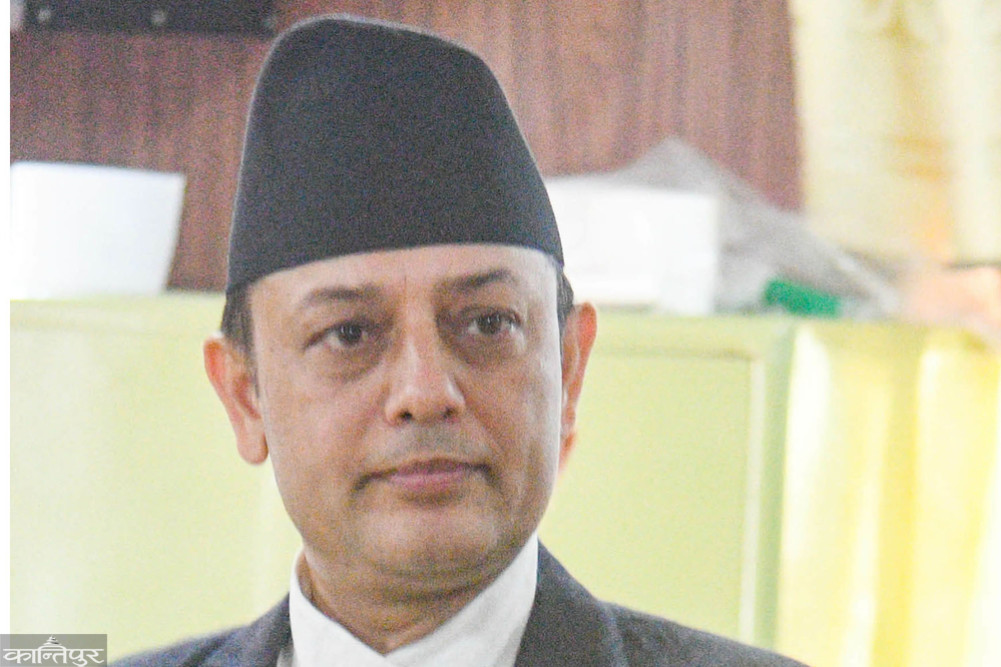
How far can the role of this position extend? What are the challenges facing RSP Deputy President DP Aryal, who is about to be elected as the Speaker? We have tried to explain in seven questions and answers.
We use Google Cloud Translation Services. Google requires we provide the following disclaimer relating to use of this service:
This service may contain translations powered by Google. Google disclaims all warranties related to the translations, expressed or implied, including any warranties of accuracy, reliability, and any implied warranties of merchantability, fitness for a particular purpose, and noninfringement.
Rastriya Swatantra Party (RSWP) Vice President DP Aryal has filed his candidacy for the new Speaker of the House of Representatives. As only Aryal has filed his claim within the stipulated time limit for nomination, it seems almost certain that he will be elected unopposed. The Speaker election will be held on Chaitra 22 and then he will formally become the highest office bearer of the House of Representatives.
Till now, senior member Arjun Narsingh KC has been conducting the meetings of the House. With the arrival of Aryal, the Parliament is getting permanent leadership. This journey from businessman to Speaker, less than four years after entering politics, raises many questions - such as what kind of position is the Speaker, what are its powers, what are the challenges? An attempt has been made to find answers to these questions.
What is the Speaker and why is this position considered important?
The Speaker is the chief official of the House of Representatives. In English, it is called 'Speaker', meaning the person who speaks on behalf of the House. However, the Speaker is neither a representative of the government nor of the opposition. He represents the entire House. His main responsibility is to maintain the dignity and dignity of the Parliament by being impartial.
As provided by the Constitution of Nepal, the election of the Speaker and Deputy Speaker must be completed within 15 days of the first meeting of the House of Representatives. The senior member presides over the meeting until the post of Speaker is vacant, just as Arjun Narsingh KC is currently doing.
What is the relationship with the party after becoming the Speaker?
After reaching the post of Speaker, that person cannot remain an active member of any party. It is believed that the Speaker must rise above party politics so that he can work impartially.
This is why DP Aryal, after becoming the Speaker, is not only not allowed to remain the Deputy President of the Rashtriya Swayamsevak Sangh (RSS) but also an ordinary member. He will have to renounce his party membership. This system is a good tradition, because the impartiality of the Speaker is a prerequisite for running the Parliament above party interests.
What powers does the Speaker have?
Looking at the powers of the Speaker, it is clear why this position is considered powerful. First, the Speaker has the supreme power to run the Parliament. The agenda of each meeting, that is, which day and which topic will be on the agenda of the meeting, is decided by the Speaker. The decision on which topic to raise and when, which proposal to advance or not, is in the hands of the Speaker.
The final decision on which MP to speak and for how long is also the Speaker's. If he starts speaking for too long, he rules. The Speaker is also the head of the Management Committee of the Federal Parliament Secretariat. This gives him direct supervision over the administrative structure of the Parliament and staff management.
The second important right is that the Speaker is an ex-officio member of the Constitutional Council. The Speaker has a direct role in this council, which recommends appointments to the Commission for the Investigation of Abuse of Authority, the Election Commission, the Human Rights Commission, and the Chief Justice. This helps him in important appointments from the judiciary to independent commissions.
The Speaker also heads the recommendation committee for the appointment of the Chief Commissioner and Commissioners of the National Information Commission. In special circumstances, if both the posts of President and Vice President are vacant at the same time, the Speaker can also assume the duties of the President.
What is the rank and service facilities of the Speaker?
If we look at the rank and service facilities, the Speaker ranks fifth in the country. He comes after the President, Vice President, Prime Minister, and Chief Justice in the Speaker's order of precedence. This order alone can explain the constitutional dignity of this position.
In terms of service facilities, the Speaker has been fixed at a monthly salary of Rs 67,320, while there is a provision for an additional Rs 37,000 per month under various headings. The government provides government accommodation in Lainchaur. In addition, the Speaker also gets security personnel, government vehicles and other state protocols.
Why was the Speaker and Deputy Speaker from different parties and different genders made?
Our constitution has made a provision that the Speaker and Deputy Speaker should be from different parties and different genders. This has two objectives. First, it is to prevent the tyranny of the majority. If the same party takes both the posts, there is a risk of monopolization in the operation of the House. The arrangement of different parties creates a kind of check and balance. Second, it is to ensure gender representation. This ensures the mandatory presence of women in the parliamentary leadership.
Since the RSVP has a two-thirds majority, it is almost certain that DP Aryal will become the Speaker, but the Deputy Speaker cannot be from his own party. Since Aryal is a man, the Deputy Speaker must now be a woman. RSP President Ravi Lamichhane has said that he has not yet decided who to support for the Deputy Speaker.
What are the main challenges facing the Speaker?
The biggest challenge is impartiality. The Speaker usually comes as an MP from the ruling party, but after reaching the office, both the ruling and opposition parties must be treated equally. This sounds easy in theory, but in practice it is very difficult.
There are many examples of this in Nepal. Former Speaker Agni Sapkota had sparked controversy by saying that he did not take a timely decision on the 14 MPs who were taken action by the UML. And, the matter reached the court. The previous Speaker of the House of Representatives, Devraj Ghimire, was also accused of not giving enough time to the opposition parties, and the issue of cutting off the microphone became a topic of debate even in the last election.
Another big challenge is to strike a balance between the government and the opposition. The government wants to move its work forward quickly, while the opposition wants to prolong the discussion. Striking a balance between these two is the most difficult task of the Speaker. In the previous House of Representatives, there was even a proposal to reduce the Speaker's right to set the agenda, which raised questions about the balance of power.
What is the practice of the Speaker in Nepal and the world?
Looking at the parliamentary history of Nepal, Krishna Prasad Bhattarai became the Speaker in the first parliament of 2015. After that, Damannath Dhungana, Ramchandra Poudel (current President), Taranath Ranabhat, Subash Nembang, Onsari Gharti (the first female Speaker), Krishna Bahadur Mahara, Agni Prasad Sapkota and Devraj Ghimire held this position. Now it is Aryal's turn.
The history of the Speaker's post in Britain is almost seven hundred years old. After reaching the post of British Speaker, one has to give up their party membership and remain completely impartial.
In India, the Speaker of the Lok Sabha is considered the guardian of the Constitution and has the power to decide on the disqualification of MPs, although there has also been controversy over the interpretation of anti-defection laws.
In Canada, the Speaker is elected by secret ballot, which increases the likelihood of a person being elected independent of party pressure. In this sense, the position of Speaker is a powerful one in a country with a parliamentary democracy.