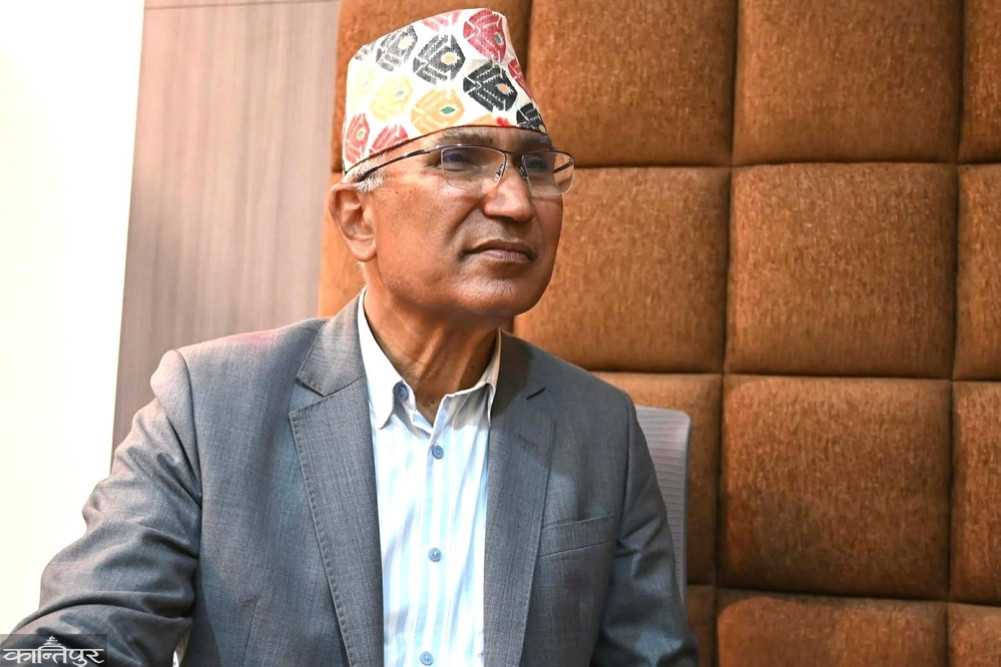
”The views expressed by Ram Bahadur Thapa as the leader of the CPN-UML party in today's meeting of the House of Representatives are contrary to the party's established policies and beliefs,” Poudel said on his Facebook page.
We use Google Cloud Translation Services. Google requires we provide the following disclaimer relating to use of this service:
This service may contain translations powered by Google. Google disclaims all warranties related to the translations, expressed or implied, including any warranties of accuracy, reliability, and any implied warranties of merchantability, fitness for a particular purpose, and noninfringement.
UML parliamentary party leader Ram Bahadur Thapa's views in the parliament meeting are against the party's established policies and norms, said another vice-chairman, Bishnu Poudel.
Thapa had said that various forces were involved in the victory of the National Independent Party in the parliament meeting on Thursday. Poudel has objected to his statement.
'The views expressed by Ram Bahadur Thapa as the leader of the CPN-UML party in today's meeting of the House of Representatives are against the party's established policies and norms,' Poudel said on his Facebook page, 'I expect a serious discussion and appropriate decision to be made in this regard at the meeting of the CPN-UML Central Secretariat organized tomorrow.'
In parliament, Thapa accused various 'visible and invisible' forces, including the Nepali Army, of playing a decisive role in the victory of the Rashtriya Swatantra Party.
In today's meeting of the House of Representatives, he mainly accused the army, bureaucracy, Sushila Sarkar, Karki Commission, and Barbar Foundation of playing a decisive role.
‘Numerous facts make it clear who played the decisive role in this magical victory,’ he said, ‘The invisible forces TOB, AI, algorithms, Goebbels who established the heroes of nationalism, democracy, republic, federalism, peace and prosperity as terrible villains and murderers. They made the villains who burned the country and erased their national identity into great heroes.’