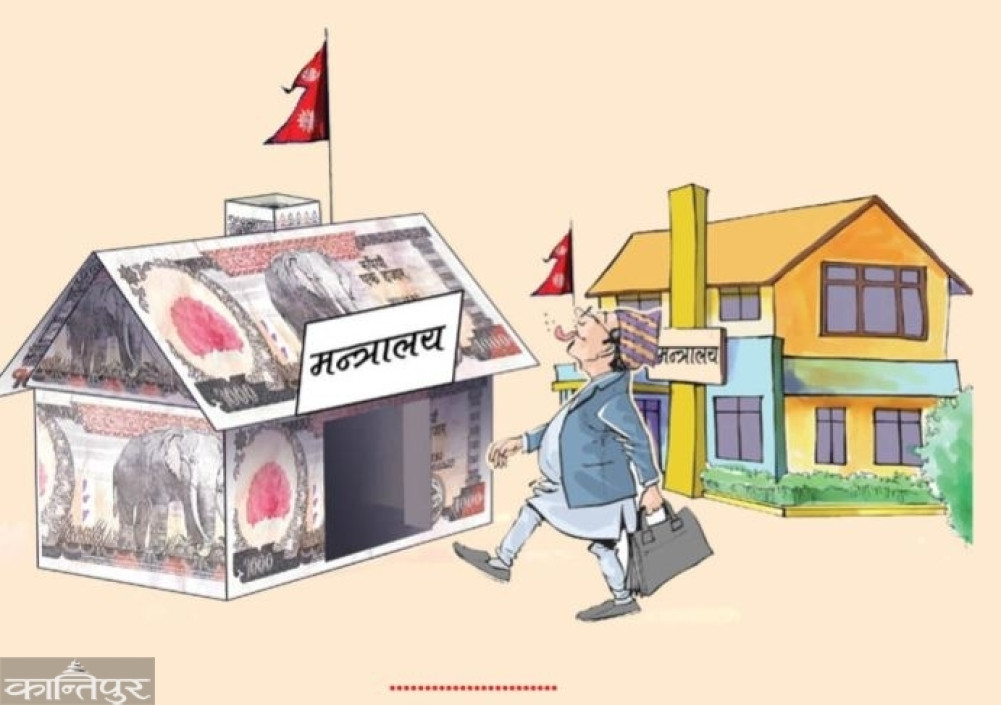
Currently, there are 10 ministries and 12 ministers in Koshi, including the Chief Minister's Office. Madhesh Province has 10 ministers, including the Chief Minister. Bagmati has 14, Gandaki has 8, Lumbini has 12, Karnali has 8, and Sudurpaschim has 9-member council of ministers.
We use Google Cloud Translation Services. Google requires we provide the following disclaimer relating to use of this service:
This service may contain translations powered by Google. Google disclaims all warranties related to the translations, expressed or implied, including any warranties of accuracy, reliability, and any implied warranties of merchantability, fitness for a particular purpose, and noninfringement.
When Prime Minister Balendra Shah has already given a signal of reform in the federation along with a planned program for governance reform, when will the provincial governments step up to support it? The question has arisen.
The federation has led a good start in governance reform. Provincial governments should be able to help in this. - Kashiraj Dahal, administrative expert In 7 provinces, the Congress is leading 4 provincial governments and the UML is leading 3 provincial governments. Prime Minister Shah has reduced the number of federal ministries from 21 to 17. Although there is a constitutional provision to have up to 25 ministers, he has formed a 15-member council of ministers including himself. On the day the government was formed, the Shah-led council of ministers also brought out a 100-member agenda related to governance reform, specifying the time frame and the responsible body for implementation.
Experts on administration, finance and federalism have praised the steps taken by the federal government and said that the provincial governments should also take such reform steps. The Congress, UML, NCP and Madheshwadi are running the government in the province. Since the people rejected the governance system they are running through the elections held on 21 Falgun, they have an opportunity to win the hearts of the people through the work of the provincial government.
Federalist and former member of the National Assembly Khimlal Devkota says that the provinces should be able to teach the new government formed in the federation under the leadership of the Rashtriya Swayamsevak Sangh (RSS) about government reforms, but even if they cannot do that, they should at least follow it and grow. ‘There were many ministries and ministers in the province. Ministries and ministers were appointed in the name of the coalition. That increased the frustration and anger of the people towards the province,’ he said. ‘Now is a good opportunity to improve that. The province should follow the positive efforts made by the federation.’
The Good Governance Roadmap prepared by the Office of the Prime Minister and Council of Ministers also mentions that the number of ministries in the provinces should be reduced among the various suggestions given for reducing administrative expenses. It has been suggested to limit the number of ministries in the provinces to 7 in order to reduce administrative expenses. The then Prime Minister Sushila Karki had formed a committee under the leadership of Secretary to the Prime Minister's Office Govinda Bahadur Karki on 14 Poush to study and report on the performance of public bodies. The report of the 'Good Governance Roadmap 2082' prepared by the committee has asked to make necessary legal arrangements to keep the number of provincial ministries within 7 based on an objective analysis of the essence of the constitution and workload.
Other reports prepared earlier had also recommended that there should be a maximum of 7 ministries in the provinces. However, their practical implementation has not been done. Before the 2074 general elections, the State Affairs Committee of the Parliament had conducted a study on the number of ministries in the union and provinces. The empowered Federal Administrative Restructuring Implementation Committee, formed under the chairmanship of Kashiraj Dahal, an expert in administration and law, had recommended having 15 ministries in the Union and 5 to 7 in the provinces.
If the trend of maintaining power is not ended at any cost, the upcoming provincial elections may also be counterproductive for the old parties: Dilliraj Khanal, economist In 2073 BS, the study committee formed under the leadership of the then Chief Secretary Somlal Subedi on the implementation of federalism and administrative restructuring also recommended having 7 ministries in the provinces. The Public Expenditure Review Commission formed under the leadership of economist Dilliraj Khanal in 2075 BS also recommended keeping the number of ministries in the provinces to a maximum of 7.
Similarly, the Federalization Implementation Study and Monitoring Parliamentary Special Committee formed by the National Assembly in 2079 BS has also recommended reducing the number of ministries and ministers in the provinces. It has also suggested amending the constitution for that purpose. The constitution states that the number of ministers in a province should not exceed 20 percent of the members of the provincial assembly in that province.
Federalism expert Devkota, who is also the coordinator of the committee, said that an amendment to the constitution has been recommended so that there can be at least 5 ministers and not more than 10 percent of the members of the provincial assembly. Article 168(9) of the constitution states that the provincial chief, on the recommendation of the Chief Minister, shall form a provincial council of ministers from among the members of the provincial assembly, including the Chief Minister, in accordance with the principle of inclusion.
‘The constitution has specified the maximum number. It cannot be increased more than that. However, it is permissible to have less. Even though the constitution provides for the federal government to have 25 ministers, Prime Minister Shah has formed a council of ministers of only 15,’ he said. ‘The facility provided by the constitution for political gain, alliances and seat sharing has been misused.’ Reforms are also needed in the provinces.'
After the new constitution came into effect, only 7 ministries were maintained in the provincial governments formed after the first provincial assembly elections in 2074. However, the split in the then ruling party NCP in 2077 disrupted the power equation from the center to the provinces. The NCP had a government in all provinces (except Madhesh) from the union. However, the split in the party necessitated an alliance with other parties, so the number of ministries and ministers in the provinces also began to increase. That process is still ongoing.
Last year, the number of ministers in the Madhesh government was increased to 20. In Koshi and Bagmati, the number of ministries was increased from 12 to 14. The remaining provinces have also continued to increase the number by splitting ministries to accommodate the coalition parties.
There were many ministries and ministers in the provinces. Ministries and ministers were placed in the name of the coalition. That has increased the people's disappointment and anger towards the province itself. Now is a good opportunity to improve it. - Khimlal Devkota, federalist
Political parties have been using the same provision of the constitution to their advantage. In the name of sharing power, the number of ministries in the provinces has been increasing and ministers have been added. In the Union, the constitution stipulates that the number of ministers can be kept up to 25. However, in the case of provinces, the constitution itself does not specify the number of ministers. Parties have been taking advantage of the 'space' given by the constitution. With the increase in the number of ministries and ministers, additional financial liabilities have been created for the state. Currently, there are 10 ministries and 12 ministers in Koshi, including the Chief Minister's Office. There are 10 ministers in Madhesh Province, including the Chief Minister. Bagmati-14, Gandaki-8, Lumbini-12, Karnali-8 and Sudurpaschim have 9-member councils of ministers.
Administration expert Kashiraj Dahal says that since the Congress or UML are leading the government in the province, they should be able to improve the administrative structure, service delivery and good governance to win the trust of the people. 'The Sangh has led a good start in governance reform.' Provincial governments should be able to help in this. Dissatisfaction with the province has increased because the provincial ministry has become a production factory,' he said. 'To instill people's trust in the province and increase positive feelings, the province should be able to improve itself. Don't delay. To gain people's support for the province's legitimacy, the administrative structure and budget management should be streamlined.'
He suggested that the number of ministries in the province should be reduced to 5 to 7. He said that the province should take prudent decisions by looking at the situation of national revenue, debt and expenditure. He mentioned that the central government can also request or suggest to reduce the administrative size of the provinces.
The Madhesh, Bagmati, Sudurpaschim and Gandaki provincial governments are led by the Congress. Similarly, the provincial governments in Koshi, Karnali and Lumbini are led by the UML. In the provinces except Madhesh, the Congress and UML have a coalition government. In Madhesh, the Congress-led government includes the NCP and Madhesh pro-party parties.
Economist Dilliraj Khanal says that the administrative structure should be improved at the center, provinces and local levels to reduce public expenditure. He said that while the new government formed in the union, as the saying goes, 'Morning Saw the Day', has taken good steps in that direction, the provinces should also help reduce unproductive expenditure. ‘Looking at the steps taken by the Union government and understanding the sentiments of the Center, the provincial governments should take proactive steps,’ he said. ‘The Union government can also sit with the provincial governments and request for administrative reforms with logic.’ He suggested that the Congress and UML should also take a new approach.
‘The path they were taking yesterday is not working. The people have already rejected it. They should be able to learn from that,’ he said. ‘There are questions about the province’s expenditure and its performance. We should improve it and take a new approach.’ He mentioned that the initiative for this can be taken by reducing the number of ministries in the provinces. He said that if the trend of maintaining power is not ended at all costs, the upcoming provincial elections will also be counterproductive for the old parties.’