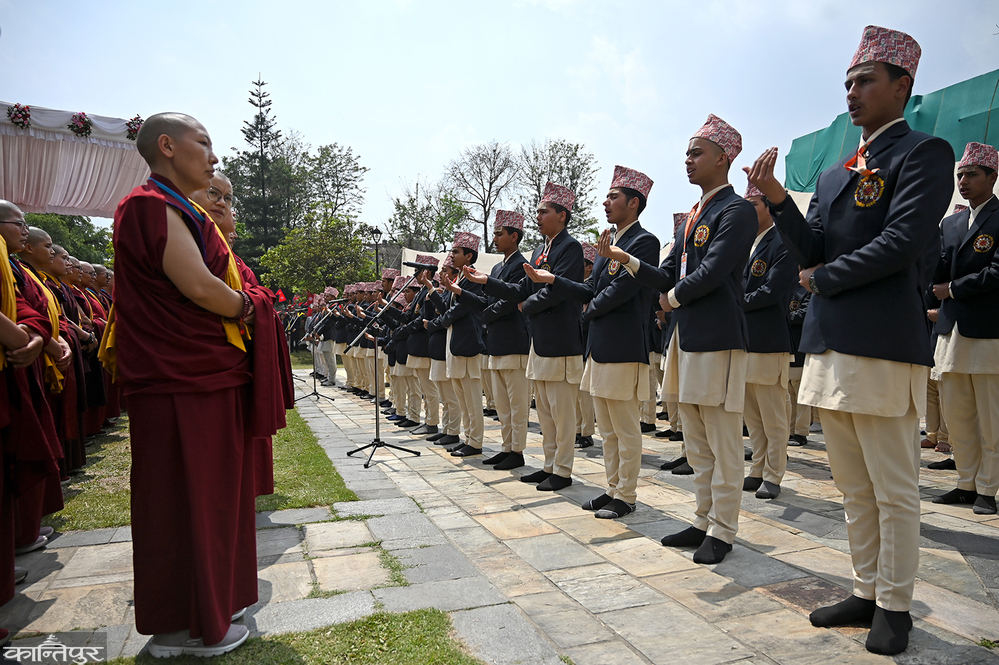
Balendra Shah took oath on Friday, choosing Ram Navami, with 7 conch shells blown, 108 batuks reciting Swasti and 108 Buddhist monks reciting Ashtamangala. The Prime Minister of a 'secular' state is facing criticism for such 'religious' actions on the first day of his term.
We use Google Cloud Translation Services. Google requires we provide the following disclaimer relating to use of this service:
This service may contain translations powered by Google. Google disclaims all warranties related to the translations, expressed or implied, including any warranties of accuracy, reliability, and any implied warranties of merchantability, fitness for a particular purpose, and noninfringement.
On Friday at 12:34 pm. Balendra Shah took oath as the 40th Prime Minister of the country at the time chosen due to the astrological compatibility of the numbers 1-2-3-4. Before taking the oath, the sound of 7 conch shells echoed. 108 Vedic scholars recited mantras. And, 108 Buddhist monks recited Ashtamangala. 'Ram Navami', the birth anniversary of Lord Ram of Hindu religion, was chosen for the oath.
The oath-taking ceremony held at the President's Office, Sheetal Niwas, is not a religious ritual. It is a state event spent on state coffers. A state that the constitution has declared secular.
Rapper and civil engineer Shah has become the youngest Prime Minister of democratic Nepal in a short period (three years) of being the Mayor of Kathmandu Metropolitan City.
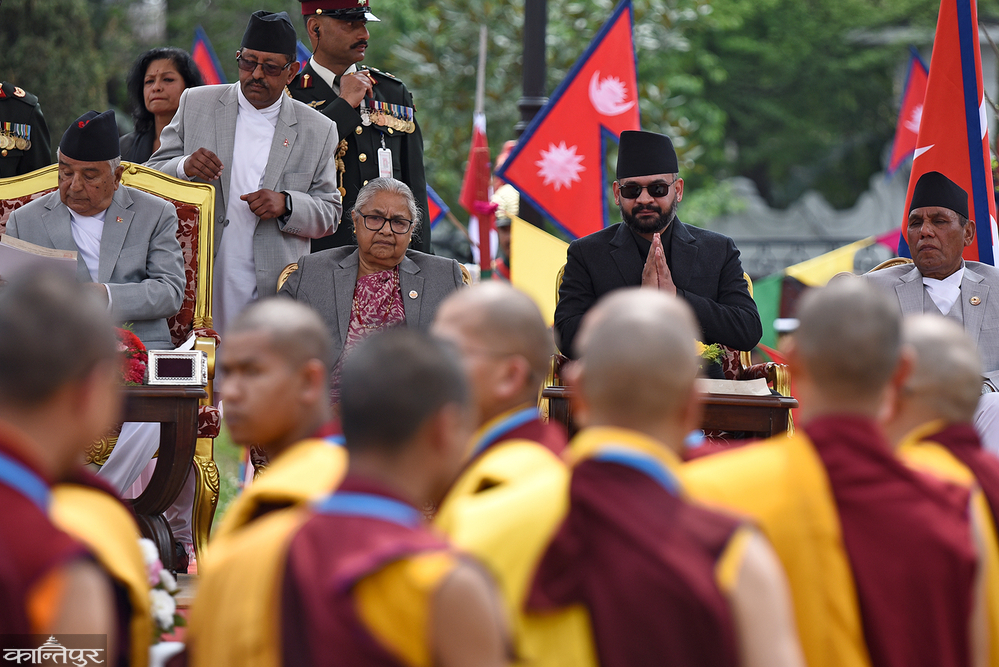
Shah, who was elected by popular vote due to the extreme distrust of the people towards the old parties and their leaders and the failure in service delivery, conveyed a different message from the very beginning of his oath-taking. In the oath-taking ceremony, which was a public event organized to complete the constitutional process, he demonstrated the state's 'Hindu identity'. Critics have interpreted this not only as Shah's personal religious behavior but also as the state's inclination towards a particular religion. But his supporters are defending it by saying that it is a step to preserve Hindu-Buddhist culture.
Political analyst Roshan Janakpuri says that although Shah's personal opinion on whether to follow any religion or not is a personal opinion, there will be no question about his use of it in his private life, but as the Prime Minister, questions will be raised about his public display and behavior. ‘There are many religions, sects, castes, beliefs and views in the country, the Prime Minister is common to all of them, he should be,’ he says, ‘but now the politics of using religion as a weapon is going on, the oath ceremony has expressed that message.’
Outgoing Finance Minister Rameshwor Khanal had expressed his dissatisfaction even before taking the oath regarding the issue of the oath being taken by looking at the website and choosing a day that has special significance in Hinduism. ‘I really did not like the tradition of taking the oath by showing the website. We did not have the time or the opportunity to look at the website,’ he wrote on the social network Facebook, ‘But, for the first time in history, a clean election was held. Intention and honesty are more important than cosmic time.’
Shah did not suddenly appear in a ‘religious style and message’ at the oath ceremony. He had already hinted at this after resigning from the post of mayor last Magh and joining the Rashtriya Swayamsevak Sangh (RSS). He started his election campaign from Janakpur in Madhesh. He had offered prayers at the Janaki Temple in the morning. Starting from Janakpur, which is considered the birthplace of Sita, his political ‘campaign’ with religious messages was gradually seen elsewhere. After reaching the eastern hills after Janakpur, he posted a photo of himself standing in front of the temple with folded hands on Facebook. In the photo, he had tied a red turban with the words ‘Jai Maa Pathibhara’ written on his head. In his status, he wrote, ‘Jai Pathibhara, Jai Mukkumalung.’
He also posted religious sayings popular among Hindus on social media such as ‘Dharmo Rakshati Rakshit’, meaning ‘Dharma protects him who protects religion’. At a meeting organized in Janakpur, Shah urged the Madheshi people to come to visit Pashupatinath and Swayambhu instead of demanding the right to the federal capital Kathmandu. However, during the election ‘campaign’ and even after that, Shah was/is extending separate greetings to the followers of these religions and communities on occasions like Eid, Sherpa and Tamang festivals, and Magar Day.
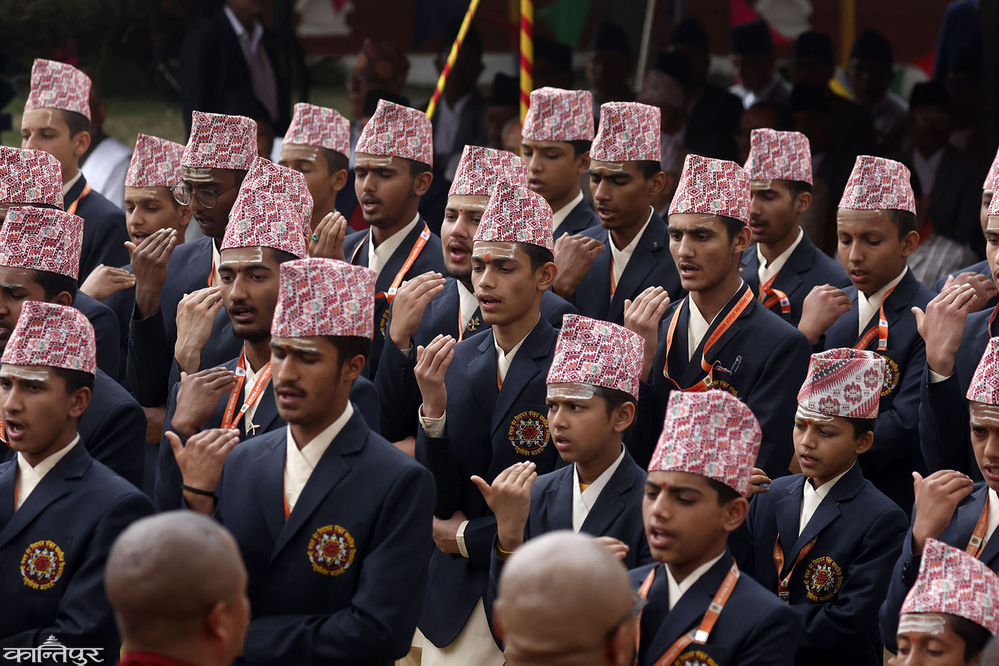
Political scientist Sucheta Pyakurel says that people holding public office should keep religion limited to the private sphere but should stand without mixing religion and politics. ‘I do not remember an elected prime minister in any democratic state taking an oath with religious pomp,’ she said. ‘Earlier, kings and maharajas used to perform coronations, that is a different matter.’
The constitution has defined the country as a ‘secular’ state. It has further explained that ‘religious and cultural freedom should be understood as including the protection of religious and cultural traditions that have been practiced since ancient times.’ The term ‘has been practiced since ancient times’ mentioned in it does not include some religions, including Muslims and Christians, that are considered in Nepal. However, despite such a narrow definition, there are many examples of previous Prime Ministers and Heads of State and other state bodies not treating all religions equally as a ‘secular’ state.
The federal, provincial and local governments have been continuously providing funds from the state treasury to Hindu monasteries and temples. Leaders such as KP Sharma Oli, Pushpa Kamal Dahal, Baburam Bhattarai, Sher Bahadur Deuba, and others, as Prime Ministers, have been participating in programs related to Hinduism, flaunting and demonstrating it in a manner that goes far beyond the limits of personal faith.
Anthropologist Dambar Chemjong says that Prime Minister Shah has also continued the behavior of the old leaders. ‘Today he (Shah) showed again who the state belongs to and how the state should be,’ he said, ‘Finally, it has been proven once again that Hindu dominance persists here.’
He says that such behavior of the state will affect the alternative, federalist politics being practiced in Nepal. ‘The identity politics started by the minority that all religions are equal in opposition to Hinduization and their cultural/political expansion must have become a shambles today,’ Chemjong said.
Political scientist Pyakurel says that the democratic system is a system where religion and politics are separated. ‘Religion should not be used in politics,’ she said, ‘Let’s keep it limited to private life.’
Another example of the state’s behavior not being separated from religion can also be seen in Nepal’s judicial system. Even after secularism was enshrined in the constitution, the Supreme Court has ruled by comparing the judge’s chair to the ‘seat of Lord Vishnu’. In Baisakh 2075, the Supreme Court held a grand religious ceremony and placed the Yantra with the letter 'Shri', which was removed 36 years ago, in the main building of the Supreme Court. A procession of the Shree Yantra was held inside the Supreme Court premises for about 8 hours after performing yagna, homa and puja.
Before reinstalling the Shree Yantra on the top of the window in front of the Supreme Court building at 4:30 pm as predicted by the astrologer, the then Acting Chief Justice Deepak Raj Joshi and Chief Registrar Rajan Bhattarai (currently a judge) sat in the mandap, blowing conch shells, bells and drums, and applying sandalwood tika. Bhattarai had been sitting in the mandap for the whole day, wearing an ochre cloth tied around his waist, while Acting Chief Justice Joshi, with his wife, was busy with the homa and puja, offering charu and puja.
In Nepal, which is secular in the constitution but remains a Hindu nation in practice, the new Prime Minister has not questioned this trend in his first day in office, but rather endorsed it. Rashtriya Swayamsevak Sangh (RSS) leaders are saying that Prime Minister Shah and his family are religious and that he deeply believes in religion and astrology in his private life. Analysts say that no question arises when Prime Minister Shah or any other person is privately involved in religious activities according to his faith. But here, questions have been raised about the fact that the Prime Minister's oath-taking ceremony, which was held at the office of the Head of State at the expense of the national treasury, could not be religiously neutral.
Analyst Janakpuri says that the decisions made by the Prime Minister should be such that all citizens of the country feel a sense of belonging. 'The state has no religion, the people are at the center of politics,' he said, 'A group representing the people could have been present at the oath-taking ceremony.' How great it would have been if the members of the Gen-G martyr family, the cultural tableaus of all the country were displayed.'
According to the latest census 2078, four out of every five people in Nepal are Hindus and one is a follower of another religion. The second largest population in Nepal is Buddhist - about eight percent. Then there are Islam at five percent, Kirat at three percent, and Christians at two percent. Then there are sects like nature worshippers, Bon, Sikhs, Jains, and Baha'is.
Secularism is also linked to the concept of equal treatment for minority communities. 'Regardless of whether they are small or big, all religious sects are equal, the state should treat them all equally,' says Janakpuri. 'The oath-taking program has sent a message across the country that one religious sect is superior to the others.' It showed that Hindus come first, Buddhists come second, and only then others.'
The favoritism shown in such public programs sends a clear message about whose cultural customs the state celebrates and whose symbols it worships. Those who have closely observed the atrocities that the politics of Hindutva has imposed on religious minorities in neighboring India are worried that a similar 'religious frenzy' will be encouraged in Nepal. 'The question is not about Prime Minister Shah's personal religious beliefs, it is about a religious ceremony organized at the expense of the secular state's funds,' Pyakurel said. 'Will a Muslim, Christian or other religious person be allowed to hold such a ceremony when he becomes the Prime Minister tomorrow? Or is this a special privilege given only to people from the majority religious community?'
Analyst Janakpuri says that the oath-taking ceremony sent a message that Prime Minister Shah is trying to use the religious base among the people as his political strength. "Right-wing politics has disappeared and emotional politics with religious fervor is taking its place," he said. "Balen's political style represents that."

