Even though she passed her IA from Padmakanya College in 2049 BS, she worked to earn a living by spinning wool, knitting sweaters, and shoveling sand in the Bishnumati River at night.
We use Google Cloud Translation Services. Google requires we provide the following disclaimer relating to use of this service:
This service may contain translations powered by Google. Google disclaims all warranties related to the translations, expressed or implied, including any warranties of accuracy, reliability, and any implied warranties of merchantability, fitness for a particular purpose, and noninfringement.
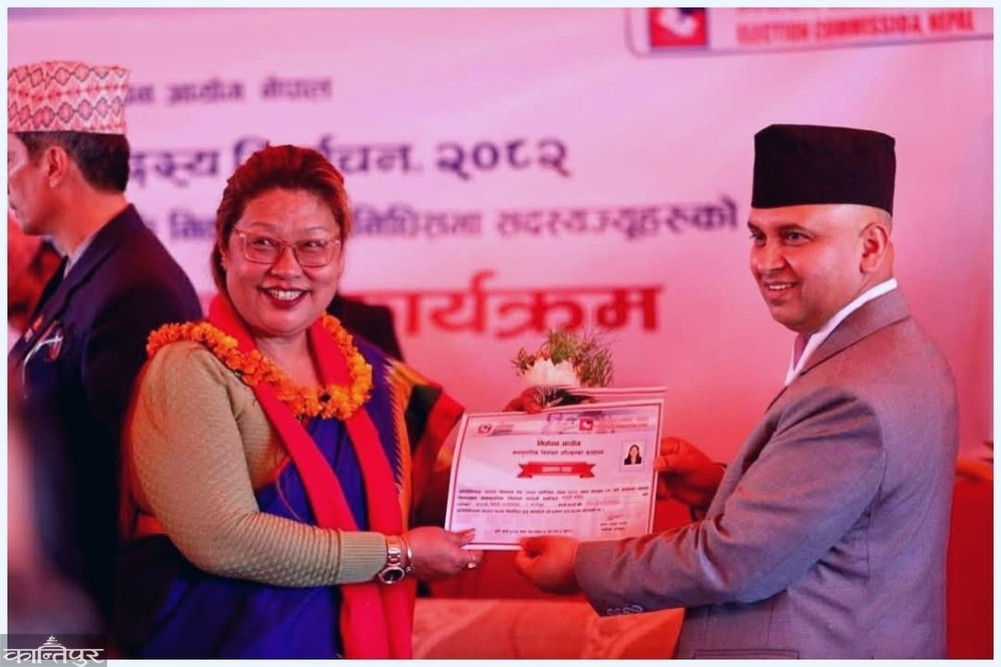
Basumaya Tamang, 54, born in Ruby Valley, Dhading, has been recommended as the first female member of the House of Representatives under the indigenous and nationalities cluster from the Rashtriya Swayamsevak Sangh (RSS) in the proportional representation. She became an MP in her second attempt.
In the 2079 BS House of Representatives election, she had directly contested from Dhading-2 from the RSS. Despite getting 5,559 votes, she could not win. Ramnath Adhikari of the Nepali Congress was elected in that election. This time, she said that she had gone for the proportional representation by giving opportunities to other capable people. 'There were friends who were more qualified than me, so I gave them a place,' she said.
Tamang, who has been active since the day the RSS was announced, is a founding central member of the party. She is currently working as the party's co-treasurer and secretariat member. But her identity is not limited to politics - she is also a successful entrepreneur.
She has made her product known within the country and abroad by producing pickles under the brand 'Nepali Man'. But this journey to success was not easy. She has reached this point by working from moving and carrying sand on the banks of the Bishnumati River in Kathmandu to selling Ma:ma chowmin on a cart on the street.
Basumaya, who was born in Ruby Valley in Dhading, came to Kathmandu at the age of eight or nine. Basumaya's parents and family moved to Jwalamukhi Rural Municipality in Dhading to educate their children. At that time, her family came to Kathmandu with the desire to educate a daughter and two sons. She says that she came to Kathmandu with her family at the age of eight or nine. She passed her IA from Padmakanya College in 2049 BS.
After her father's death 30 years ago, she could not continue her studies due to additional family responsibilities. On the other hand, despite having a certificate, she could not get a job anywhere. 'Even though I was educated, I got a job, I did many jobs, and now I have arrived here,' she said. At that time, she worked as a spinner, knit sweaters, and shovel sand in the Bishnumati at night to earn a living. Later, she started selling ma:ma and chowmin on the street. The business declined after the pickles used in the business did not win the hearts of customers. When she found out that pickles were not tasty, she remembered picking tomatoes and making chhops for her children.
And her journey towards the 'pickle' industry began. 'As a child, she liked to eat them with chhops and eat them, and they were also sweet,' she said. Thinking about it, she bought Timur, salt and chillies and made one kilo of Chhop. She put it in a stall and sold it, but it took a month and a half to sell the Chhop made at a cost of one thousand. But she did not stop making Chhop. Then she made five kilos of Chhop at once. She went to Bhatbhateni to sell the Timur Chhop.
And she realized that to do business professionally, the expiration date from the production date, the name, everything is needed. She realized that it should be sold only after packaging. And after continuous efforts, she registered the ‘Nepali Man’ industry in 2067 BS. Today, she claims to be one of the leading female entrepreneurs who established Timur Chhop as a brand. She said that the industry has directly and indirectly employed more than 150 people.
Tamang is now standing with her children as a single woman. Now her goal is to create a different identity in the level of politics and policy making. 'Our party has always been inclusive,' she said. 'Now my aim is to become the voice of the Tamang community, ordinary Nepalis and those who cannot speak, and to work towards building a well-governed nation.'
She said that she is committed to addressing the expectations of Gen-G and the people's desire for change and solving the country's core problems. 'So far, I have worked on expanding the party's organization, and have continuously supported the party by participating in almost all areas,' she said. 'The people have sent me by voting.' Keeping in mind the change sought by the people and the demands of Gen-G, we will now move forward in an organized manner for the development of the country.' She said that she will identify the core problems of the country and work on formulating policies and regulations on all issues, regardless of whether they are big or small.'