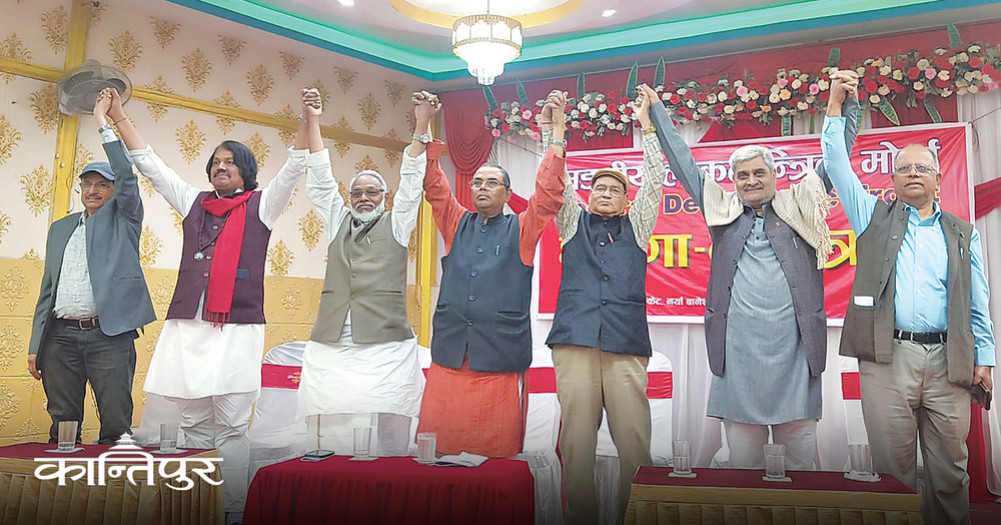
Leaders say: We have not forgotten the issues of Madhesh. We are making programs to regain the trust of the people.
We use Google Cloud Translation Services. Google requires we provide the following disclaimer relating to use of this service:
This service may contain translations powered by Google. Google disclaims all warranties related to the translations, expressed or implied, including any warranties of accuracy, reliability, and any implied warranties of merchantability, fitness for a particular purpose, and noninfringement.
Madhesh-centric parties are in confusion after their numbers dwindled to zero in the House of Representatives elections. Janata Samajwadi Nepal, Janmat, Aam Janata Party and other parties are going to conduct an internal review. But they have not been able to decide how to proceed in the coming days.
Since they are not represented in the House of Representatives, they have the option of raising their issues in the street front and the forum of the provincial parliament. Madhesh-centric parties have wished Balendra Shah, a senior leader of the National Independent Party, who is ready to take the oath of office as Prime Minister, success. They have expressed happiness that the first Prime Minister from the Madhesh community is about to be appointed and said that they are ready to make the upcoming program.
Even though JSP Nepal did not win a single seat from Madhesh Province in the elections, it has stated that it will hold a central committee meeting in the second week of Chaitra to decide the program. JSP leader Manish Suman said that they will review the election on Chaitra 15 and make the program.
He said that Madhesh-centric parties are conscious of protecting federalism, republicanism, proportional and inclusive systems. ‘We are conscious of protecting the federalism, proportional and inclusive systems achieved through the people’s movement and the Madhesh movement. If there is a threat to this, we will be alert,’ he said, ‘We will positively support Balendra Shah, who is about to be appointed as the Prime Minister, in protecting the achievements achieved through the past movement. We will support the good work done by the government from outside.’
He said that the Madhesh-centric party front will be maintained and they will cooperate on the common issues of Madhesh. ‘We have common issues for the rights, development and prosperity of Madhesh,’ he said, ‘We will be determined on these issues in the future.’
Suman said that the Madhesh people will maintain their trust in the JSP Nepal by correcting the shortcomings in the past. ‘We could not win the election with the new wave this time, but the trust of the Madhesi people in us has not diminished or broken,’ he added.
Janmat Party Chairman CK Raut has already said that he will retire from parliamentary politics immediately after the election. But he said that he will continue to struggle on Madhesh issues. ‘I have taken this decision to focus primarily on the struggle,’ he said, ‘I will struggle for the people from the streets and will never back down from it. I want to reassure the common people who are always fighting for their rights.’
Raut, who left the separatist movement of Tarai Madhesh on Falgun 25, 2075 and joined the peaceful movement, quickly made a name for himself in the 2079 elections. He succeeded in forming a national party by focusing on the issues of the landless, farmers, and Dalits. But after falling to zero seats from Tarai Madhesh in this election, he announced his retirement from active politics.
‘This is not really related to the results of the current election, my entry into politics was not to get any post or become an MP or a minister,’ he told Kantipur last week.
Even though his party joined the government, he did not become a minister. He said that he had no regrets about the party’s defeat this time and that he had not abandoned the Madhesh issue.
Janmat has stated that it will support or oppose the work of the Rashtriya Swayamsevak Sangh (RSS) government based on its performance. Janmat General Secretary Chandan Singh said that he will formulate his program after closely observing the work of the Balendra Shah-led government. ‘May the Balendra government be formed, best wishes for good work,’ he said, ‘It is customary to watch the first 100 days of the government. We will also watch. What kind of work will it do for the rights, welfare and identity of the Terai Madhesh? We are waiting.’ He said that the front of the Madhesh-centric party will continue to advance the common cause. ‘Terai Madhesh has common issues. There are issues of identity, discrimination, rights. They are common issues for all,’ he said, ‘Now there is no option but to go to the people with the issues of Madhesh.’
Singh, who is also a member of the Madhesh Provincial Assembly, said that he would continue to raise the party’s agenda from the Provincial Assembly. In the 2079 elections, JSP Nepal won 12 seats, Loktantrik Samajwadi Party 4 and Janmat Party 6 seats.
Before the Falgun 21 elections, JSP Nepal and LOSPA had a party merger. All the leaders who were candidates, including JSP Nepal President Upendra Yadav, were defeated.
JSP led by Ashok Rai has also been promoted in this election after separating from JSP Nepal. Similarly, the Aam Janata Party led by Prabhu Sah could not win a single seat this time. In the 2079 elections, AJPA had won one seat.
Thakurram Multiple Campus Birgunj Associate Professor of Sociology Birendra Sah said that after the Gen-G movement, the Madhesh-centric parties had to be defeated because they did not have a new issue.
‘After the Gen-G movement, the Madhesh-centric parties did not have an issue to address the common people,’ he said, ‘Even after losing in the elections, they have not accepted their weaknesses.’ He said that the Madhesh-centric parties that emerged after 2064 were more interested in power than the Madhesh issue. ‘If the Madhesh parties accept their weaknesses and go among the people, they will rebuild this party again,’ he said, ‘Even if we struggle on the streets again, the common people have no basis to trust.’
He said that trust in the Madhesh-centric parties has been broken due to the tendency to divide power and become the president of the party. ‘If there was confidence that they would do something now, some seats would have come in the proportional representation,’ he added, ‘In the past, the elections were nullified due to forgetting the Madhesh issue for power and dividing the party for selfish reasons.’
The governments formed after the 2079 election included the then Maoist Chairman Pushpa Kamal Dahal and UML Chairman KP Sharma Oli in the government. Before the Gen-G movement, the Oli government included the LSP and the JSP led by Ashok Rai.
After the 2079 election, the main Madhesh-centric parties (JSP, LSP, and Janmat) and the Nagarik Unmukti Party joined almost all governments or equations. After reaching the government, they forgot their promises to end agriculture, employment, and discrimination that directly affected the common people of the Terai-Madhesh. Due to which they could not win a single seat in the Falgun House of Representatives election.