Although the chairperson of the Constitutional Council is the Prime Minister, the government does not make appointments to constitutional commissions. There is no room for the government to directly intervene in vacating constitutional positions and making new appointments, because among the council members, the Speaker of the National Assembly is not from the ruling party's background. The ruling party also has no role in selecting the Deputy Speaker of the House of Representatives and the leader of the opposition party.
We use Google Cloud Translation Services. Google requires we provide the following disclaimer relating to use of this service:
This service may contain translations powered by Google. Google disclaims all warranties related to the translations, expressed or implied, including any warranties of accuracy, reliability, and any implied warranties of merchantability, fitness for a particular purpose, and noninfringement.
The Rashtriya Swayamsevak Sangh (RSS) has won nearly two-thirds of the seats in the House of Representatives elections and is leading the government from next Friday. While the homework for selecting ministers is underway, the top leaders of the RSS are also discussing the issue of vacating the posts that were previously politically appointed. However, the RSSS leadership itself is not clear about what are political appointments and what are not.
Senior RSSS leader Balendra Shah is preparing to take the oath as Prime Minister on Friday. According to the RSSS leaders, discussions are underway between President Ravi Lamichhane, senior leaders and future Prime Minister Balendra Shah on what to do with past political appointments. Some leaders have started expressing that the officials who received political appointments in various bodies during the previous government should resign and pave the way for the formation of the new government.
Although the government does not have a direct role in the appointments and continuity of constitutional bodies, there is fear that there will be interference. While various state bodies have their own procedures for appointments. The Constitutional Council recommends the appointment of the Chief Justice of the Supreme Court and the heads and officials of 13 commissions including the Authority, Election Commission, and Human Rights Commission.
Although the Chairman of the Constitutional Council is the Prime Minister, the appointment is not made by the government. Apart from the Prime Minister, the Constitutional Council, which also includes the Chief Justice, Speaker, Deputy Speaker, National Assembly Speaker, and Leader of the Opposition, has a process of appointment by the President after the House of Representatives also approves the recommendation of the Constitutional Council. Therefore, there is no room for the government to directly interfere in these appointments. Because this time too, the ruling party does not have a role in the selection of the Speaker of the National Assembly, Deputy Speaker of the House of Representatives, and Leader of the Opposition.
Similarly, judges of courts including the Supreme Court are also appointed on the recommendation of the Judicial Council. The Judicial Council consists of the Chief Justice, the most senior judge of the Supreme Court, the Minister of Law, representatives appointed by the President on the recommendation of the Prime Minister, and representatives of the Nepal Bar. Therefore, these appointments are also not government appointments. Because the Constitution of Nepal has defined the legislature (government), judiciary (courts), and executive (government). There is a legal consensus that only appointments made by the executive, that is, the government, can be political appointments.
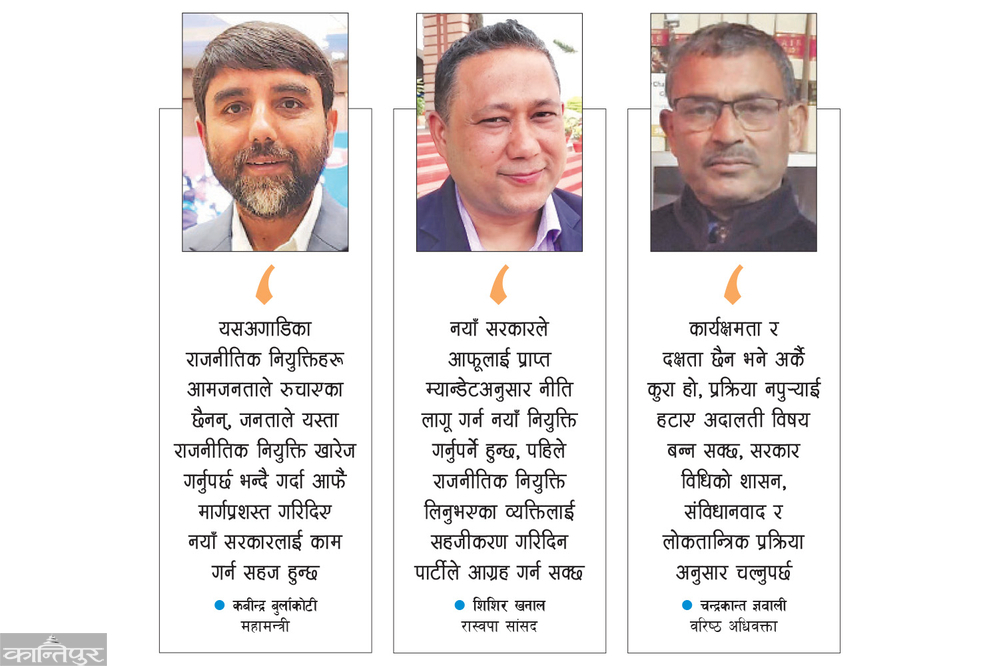
Constitutional scholar Chandrakant Gyawali says that the government elected by the people should abide by the constitution, the rule of law, and democratic values. Since appointments to various state bodies are made according to the law, laws and procedures should be followed regarding what and how to vacate them, Gyawali said. ‘There is a law in the country, the term of those appointed to any body is clearly mentioned in the law. Earlier, the court also said that the government’s decision was correct in appointments made for a maximum of so many years. But now the term is specified in the law itself,’ he says, ‘If there is no efficiency and honesty, it is another matter, but if the process is not followed, it can become a court matter.’
Apart from the Constitutional Council and the Judicial Council, committees of various public institutions also make appointments only after taking exams. Therefore, there is no legal way for the government to dismiss them arbitrarily. Political appointments are made through the Council of Ministers and ministerial decisions, which the government can question.
There is also a practice of appointing ambassadors from 50 percent foreign service officers and 50 percent political quotas. There is a practice of recalling ambassadors appointed on the basis of political quotas after the formation of a new government. RSP leaders have also said that foreign service ambassadors will be evaluated on the basis of performance.
CTEVT Vice-Chairman, National Examination Board Chairman, Health Sciences Academy Chairman, Teachers Service Commission Chairman, Medical Education Commission Vice-Chairman and Executive Director, Medical Council Chairman, University Grants Commission Chairman and Member Secretary are also political appointments. Executive directors of Bir Hospital, National Trauma Center, Gangalal and other federal hospitals are also appointed on a political basis.
RSP plans to appoint people who can implement its policies and programs when political appointments become vacant. However, the RSP has not yet decided which positions should be cleared.
RSP General Secretary Kabindra Burlakoti informed that the party has not taken an official decision on old political appointments. He said that he did not ask those in political appointments to leave, but it would be appropriate for them to leave. ‘The general public has not liked the previous political appointments because they were not made on the basis of merit. Since appointments were not made on the basis of merit, the people are saying that such political appointments should be canceled. If the path is cleared from the places where such political appointments were made, it will be easier to work tomorrow,’ he said.
RSP MP Shishir Khanal says that the positions of appointments made in various state bodies in the past should be vacated to implement the agenda that the party put forward to the people through the election pledge. ‘We are urging those appointed on political grounds to clear the way to make it easier for the government that has come with such a big mandate,’ he says. ‘The RSP is not a party that has collaborated in division in the past, but it would be better for them to vacate their positions to make it easier for the new party that has come with a new mandate to work.’
Khanal says that since those who received political appointments in the past will implement the policies of the appointees at that time, they should be cleared according to the new mandate. ‘The party can request that those who have taken political appointments be facilitated, considering them as the duty of everyone, including ordinary citizens,’ he says. Former Secretary Sharada Prasad Trital says that officials who received political appointments in the past should resign immediately. He says that those working in political appointments should resign before the new government comes. ‘After such a change in government, all officials who received political appointments in the past should leave voluntarily,’ he says.
‘It would be easier if the path is cleared in place of political appointments’
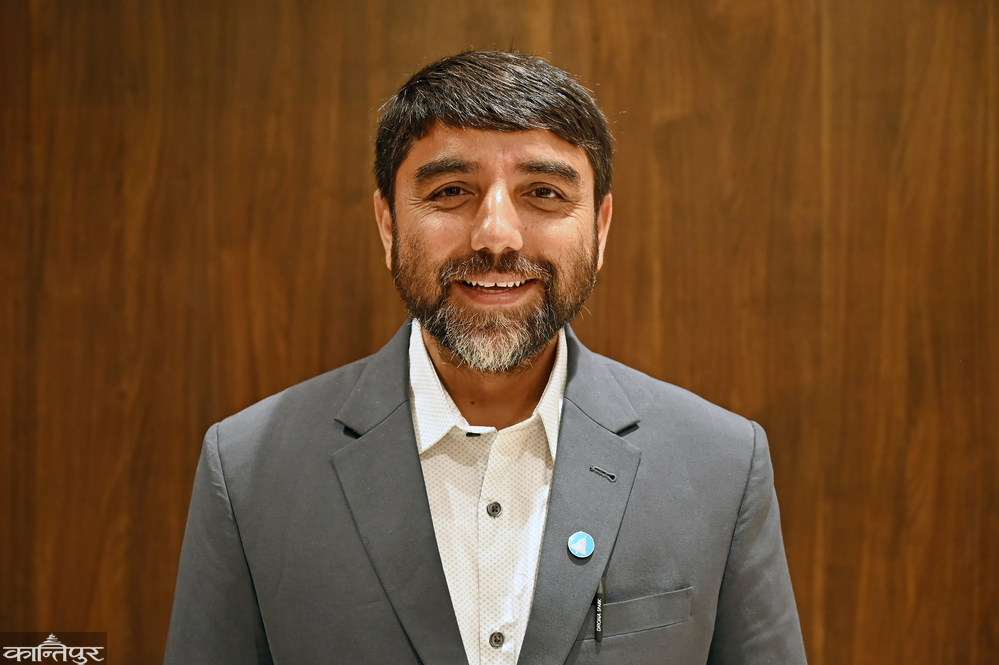
Are you saying that appointments made by previous governments should be automatically left?
This is not our formal decision or directive. But it is a matter of our opinion. The general understanding is that the public has not liked the previous political appointments because they were not appointed on the basis of merit. Since appointments were not made on the basis of merit, the people are saying that such political appointments should be dismissed. If the path is paved from such political appointments, it will be easier to work tomorrow.
Are you saying that it is easier if you leave spontaneously?
When you leave spontaneously, the position becomes vacant, good people can be appointed based on their qualifications.
There were also appointments to constitutional commissions, and there was a dispute when they were appointed. What is your opinion about those appointments?
We will discuss that after the government is formed. Not everyone can be viewed from the same perspective. In places where there is controversy, the government will decide what is appropriate to do based on legal advice after the government is formed. The party has not discussed it and will not do so now.
Do you also have an interest in the members of constitutional commissions?
Naturally, there is interest, but it is more in controversial cases. The government should have taken an interest in how all the organs of the state work, whether there has been good delivery or not, and if not, why delivery could not be made, all those things.
If all the organs of the state do not work properly, if they are not effective, the people suffer. If work is done to facilitate the people, the government takes interest in the progress and performance of those bodies. Right now, we are more interested in performance than digging into which commission and how people were appointed to which body and immediately dismissing them.

