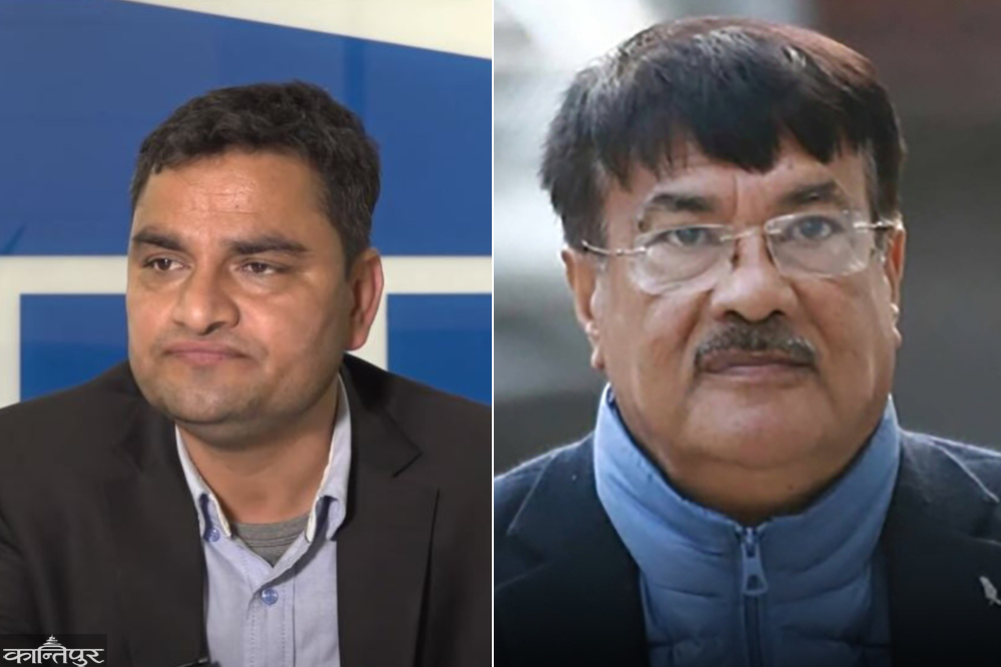
The then acting president, Khadka, is preparing to convene a meeting of the central working committee elected by the 14th general convention within a few days.
We use Google Cloud Translation Services. Google requires we provide the following disclaimer relating to use of this service:
This service may contain translations powered by Google. Google disclaims all warranties related to the translations, expressed or implied, including any warranties of accuracy, reliability, and any implied warranties of merchantability, fitness for a particular purpose, and noninfringement.
The supporters of former President Sher Bahadur Deuba are dissatisfied with the Congress holding a central working committee meeting to review the House of Representatives elections. The Deuba faction is dissatisfied, saying that the central working committee meeting was held in a 'unilateral' manner without taking any initiative for unity.
The working committee elected from the special general convention held on 27-30 Poush does not have representation from the former President Deuba and leader Shekhar Koirala faction. That is why they called the working committee meeting that began on Friday 'unilateral'. They also object to the fact that the blame for the defeat in the House of Representatives elections was pointed out to the working style of the old working committee in the working committee meeting.
The president can nominate about 20 percent, or 33, of the 167-member central working committee. The special general convention has elected 134 central working committee members under the leadership of Gagan Thapa. In the working committee meeting on Friday, Vice President Bishwaprakash Sharma presented a proposal for an election review and concluded that the defeat in the elections was not due to the special general convention and the 50 days of the central working committee that emerged from it, but due to the discrepancies that had accumulated since then.
The 27-point election review has mentioned that the party formed a government with another party after the election by forming an alliance with one party, that the Congress-UML coalition government did not do what it should have done, and that the Congress is not seen in any capacity as the government and the main opposition despite winning the election and becoming the largest party. Leaders from the Deuba faction have accused the Thapa-led working committee of trying to whitewash the leadership before the special general convention. They say that such a review will not create an environment for unity before the court's verdict on the party's legitimacy dispute.
Ramhari Khatiwada, a leader of the old establishment faction, says that the new faction should not weaken the party by blaming the old and the old faction should not blame the new. "The two sides should discuss whether the regular general convention should be held by the current working committee or whether both should be accommodated or whether the current working committee should be dissolved and a general committee should be formed," he says. "It is no longer about old and new. We should work together to build the party for five years."
General Secretary Pradeep Poudel says that all parties can be included in the nomination of central members. "Especially when talking to them (the old establishment), it is not known what common ground will be found. There are no former presidents. There are also different views in their group," he says. "After the current meeting, there will be an attempt to talk, but it is not possible to wait for a long time. They are trying to go to the parliamentary party in a different way. Therefore, it is not certain that it will be resolved through dialogue."
The president can nominate about 20 percent, or 33, of the 167-member central working committee. The special general convention has elected 134 central working committee members under the leadership of Gagan Thapa. Leaders in favor of the special general convention say that there is a plan to include the old establishment from the 33 members that the president can nominate.
According to leader Min Bishwakarma, the then acting president Purna Bahadur Khadka is preparing to hold a meeting of the top leaders of his group within a few days. After that, plans are being made to call a meeting of the members of the central working committee elected from the 14th general convention.
Deuba's pro-party leader Krishna Prasad Sitaula says that they are waiting for the Supreme Court's decision. He says that there is little chance of an understanding in the process of the 15th general convention until the court gives its decision.
The Election Commission had decided to update the details on 4th Magh, recognizing the central working committee elected from the special general convention. Challenging the commission's decision, former president Deuba and the then acting president Khadka had filed a writ petition in the Supreme Court. The date has been set for 22 Chaitra.
Deuba faction leader Bishwakarma says that broad unity within the party is a mandatory ‘condition’ before going ahead with the process of the 15th general convention. For that, he argues that he should go back to the time before the special general convention was announced. Sitaula says that the problem arose because the Supreme Court did not decide on time. ‘Even if the Supreme Court had given a decision, the way forward would have been opened,’ he says. ‘The way in which the party is trying to move forward after the special general convention has not sent a good message. The proposal presented in the meeting as a review of the election is self-centered. This also does not seem to be a place for consensus in the process of the 15th general convention while maintaining the unity of the party.’
The dissatisfaction arising from the election results of members of the House of Representatives, questions raised about the leadership’s working style, and preparations for the upcoming leadership selection have begun to show signs of parallel political exercises within the Congress. On the one hand, Thapa and Sharma’s group is intensifying preparations for the general convention and putting forward the agenda of organizational reorganization. On the other hand, the Deuba faction has taken a stand that the party should not go to the general convention without consensus and unity within the party.
Deuba faction leader Bishwakarma says that broad unity within the party is a mandatory 'condition' before going into the process of the 15th general convention. For that, he argues that he should go back to the time before the special general convention was announced.
Bishwakarma says that the party that went to court raising questions about the legality of the central working committee that came from the special general convention would be morally uncomfortable participating in the 15th general convention to be held by the same working committee. 'In the current situation, if you try to hold a regular general convention, there will be no situation where the other party will go, and unknowingly the party will become two. There will be conflicts up to the district, area and ward levels. Therefore, there is a need for serious dialogue between the two parties on the issue of dissolving the central working committee that came from the special general convention and forming an organizing committee or adjusting the central working committee that came from the 14th general convention and the special general convention,' he says. He says that a task force should be formed to prepare a model of unity between the two parties.
General Secretary Poudel says that the Central Working Committee, which came from the special general convention in the name of unity, cannot be dissolved or merged. ‘If there is a situation of defeat or victory in the Supreme Court’s decision, it will be a separate matter, otherwise there will be no question of dissolution. Everyone should follow the definite process of the law,’ he says.
Leaders supporting former President Deuba are in confusion as he is abroad. Deuba had gone to Singapore on 13 Falgun before the House of Representatives elections. Mrs. Arju Rana Deuba, who had gone to India on 10 Falgun, had gone to Singapore. The Deuba couple reached Hong Kong on Saturday. A close leader says that the Deuba couple will take a decision on returning home after observing the activities of the government formed by the Rashtriya Swayamsevak Sangh (RSS), which won a close two-thirds majority in the elections.
Deuba is holding discussions with close leaders about the party’s situation. “He has said that we should wait for the court’s decision for some time,” said a leader. “He believes that unity can be maintained only after the court’s decision by going through the general convention process.”
Another leader, Sitaula, says that for the regular general convention, at least the amendment of the statute, the schedule of the general convention, the decision on active membership and the agreement on the election committee should be made through broad unity. “I do not think that there will be an agreement before the court’s decision,” he added. Deuba, Khadka and leaders close to them, who did not participate in the House of Representatives elections, have not accepted the existence of the central working committee elected from the special general convention. Despite opposing the special general convention, leaders such as Bimalendra Nidhi, Prakash Sharan Mahat, NP Saud, Mahendra Yadav, Kishore Singh Rathore and others contested the election by taking tickets signed by President Thapa.
Leader Bishwakarma says that if one side calls a meeting without a broad consensus, the other side will also be able to call a parallel meeting, and that will not be good for the future of the Congress. He says that until there is an atmosphere of unity between both sides, it will not be possible to agree on the process of a regular general convention and that can lead to division within the party. 'Gaganji should play a role for broad unity. Resignation/not resigning, acceptance/not being accepted does not mean much. If a unilateral meeting continues without dialogue, the other side can call another meeting. If they walk in unison and the other side also walks in unison, the party will be divided,' he says.
Another leader Sitaula says that for a regular general convention, at least the amendment of the statute, the schedule of the general convention, the decision on active membership, and the election committee should be agreed upon through broad unity. 'I do not think that there will be an agreement for that before the court's verdict,' he added.
Without an agreement between the two sides, the Nepal Students' Union has decided not to be a fraternal organization of the Congress. The Nepali Congress has also brought a schedule for the 13th general convention on 20 and 21 Baisakh. This has increased the risk of provoking a dispute in the Congress. Nepali Congress President Dujang Sherpa has said that the party has not given a statute and will now make its own statute and hold the general convention on the specified date. While the Thapa-led Central Working Committee has been trying to dissolve fraternal organizations that have been running on an ad hoc basis without holding a general convention for years, the Deuba-supporting Sherpa has brought the schedule for the general convention.
President Thapa, on the other hand, has resigned taking moral responsibility after the party and himself were defeated in the elections. Thapa's resignation on Wednesday was presented by Vice President Sharma at the Central Working Committee meeting on Friday. Along with this, Sharma has also put forward a separate proposal to reject the resignation. The central members who spoke at the first day's meeting have expressed the opinion that Thapa's resignation should be rejected. 18 people spoke in the first meeting.
Since the Central Working Committee selected from the special general convention was chosen by Thapa and Sharma, there is a strong possibility that the president's resignation will not be accepted. President Thapa himself has not publicly commented on the matter after the election.
General Secretary Poudel says that the meeting to be held on Sunday will decide on President Thapa's resignation. According to him, the Central Working Committee meeting will then end for a while and another meeting will be held within a week or a week and a half to move forward with the schedule and preparations for the regular general convention. Since there is a possibility that the meeting will reject the resignation, Poudel says that the next meeting will be chaired by Thapa himself. 'After the meeting ends and until the next meeting is held, there will be a discussion on how to connect the leaders who are not in favor of the special general convention,' he says. 'After that, we will start preparing for the regular general convention, which will lead to greater unity in the party.'