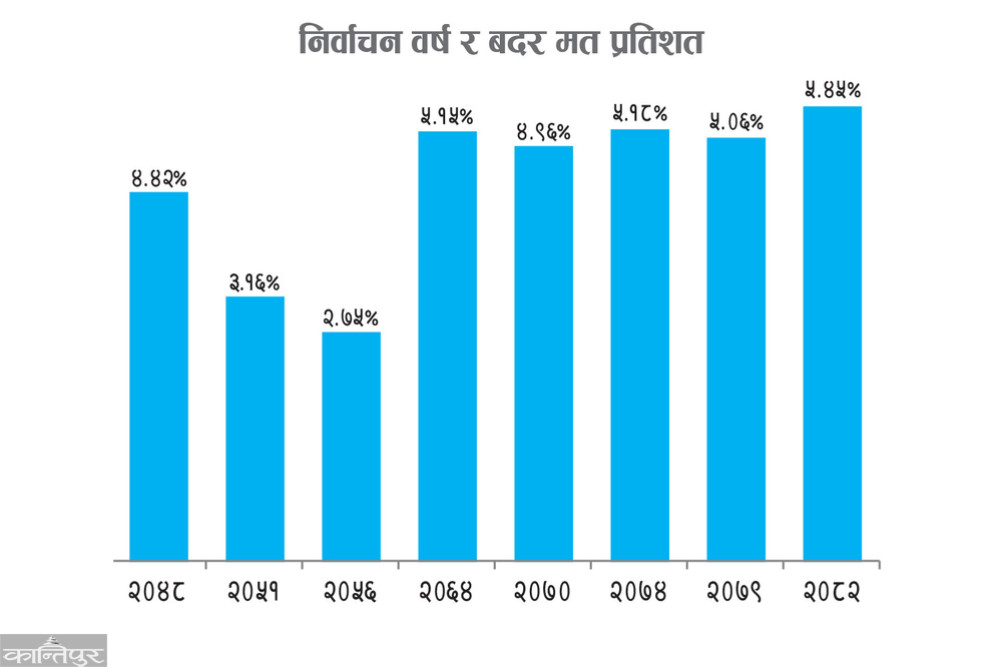
More votes were invalidated in direct elections than in proportional elections, but this year's proportional elections have improved compared to 2074 and 2079 BS.
We use Google Cloud Translation Services. Google requires we provide the following disclaimer relating to use of this service:
This service may contain translations powered by Google. Google disclaims all warranties related to the translations, expressed or implied, including any warranties of accuracy, reliability, and any implied warranties of merchantability, fitness for a particular purpose, and noninfringement.
This time, the percentage of invalid votes in the House of Representatives elections has been higher than in previous elections. Of the two systems adopted in the election, more votes were invalid in direct than in proportional. According to the Election Commission, out of 18.9 million 3 thousand 6 hundred 89 voters, 11.68 million or 59.08 percent voted in direct. Of the votes cast, 6 lakh 9 thousand 15 votes (5.45 percent) were invalid. 4.10 percent votes were invalid in proportional. Out of 11.12 million 4 hundred 55 votes (59.84 percent) cast, 4 lakh 63 thousand 3 hundred 73 votes were invalid.
The Commission had been authorized to spend Rs 250 million this time under the heading of electoral education. The Commission had mobilized volunteers in each ward and conducted a voter education program. At the ward level, only Rs 74.6 million was spent on mobilizing volunteers in this way. Apart from that, a huge amount of money has been spent on digital platforms and public media, pamphlets, and printing sample ballots for voter education. Voter education is believed to contribute to reducing invalid votes and increasing the voting percentage. However, invalid votes have increased compared to the past, and the voting percentage has decreased.
Commission spokesperson Narayan Prasad Bhattarai said that he would not comment on it right now as the entire data of the election results has not been studied and analyzed. ‘I understand that the percentage of invalid votes has decreased compared to the past in the proportional representation. The situation is the same as in previous elections in the direct representation,’ he said, ‘Every possible effort has been made through voter education to reduce invalid votes. It has also yielded some results, but we can comment on whether or not it yielded any results, only after studying and analyzing the data.’
In the 2079 elections, 5.06 percent of the votes were invalid in the direct representation. Out of 17.988 million, 570 total voters, 11.47 million (61.41 percent) voted. Of these, 559,076 votes were invalid. Similarly, 566,144 or 5.09 percent of the votes were invalid in the proportional representation. Even then, Rs 250 million was spent on voter education.
In the 2074 election to the House of Representatives, 5.17 percent of the votes were invalid in the direct representation. Out of a total of 15,479,038 voters, 159,444 (68.66 percent) voted. Out of these, 548,570 votes were invalid. Of the votes cast, only 9,544,779 votes were valid in the proportional representation. At that time, a large number of votes were invalid in the proportional representation. The commission has not made public the percentage of invalid votes in the proportional representation in the 2074 results report. The difference between the votes cast and the valid votes is 1,049,000. The invalid votes in the proportional representation are 9.90 percent.
In the second Constituent Assembly election of 2070, 471,826 votes were invalidated in the direct election, or 4.96 percent. Similarly, 312,841 (3.20 percent) votes were invalidated in the proportional election. In the first Constituent Assembly election of 2064, 560,111 votes (5.15 percent) were invalidated in the direct election. 477,462 votes (3.26 percent) were invalidated in the proportional election. Before that, there was no mixed electoral system. In 2048, 2051 and 2056, 4.42, 3.16 and 2.75 percent of votes were invalidated, respectively.
Shekhar Parajuli, Executive Director of the Democracy Resource Center, which has been observing the elections, says that the percentage of invalid votes has increased instead of decreasing due to the failure of voter education to be effective. 'The expenditure was incurred but its effectiveness was not seen, the commission said that volunteers were deployed at the ward level to educate voters. But the work done by the volunteers was not monitored,' he said, 'The state has made a huge investment for the voters during the election. It is not good for votes to be invalidated more than the average. No serious work has been done to reduce it.'
Parajuli said that while 2-3 percent of votes can be considered normal, 5 or more percent of votes are invalidated. He commented that the voter education program has not been effective this time in both the goals of reducing invalid votes and increasing the voting percentage. He said that the percentage of invalid votes has increased even though voters have not been properly informed about the need to vote at two places. 'Voters received the ballot papers for the direct route first, some people put swastika symbols on two symbols on the same ballot paper, saying that they can vote at two places,' he said, 'That may be why more invalid votes were registered in the direct route.' He said that votes were also invalidated when the polling officer gave the ballot paper without signing it or did not provide correct information about which ballot box to vote in.