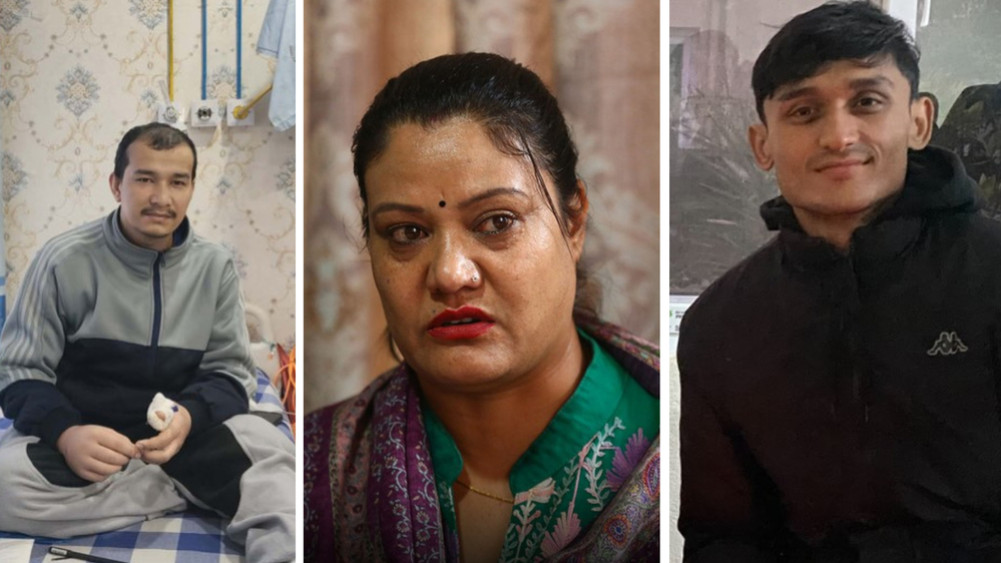
Although the names of Prakash Bohora, Pawan Shahi, and Rachana Khatiwada are on the proportional list, there is confusion over their representation due to constitutional inclusion and women's quotas.
We use Google Cloud Translation Services. Google requires we provide the following disclaimer relating to use of this service:
This service may contain translations powered by Google. Google disclaims all warranties related to the translations, expressed or implied, including any warranties of accuracy, reliability, and any implied warranties of merchantability, fitness for a particular purpose, and noninfringement.
When the Rashtriya Swayamsevak Sangh (RSS) announced its proportional representation candidates, it also included the families of the injured and martyred members of the Gen-G movement in the list.
The names of Prakash Bohora from Dailekh, Pawan Shahi from Kalikot and Rachana Khatiwada from Kathmandu were included in this list. However, the question has been raised as to how they will be represented due to constitutional inclusion and women's quota.
Prakash Bohora is at number four in the Khas-Arya cluster and Pawan Shahi is at number five in the closed list submitted by the Rashtriya Swayamsevak Sangh to the Election Commission. Prakash, 28, was injured during the Gen-G movement on Bhadra 23. His left leg was injured.
The shoes he wore while injured became famous as the 'iconic' symbol of the Gen-G movement. Prakash was discharged from the hospital five months after his injury and went out for election campaigning on Baisakhi.
Pawan Shahi was injured during the Bhadra 23 movement after being shot in the stomach and arm. Rachana Khatiwada is the mother of Gen-G martyr Rasik Khatiwada, who was killed in a shooting on 23 Bhadra.
47 women mandatory
In the House of Representatives elections held on 21 Falgun, the Rashtriya Swayamsevak Sangh (RSS) has won 125 seats through direct and 57 seats through proportional representation.
According to the constitution, at least one-third of the total number of members elected from each party representing the federal parliament (House of Representatives and National Assembly) must be women. Since the RSS is not represented in the National Assembly, this ratio must be adjusted in the House of Representatives.
There will be a total of 182 RSS MPs in the House of Representatives, including 125 from direct and 57 from proportional representation. One-third of them, or at least 60, must be women. Since 13 women were elected directly, at least 47 women will be RSS MPs from the proportional list.
The obligation of the inclusive cluster
Out of the 57 seats obtained through proportional representation, the Rashtriya Swayamsevak Sangh (RSS) will have to select 16 indigenous people, 18 Khas-Aryas, 4 Tharus, 8 Dalits, 9 Madhesis and 2 Muslims. There is a provision that at least 47 women and 2 people from backward areas should also be included from the inclusive group.
Expectations of representation
Meanwhile, there is a voice being raised that the injured and martyred families of the Gen-G movement should also be represented in the parliament. In the same way, the RSS will also face challenges if they do not represent them. For example, the party may be accused of using the 'sentiments' of the injured and martyred families in the election campaign.
Ganesh Parajuli, a central member of the RSS, says that the party should go according to the party rules rather than whether or not the injured or martyred families should be represented. ‘As per the constitution, the name of the person who is at the top of the list comes. We send them as per the rules,’ he says.
Prakash Bohora, an injured member of the Gen-G movement, says that he should reach the parliament to represent the injured as well as the Karnali region. He and Pawan Shahi are from the group of Kathmandu Metropolitan City Mayor Balendra Shah in the proportional list, while Rachana is from the group close to Khatiwada Party President Ravi Lamichhane.
Ravi Lamichhane had met Rachana while meeting the Gen-G martyr family immediately after his release from jail. Similarly, Balendra Shah had also met Prakash’s group and listened to their stories.
‘The Rashtriya Swayamsevak Sangh has felt the pain of the martyr family and the injured. We are certainly hopeful of getting representation,’ Prakash said.